Microwave To Oven Conversion Calculator
Convert microwave timing to oven time by food type, wattage, dish depth, and finish style.
| Wattage | Factor | Speed | Note |
|---|---|---|---|
| 650 W | 1.20x | Slow | Older unit |
| 700 W | 1.13x | Gentle | Compact |
| 800 W | 1.06x | Mid | Common |
| 850 W | 1.03x | Mid+ | Balanced |
| 900 W | 1.00x | Base | Standard |
| 1000 W | 0.94x | Strong | Fast |
| 1100 W | 0.89x | Quick | Modern |
| Food | Base | Temp | Cover |
|---|---|---|---|
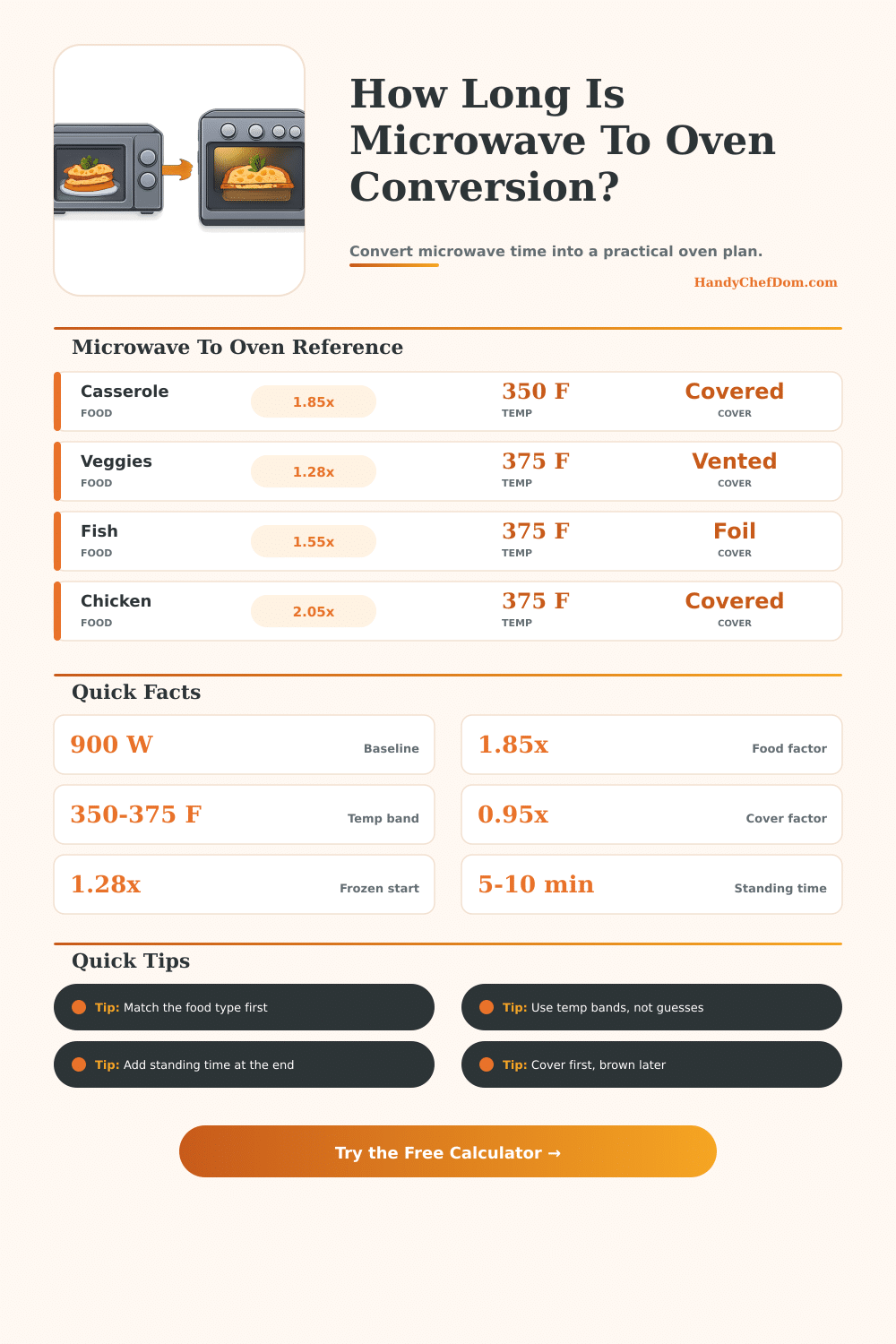
| Casserole | 1.85x | 350 F | Covered |
| Vegetables | 1.28x | 375 F | Vented |
| Fish | 1.55x | 375 F | Foil |
| Chicken | 2.05x | 375 F | Covered |
| Potato | 1.72x | 400 F | Uncovered |
| Dessert | 1.45x | 350 F | Open |
| Depth | Factor | Use | Result |
|---|---|---|---|
| Shallow | 0.93x | Fast | More crust |
| Standard | 1.00x | Base | Everyday |
| Deep | 1.15x | Slow | More mass |
| Covered | 0.95x | Moist | Steam hold |
| Temp | Band | Use | Note |
|---|---|---|---|
| 325 F | Gentle | Casseroles | Soft set |
| 350 F | Standard | Desserts | Balanced |
| 375 F | Hot | Veg + Fish | Faster |
| 400 F | Crisp | Potatoes | Browning |
Use the preset buttons to jump to common microwave-to-oven conversions, then tune wattage, depth, cover style, and standing time for your exact dish.
Microwaves and ovens is two different appliance that use different methods to heat food. In order to effectively convert cooking times from a microwave to an oven, it is first necessary to understand the difference between microwaves and ovens. Microwaves use energy to agitate the water molecules that is present in the food.
Ovens, on the other hand, heat the exterior of the food until the interior of the food reach the desired temperature. Because microwaves heat the food so quick, the cooking times required for microwaves are much shorter then those for ovens. The cooking times for ovens are much more longer because of the use of radiant heat.
How to Change Microwave Times to Oven Times
The type of food that you are to cook require different conversion factors when converting cooking times from microwaves to ovens. Saucy casseroles contain alot of moisture and require approximately 1.85 time the cooking time of a microwave if you prepare them in an oven that reaches 350 degrees. Vegetables contain less moisture and release steam from the food.
Therefore, vegetables requires only approximately 1.28 times the cooking time of a microwave if prepared in an oven that reaches 375 degrees. Chicken is dense in nature and require careful heating to ensure that the chicken is safe to eat. Therefore, chicken requires approximately 2 times the cooking time of a microwave if prepared in an oven.
The wattage of the microwave will also impact the time that must be added to the cooking times when converting from a microwave to an oven. The higher the wattage, the more energy that the microwave will use to cook the food. For instance, 1100 watts of energy provide more energy to heat food than 650 watts.
Therefore, 650 watt microwave will take longer to cook the food than a 1100 watt microwave. When converting cooking times from a 650 watt microwave to an oven, it is necessary to add 20 percent more time to the recipe to compensate for the lower wattage of the microwave. The starting state of the food will also impact the cooking time.
Food that is frozen will require 28 percent more cooking time in an oven than in a microwave because ovens are not as effective in thawing food as microwaves. Food that you are to cook from a chilled state will only require an additional 8 percent cooking time in an oven than in a microwave. The dimension of the dish in which you will cook the food can impact the cooking time of the food.
A deep 8×8 pan will hold more food than a shallow pan and will require 15 percent more cooking time. If you cover the food with a lid, the steam will cook the food from the liquid and will require 5 percent less cooking time. If the food is not covered, the evaporation of the liquid from the food will allow for the formation of a crust on the food.
Finally, the number of servings impact the cooking time. To cook food for eight servings will require 15 percent more cooking time than cooking four servings for the same number of people. A hybrid approach can be used that utilizes both the microwave and oven to cook the same food.
In this approach, the food is cooked in the microwave and then the oven cooks it to enhance the texture of the food. For instance, rice can be steamed in the microwave and then cooked in the oven at 350 degrees for crispiness. This approach will decrease the cooking time for the food while still enhancing the texture of the food.
There are a few common mistakes that you can make when cooking in an oven in place of a microwave. One of the common mistakes is ignoring the depth of the food. If food is ignored, it is possible that the top of the food will burn before the bottom is cooked.
The second common mistake is guessing the temperature of the oven. If the temperature is too high for food such as fish, the fish will become toughness when prepared. The third common mistake is forgetting standing time.
Standing time allows food to even out in temperature, so the center of the food will not be cold while the rest is overcooked.