Microwave Capacity Calculator
Measure how much real room your microwave gives you, then compare cavity volume, dish footprint, and safe headroom before you load a bowl, tray, or deep bake dish.
Use the shell measurements for the oven cavity, then match the dish footprint and fill height to see how much usable room is left once the spinner and clearance are accounted for.
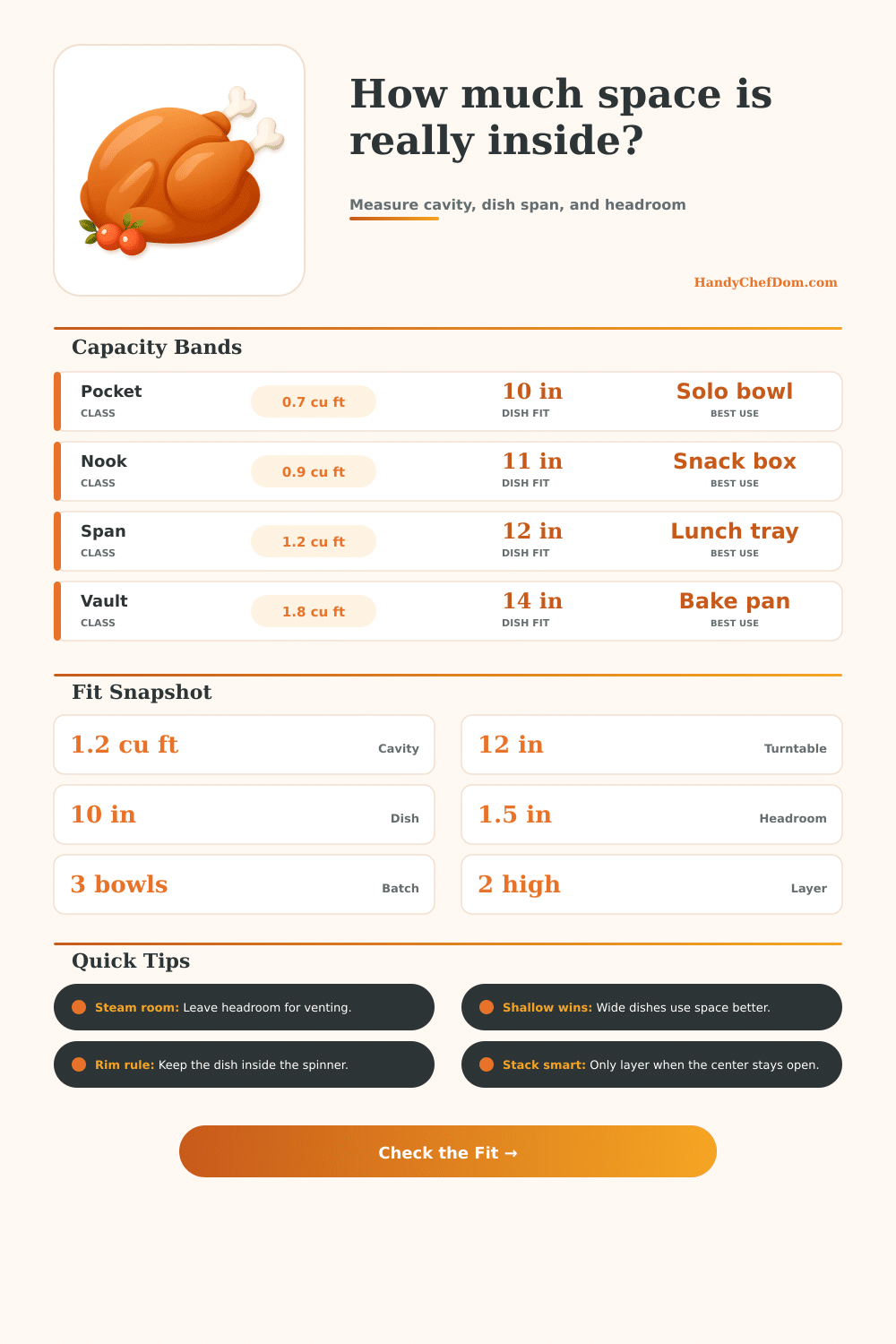
| Class | Cavity | Dish fit | Sweet spot |
|---|---|---|---|
| 0.7 cu ft | 10 in | Solo mug | |
| Nook | 0.9 cu ft | 11 in | Lunch bowl |
| Span | 1.2 cu ft | 12 in | Plate stack |
| Vault | 1.8 cu ft | 14 in | Deep tray |
| Spinner | Max dish | Fit | Note |
|---|---|---|---|
| 10 in | 8.8 in | Tight | Best for cups |
| 11 in | 9.6 in | Neat | Good for bowls |
| 12 in | 10.5 in | Easy | Fits plates well |
| 14 in | 12.2 in | Wide | Room for trays |
| Fill height | Best dish | Safe load | Why |
|---|---|---|---|
| 1.5 in | Plate | Low | Fast, shallow heat |
| 2.5 in | Bowl | Medium | Good for most meals |
| 3.5 in | Tray | High | Needs extra air above |
| 5.0 in | Pot | Very high | Watch the rim line |
| Style | Factor | Cover | Room use |
|---|---|---|---|
| Bowl stack | 1.00x | Vented lid | Round meals |
| Plate run | 0.94x | Loose cover | Flat dinners |
| Tray pack | 0.88x | Snap cover | Square meals |
| Bake dish | 0.82x | Foil tent | Deep casseroles |
| Pizza round | 0.76x | Open top | Wide slices |
Microwave capacity are the measurement of the amount of space in a microwave. Understanding the concept of capacity is an essential concept in understanding that a microwave with insufficient capacity will not be able to evenly cooking it’s food. If the dishes that are to be heated is too large for the microwave, the dish may come into contact with the walls of the microwave, or the dish may prevent the turntable from rotate.
If the turntable is not able to rotate, the microwave will not be able to even cook the food within the dish; there will be cold spots in the food. Thus, when purchasing a microwave, it is necessary to consider the amount of space within the microwave itself. The capacity of the microwave are often expressed in relation to the size of the microwave’s cavity, and the space within that cavity is the space within which food can be placed.
How to Measure the Space Inside a Microwave
The ratings published by manufacturers of microwaves, however, often do not reflect the amount of space within the microwave that can be used to cook food; the measurements often include the space for the turntable itself, and the space required for the food to be able to circulate steam. You should measure the usable cavity of the microwave to determine the amount of food that will fit within the microwave. The width, depth and height of the microwave cavity should be measured.
You can measure the width of the microwave from one side of the microwave to the others. The depth of the microwave is the measurement from the back of the microwave to the door seal. The height of the microwave is the measurement from the floor of the microwave (the turntable) to the ceiling within the microwave.
These measurements will determine the capacity of the microwave for food. A microwave may have a high cubic foot measurement, but if the turntable are large or the height is low, the capacity of the microwave for food may be less than you would expect. Another consideration that should of been made in selecting a microwave is the size of the dishes that are to be heated with the microwave.
The shape of the dish will determine how much space it will take up within the microwave. Large, shallow dishes will require less space within the microwave than dishes that are tall and narrow that can hold the same amount of food. Additionally, it is necessary to ensure that there is enough space within the dishes for the food steam to be able to escape the dish.
If the height of the food is too high within the dish, the food will not have enough space for steam to exit the dish. Space within the food dish should be left for steam to exit the food dish; steam can become trapped within food if there is no space for it to escape. If there is no space for steam to exit the food dish, the food may cook unevenly within the microwave.
Another consideration is the size of the turntable within the microwave. Dishes must be of a size that allows for a gap of at least half an inch between the dish and the walls of the microwave; otherwise, the dish may become jammed into the microwave walls while the turntable rotates. Finally, it is also important to consider the number of items that will be cooked within the microwave.
If the number of individuals that will be fed with the food is only one or two, the size of the microwave may be small enough. However, if the number of individuals that will be fed is many, then the microwave will have to have a large cavity for the food to be cooked. Microwaves are often overloaded with items to be cooked.
If the items to be cooked are too large for the microwave, the food will not cook evenly throughout the item; the cooking waves cannot reach some parts of the food while other parts of the food are heated. For instance, if there is one oversized dish in the microwave, the corners of the dish will block the microwave cooking waves from heating those portions of the dish. One way to avoid cooking problems caused by overcrowding the microwave is to perform a test fit of the dish within the microwave.
Place the dish onto the turntable while the microwave is empty, and rotate the turntable by hand. Ensure that the dish clears each of the walls of the microwave by at least half an inch, and ensure that the food is at least half an inch from the ceiling of the microwave. Overall, when selecting a microwave, people should look beyond the microwave capacity that the manufacturer of the appliance publishes.
The width, depth and height of the interior cavity should be measured to determine the amount of usable space within the microwave. Additionally, you should consider the size of the dishes and the height of the food within the dishes to ensure that there is enough space for both the turntable to rotate and for steam to exit the food dish. If you match the dishes that are to be heated to the capacity of the microwave, the microwave will cook the food more efficient and evenly.