🍳 Oven Dry Weight Calculator
Estimate dry yield, moisture loss, and oven time for herbs, fruit, and vegetables with a batch-friendly drying setup.
Select a food, then set the fresh weight, moisture targets, slice thickness, and oven conditions. The calculator estimates true dry mass and batch time.
| Food | Fresh Moisture | Dry Target | Cut Style |
|---|---|---|---|
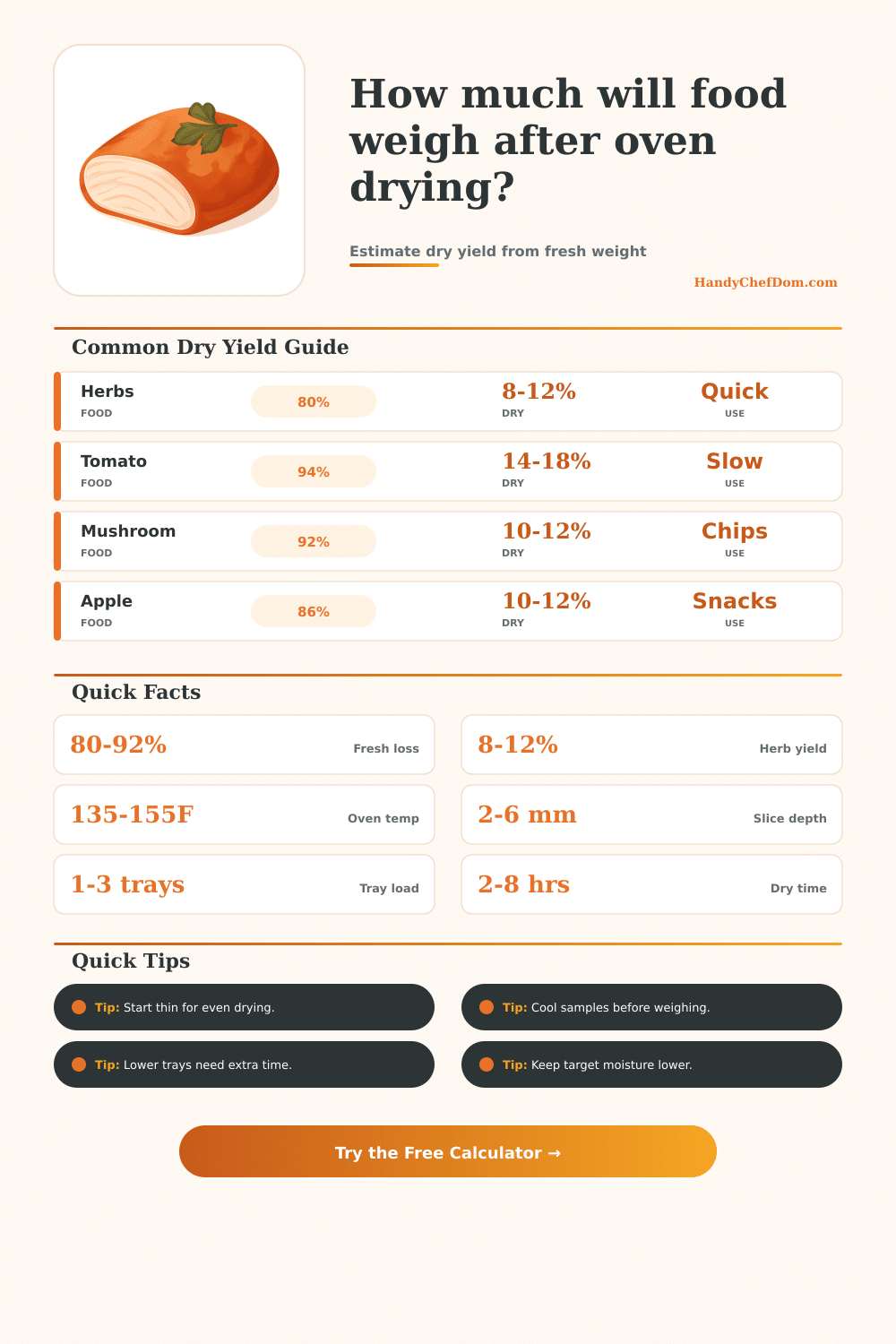
| Fresh herbs | 80% | 8-12% | Leaves |
| Tomatoes | 94% | 12-15% | Thin slices |
| Mushrooms | 92% | 10-12% | Quartered |
| Apples | 86% | 10-12% | Rings |
| Bananas | 74% | 10-12% | Rounds |
| Peppers | 92% | 8-10% | Strips |
| Purpose | Target | Yield | Note |
|---|---|---|---|
| Light crisp | 8-10% | 8-15% | Very dry |
| Snack chips | 10-12% | 10-18% | Crunchy |
| Powder prep | 12-15% | 12-20% | Grind later |
| Leather sheet | 18-22% | 18-28% | Soft finish |
| Storage dry | 8-12% | 10-20% | Jar safe |
| Quick bake | 12-16% | 14-24% | Less time |
| Temp | Slice | Airflow | Effect |
|---|---|---|---|
| 135 F / 57 C | Thin | High | Slowest |
| 145 F / 63 C | Thin | Normal | Balanced |
| 150 F / 66 C | Medium | High | Good speed |
| 155 F / 68 C | Medium | Normal | Even dry |
| 165 F / 74 C | Thick | High | Faster |
| 175 F / 79 C | Thick | Low | More browning |
| Fresh | Start | Target | Final Dry |
|---|---|---|---|
| 12 oz herbs | 80% | 10% | 2.7 oz |
| 1.5 lb tomato | 94% | 15% | 3.8 oz |
| 24 oz mushrooms | 92% | 10% | 2.3 oz |
| 64 oz apples | 86% | 12% | 9.3 oz |
| 32 oz bananas | 74% | 12% | 8.4 oz |
| 16 oz citrus | 70% | 8% | 4.9 oz |
When drying foods, the weight of the food will change due to an evaporation of the water that is naturaly present within the food. Because most food contain a great deal of water, much of that water will leave the food during the drying process. Thus, the final weight of the food will be much more less than the initial weight of the food that was added to the drying process.
An understanding of these two variable will allow for the successful calculation of an amount of dried food that will be produced upon the completion of the drying process. The moisture content of the food will impact the amount of weight that the food will lose during the drying process. For instance, herb often contain eighty percent moisture, which means that they will lose a large amount of weight during the drying process.
How Drying Food Changes Weight and How to Plan
Foods like apples, however, contain eighty-six percent moisture, meaning that they will lose less weight during the drying process than herbs will. These weights can be calculate with the drying weight calculator that is available, and it ensures that the mathematics account for the moisture content of the food. Additionally, calculating the weight of the food allows for the food batches to be planned for the desired end result; if the calculated weight is too low, there wont be enough food, but if too high, there may be wasted time in drying the food for too longly.
The thickness of the food slice will impact the rate at which the water evaporates from the food. Thinly sliced food will have a larger surface area than food that is cut into thick slices, allowing for the water to evaporate at a faster rate. Thus, using thin slices of ginger will allow for the ginger to dry faster than thick mushrooms.
Using food of even thickness will ensure that each batch of food dries at the same rate. Additionally, the oven temperature should be set to between one-hundred-and-thirty-five and one-hundred and fifty-five degrees Fahrenheit; higher temperatures may lead to case hardening, where the outside of the food becomes hard but the interior of the food is still damp. Airflow is another variable that will impact the drying process; airflow will remove the humid air from an oven.
By increasing the airflow in the oven, such as by placing a fan within the oven, less drying time will be required to produce the same amount of dried food. Additionally, the cook may rotate the food tray within the oven; heat within ovens is not even throughout the oven, so drying the food on different trays may lead to some food drying at a faster rate then other food within the same batch. Yield percentage refers to the amount of food that will be obtained after the water has evaporated from the food.
For instance, twelve ounces of herbs that contain eighty percent moisture will yield approximately three ounces of dried herbs. Most of the weight of food that leaves the drying tray is water, which account for eighty to ninety percent of the initial weight of the food. Planning food batches with an understanding of the yield percentage will allow cooks to understand the amount of dried food that will be produced.
It is important to allow food to reach room temperature prior to weigh the food. If food is weighed while it is hot, the steam within the food will add to the weight of the food; it will weigh more than the dried food. Additionally, you should also consider the target moisture percentage of the food.
For instance, food that is to be fried will have a target moisture content of eight to twelve percent, while food that is to be rolled, like fruit leather, will have a target moisture content of eighteen percent. External factors may impact the drying process. High humidity, for instance, will impact the rate at which food dries.
Thus, an additional percentage of food should be planned for in addition to the food that will be dried; this reserve percentage may account for food that break during the process, or for sampling of the food prior to drying. Not all food react the same to the drying process. Foods that contain a high amount of water will lose a large amount of weight when they dry; tomatoes contain ninety-four percent water.
Mushrooms also will lose a large amount of weight due to there spongy structure. Foods like bananas contain seventy-four percent moisture, which is less moisture than tomatoes or mushrooms, but more than foods like apples. Ensure that food is loaded evenly onto the trays.
Food that is too crowded on a tray will not dry as evenly as food that is not so closely loaded on a drying tray. Food should also be cut to no thicker than a pencil lead. Finally, ensure that a sample of the food is test to ensure that it has dried to the desired texture.