Dutch Oven Coal Calculator
Estimate coal load, serving yield, pot fill, and refill timing for camp bakes, braises, and simmer pots.
🏕️Dutch Oven Cooking Presets
⚙Dutch Oven Inputs
📊Heat and Fuel Grid
📘Dutch Oven Reference Tables
| Oven Diameter | 350 F Base Load | Baking Split | Typical Capacity |
|---|---|---|---|
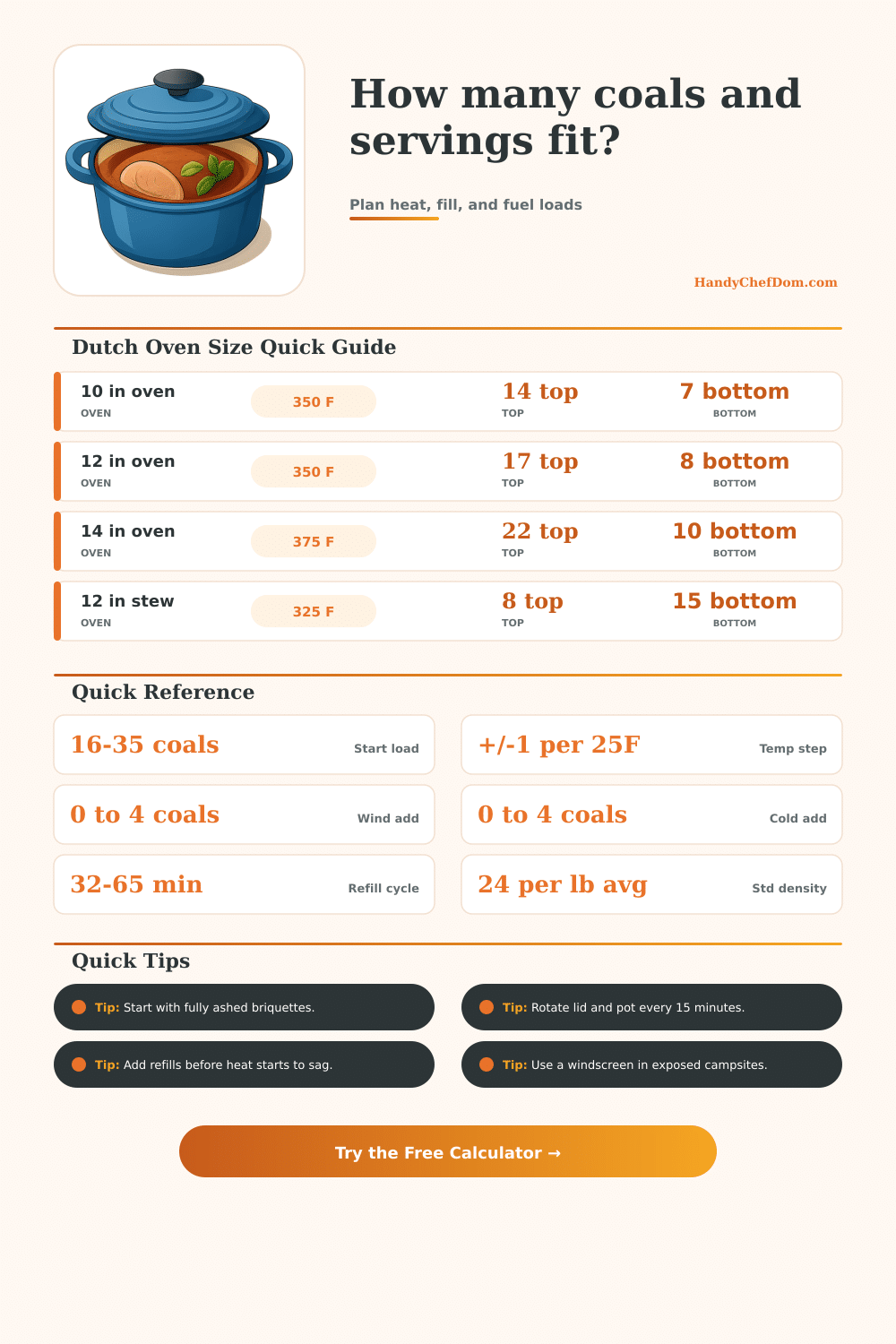
| 8 inch | 16 coals | 10 top / 6 bottom | 2 qt oven |
| 10 inch | 21 coals | 14 top / 7 bottom | 4 qt oven |
| 12 inch | 25 coals | 17 top / 8 bottom | 6 qt oven |
| 14 inch | 30 coals | 20 top / 10 bottom | 8 qt oven |
| 16 inch | 35 coals | 23 top / 12 bottom | 12 qt oven |
| Target Heat | Delta Vs 350 F | Coal Adjustment | Planning Note |
|---|---|---|---|
| 250 F | -100 F | -4 coals | Low braise or gentle simmer |
| 300 F | -50 F | -2 coals | Slow stew or beans |
| 325 F | -25 F | -1 coal | Soft bake zone |
| 350 F | Baseline | 0 | General baking target |
| 375 F | +25 F | +1 coal | Browning and crust |
| 400 F | +50 F | +2 coals | Roast and crisp |
| 425 F | +75 F | +3 coals | High heat finish |
| Method | Top Share | Bottom Share | Best Use |
|---|---|---|---|
| Baking | 67% | 33% | Bread, biscuits, cobbler |
| Roasting | 55% | 45% | Chicken, mixed vegetables |
| Stew or Braise | 35% | 65% | Stews and braises |
| Long Simmer | 20% | 80% | Chili, beans, sauces |
| Fry or Boil | 0% | 100% | Frying and high-bottom heat |
| Fuel Type | Sheltered | Moderate Wind | Strong Wind |
|---|---|---|---|
| Standard briquette | 50 min | 44 min | 38 min |
| Hardwood briquette | 55 min | 49 min | 43 min |
| Coconut briquette | 65 min | 59 min | 53 min |
| Mini briquette | 38 min | 32 min | 26 min |
| Quick light | 32 min | 26 min | 25 min |
To manage heat in a Dutch oven, it is essential to have an understanding of its components, such as the briquettes, the size of the Dutch oven, and the environmental condition. A Dutch oven is a tool used for cooking over the coals. The heat that is provided in a Dutch oven come from the placement of the coals.
If you dont use enough briquettes in your Dutch oven, the heat will fade and your food will not cook completly within the cooking vessel. The size of the Dutch oven will determine the number of briquettes you will need to use within your Dutch oven. If you have a 12-inch Dutch oven, it will hold six quarts of food.
How to Control Heat in a Dutch Oven
Additionally, a 12-inch Dutch oven will require approximately 25 briquettes to reach a temperature of 350 degrees. However, if you have an 8-inch Dutch oven, you will have less cooking area. Therefore, you will need approximately 16 briquettes to reach the same temperature of 350 degrees.
The size of your Dutch oven will determine how many briquettes you need because the larger the cooking vessel, the more coals you will need for even cooking at the top and the bottom of your Dutch oven. Another factor that will determine the type of briquettes to use in your Dutch oven is the type of cooking that you will perform in your Dutch oven. If you are baking item like bread or cobblers, you will want to place two-thirds of the briquettes on the lid of your Dutch oven.
This will allow the cooking of your food to brown the top of the food without burning the bottom of the food. However, if you are cooking stews, you will want to place the majority of your briquettes underneath the Dutch oven. This will allow the stew to bubble without drying out the food within the Dutch oven.
Using the wrong number of briquettes on the top and bottom of your Dutch oven may lead to your food either having a pale top or the bottom of the food being burnt. The number of briquettes you place in your Dutch oven will need to be adjusted based on the temperature that you would like to cook your food to. The baseline for most Dutch ovens is 350 degrees.
To adjust the temperature of your Dutch oven, you can simply add or subtract briquettes. For instance, if you would like the temperature of your Dutch oven to 400 degrees, you will need to add two briquettes to your Dutch oven. Additionally, if you are looking to cook to 300 degrees, you will need to subtract two briquettes from your initial count.
The amount of 25 degrees that you would like to change the temperature of your Dutch oven will require the adjustment of two briquettes because each briquette release a steady output of BTUs. The environmental conditions in which you are cooking within your Dutch oven will also change the number of briquettes that you need to use within your Dutch oven. The most important is the presence of the wind.
The presence of the wind will make it so that your briquettes will fade and will require you to add more briquettes to the lid of your Dutch oven. For instance, a stiff breeze will reduce the burn time of your briquettes by 10 minutes. This may require you to add two briquettes to the total count that you have within your Dutch oven.
Additionally, if it is cold in the area in which you are cooking with your Dutch oven, the metal of your Dutch oven may become chilled. In this instance, you will need to add one or two briquettes to your total count of briquettes within your Dutch oven. The altitude in which you live may also change the type of briquettes that you use.
For instance, if you live at a high altitude, you will need to use fuels that will last longer, like briquettes made from coconut shells. The type of fuel that you use in your Dutch oven will also change the number of briquettes that you use. Standard briquettes will burn for 50 minutes, and there are 24 briquettes contained in a pound of fuel.
However, briquettes made from coconut shells will burn for 65 minutes. However, there are fewer briquettes made from coconut shells contained within a pound. Additionally, mini briquettes will burn quick, but they will burn at a higher temperature.
However, they will be used up quickly if there is any presence of the wind. The type of fuel that you use will dictate the number of times that you will need to refill the briquettes within your Dutch oven. To prevent the temperature within your Dutch oven from sagging, you must plan for the refilling of briquettes.
This is because if you do not continually add new briquettes to your Dutch oven, the temperature will fade. One way that you can do this is to stage briquettes in a chimney within your cooking area. Additionally, you can rotate the lid of your Dutch oven 90 degrees and your Dutch oven 45 degrees every 15 minutes to even out the heat throughout the cooking vessel.
However, dont open the Dutch oven too often, as you may lose too much steam, and the loss of steam may result in the loss of heat from your cooking vessel. Finally, you should also consider the capacity of the Dutch oven. One way to waste fuel within your Dutch oven is if you use too much fuel to cook too much food.
For instance, a 12-inch Dutch oven can hold between four and six servings of stew. However, if you are roasting meat or baking items, there will be headspace requirements in the Dutch oven, and it will hold less food. Placing too much food within your Dutch oven will cause the heat to not circulate throughout the food.
Additionally, adding too little food will waste the fuel that you use to make the briquettes. Therefore, you can cook one quart of food for every two person that you would like to feed.