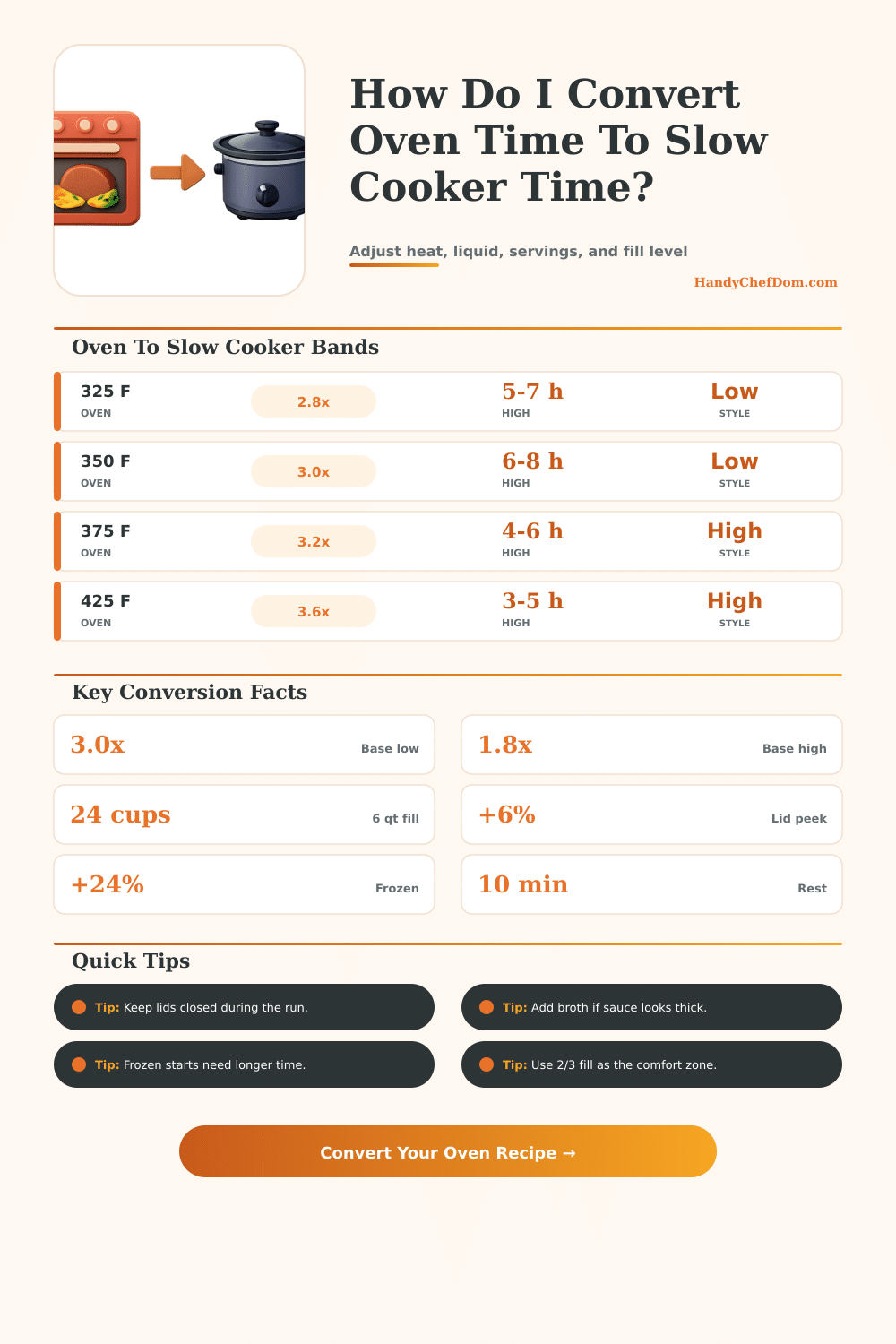
Oven To Slow Cooker Conversion Calculator
Map oven recipes into slow cooker timing by style, temperature, liquid reserve, and fill depth.
| Oven Temp | Low Hours | High Hours | Typical Match |
|---|---|---|---|
| 300 °F | 6-8 h | 4-5 h | Soft braise |
| 325 °F | 5-7 h | 3-4 h | Roast |
| 350 °F | 4-6 h | 3-4 h | Stew |
| 375 °F | 4-5 h | 2-3 h | Chili |
| 400 °F | 3-4 h | 2-3 h | Casserole |
| 425 °F | 2-3 h | 1.5-2 h | Quick bake |
| Recipe Style | Low Factor | High Factor | Liquid Base |
|---|---|---|---|
| Sunday beef pot roast | 3.2x | 1.8x | 2.2 cups |
| Pulled pork shoulder | 3.4x | 2.0x | 2.0 cups |
| Chicken cacciatore | 2.5x | 1.5x | 1.5 cups |
| Beef stew | 2.8x | 1.6x | 2.1 cups |
| Smoky chili | 2.6x | 1.5x | 2.4 cups |
| White bean cassoulet | 3.3x | 1.9x | 2.8 cups |
| Chicken noodle soup | 2.2x | 1.3x | 2.9 cups |
| Baked pasta casserole | 2.3x | 1.4x | 1.7 cups |
| Cooker Size | Capacity | Servings | Best Use |
|---|---|---|---|
| 3 qt | 12 cups | 2-3 | Side dish |
| 4 qt | 16 cups | 3-4 | Small meal |
| 5 qt | 20 cups | 4-5 | Weeknight |
| 6 qt | 24 cups | 5-6 | Family |
| 7 qt | 28 cups | 6-8 | Hearty |
| 8 qt | 32 cups | 8-10 | Batch |
| Adjustment | Time Shift | Liquid Shift | Note |
|---|---|---|---|
| Room start | Base | Base | Ready to go |
| Chilled start | +8% | +0% | Cold center |
| Frozen start | +24% | +0% | Longest reset |
| One lid peek | +5% | +0% | Heat loss |
| Three lid peeks | +15% | +0% | More drift |
| Heavy sauce | -4% | -0.3 c | Richer base |
Converting oven recipes to slow cooker recipes require an understanding of how heat and moisture interact within a slow cooker. In an oven, dry heat cooks the ingredients, and some of the liquid within the food can evaporate. In a slow cooker, steam is trap within the cooking chamber, which prevents the food from drying out.
Because of this, slow cookers require less liquid to be added to the food then are used in an oven recipe. Using too much liquid in a slow cooker will make the food too water when cooked. Using too little liquid may cause the food to become too thick or paste like when cooked in the slow cooker.
How to Convert Oven Recipes to Slow Cooker Recipes
The settings on a slow cooker determine the length of time it take for food to cook. The low setting on a slow cooker is used to braise the ingredients to approximately 200 degrees. This takes roughly three times longer than a moderate oven setting.
The high setting on a slow cooker reaches approximately 300 degrees and reduce the cooking time by approximately half the length of a low setting. If a recipe takes 90 minutes in an oven, it may take four or five hour on a low setting in a slow cooker. The length of time that the food simmers in the slow cooker will change according to whether you use the low or high setting on the slow cooker.
The type of food to be simmered in the slow cooker can also impact the cooking time. If the food contains high amount of collagen, such as pulled pork shoulder, it take longer to simmer the food. If not given enough time to simmer, the collagen will not break down to the shreds necessary to eat the meat.
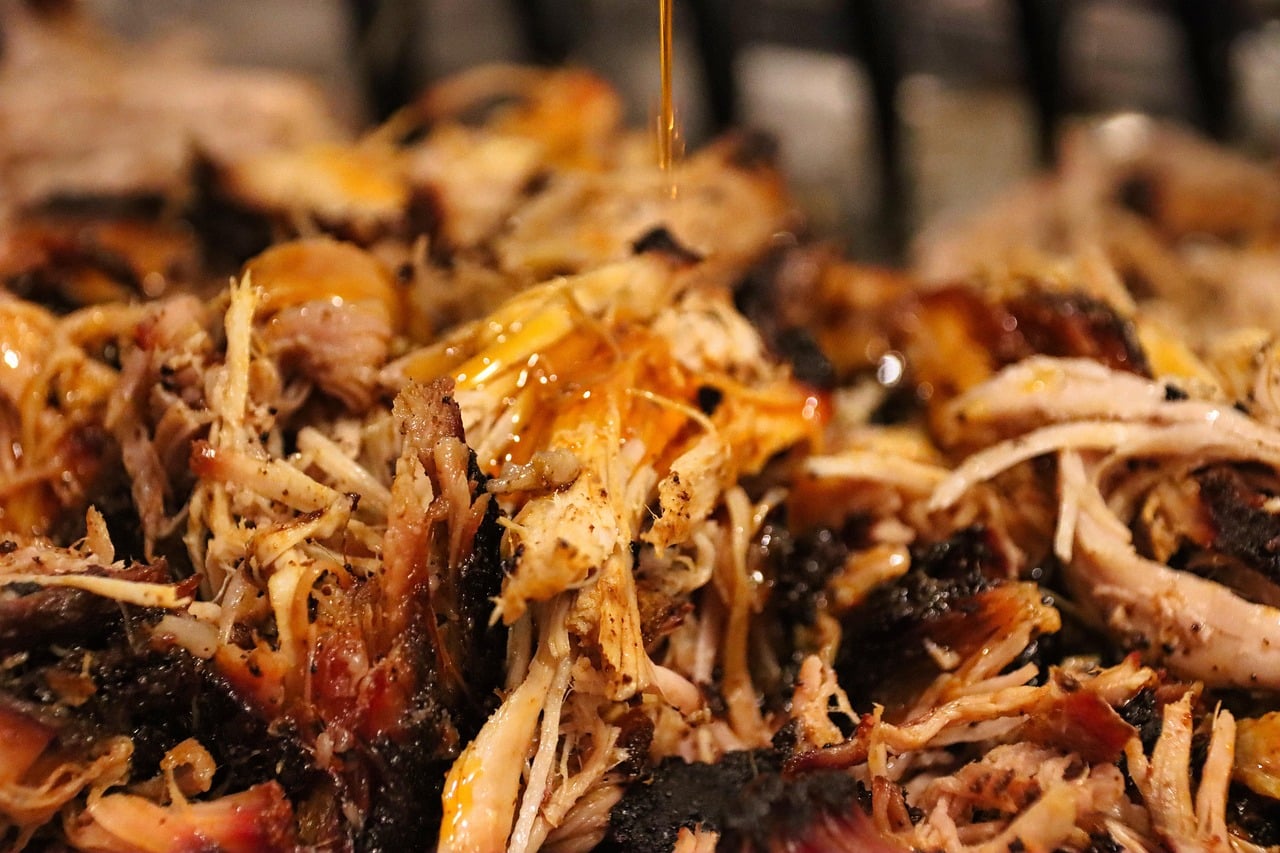
Lighter foods, such as soups, will take less time to simmer in the slow cooker. Knowing the type of food to be simmermed in the slow cooker will allow you to adjust the cooking time and the amount of liquid to be added to the slow cooker. The size of the slow cooker and the amount of food to be cooked are also important factor to consider when using a slow cooker.
A person should aim to fill their slow cooker to approximately two-thirds of the way full. If a person fills a slow cooker to the two-thirds mark, the heat will be able to adequately circulate around the food. If, however, the slow cooker is filled beyond this mark, the cooking time for the food can become unpredictable due to the restricted circulation of heat from the slow cooker.
Finally, if a slow cooker is underfilled, the empty space within the slow cooker will cause it to lose heat more quickly, which may cause the food to cook too soon. The state of the food, espeshally whether it is frozen or thawed, will change the cooking time for that food. If the food to be cooked in the slow cooker is frozen, it will take longer to cook than if the food were already defrosted or defatted.
Additionally, the cold center of the food will take time to defrost, therefore adding to the total cooking time. Food that is to be prepared in this manner will require an additional eight to twenty-four percent of cooking time to accomplish the same results as non-frozen food. For these reasons, most recipe that include food that will be cooked in a slow cooker recommend that the food be defrosted in the refrigerator overnight.
Slow cookers should never be lift while the food is cooking. Each time someone lifts the lid of a slow cooker, heat will escape from the slow cooker. If the lid is lifted once, the slow cooker will lose approximately five percent of its heat.
If the lid is lifted three times, the slow cooker will lose approximately fifteen percent of its heat. For these reasons, slow cookers should not be lift from food until the cooking process is nearly complete. Finally, another thing to remember is that the “warm” setting on a slow cooker is not for cooking food.
This setting is for keeping food at an edible temperature while it sit, such as a meal that is prepared in the slow cooker but will be eaten later in the day. If someone places cooked food into a slow cooker and cooks it using the “warm” setting, the cooking time will increase by approximately one-third of the total cooking time. By managing the liquid, temperature setting, volume, and lid of the slow cooker, a person is able to successfully convert any recipe that was prepared in an oven to a recipe that can be successfully prepared in a slow cooker.