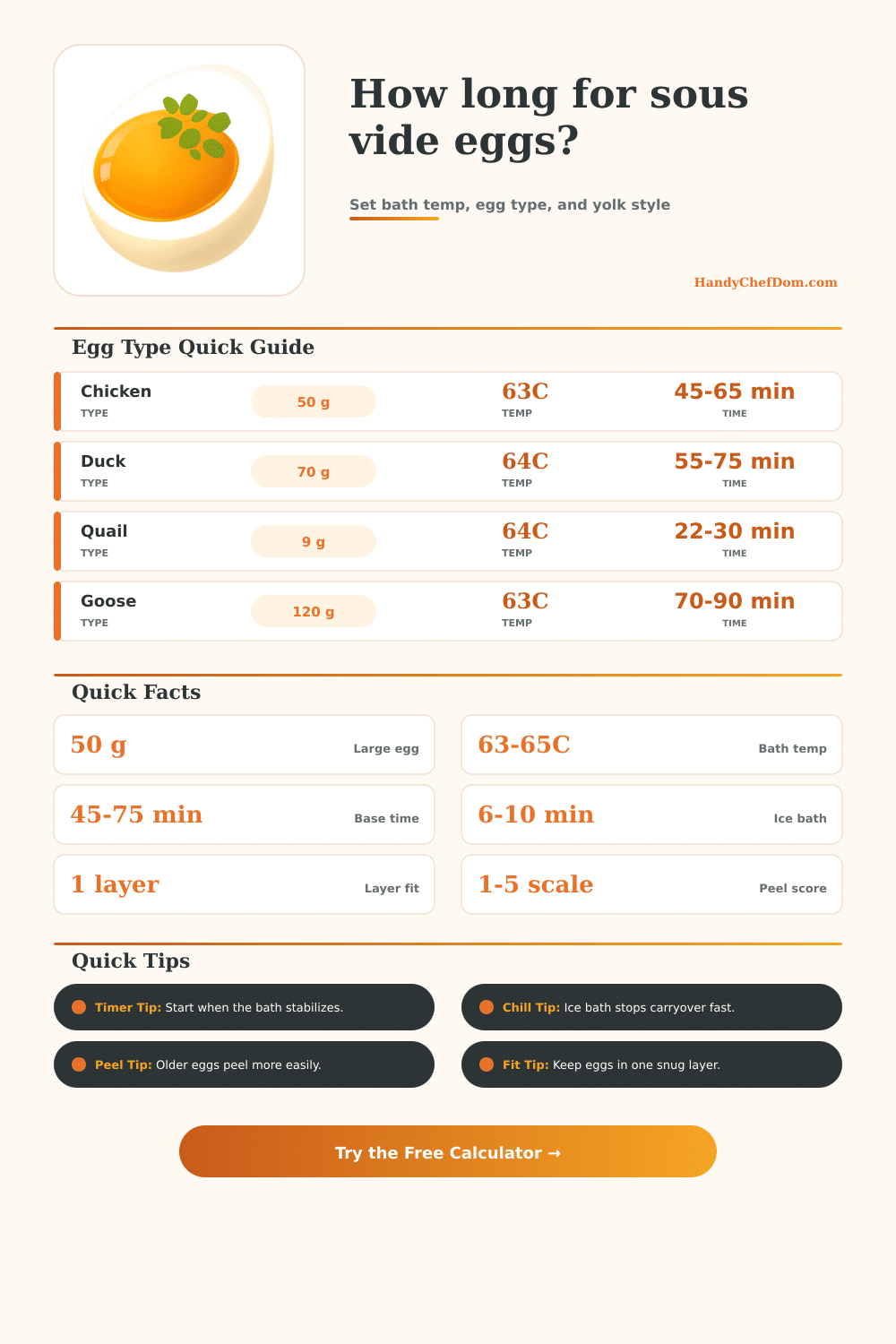
🥚 Sous Vide Egg Calculator
Plan silky, jammy, soft, or firm yolks by egg type, bath size, and recovery mode, then chill for cleaner peeling.
Use the defaults as a starting point, then fine-tune for bath size, water depth, and the yolk texture you want.
| Egg type | Weight | Target | Time |
|---|---|---|---|
| Chicken | 50 g | 63.5 C | 45-65 min |
| Bantam | 38 g | 63 C | 38-55 min |
| Duck | 70 g | 64 C | 55-75 min |
| Quail | 9 g | 63.5 C | 22-30 min |
| Turkey | 80 g | 64 C | 60-80 min |
| Goose | 120 g | 63.5 C | 70-90 min |
| Jumbo | 63 g | 63.8 C | 50-70 min |
| Bath temp | Texture | Time shift | Note |
|---|---|---|---|
| 63 C | Silky | +1.0 | Loose white |
| 63.5 C | Jammy | 0.0 | Ramen sweet spot |
| 64 C | Soft set | -0.5 | Cleaner slice |
| 65 C | Custardy | -1.0 | More set yolk |
| Bath size | Chicken eggs | Duck eggs | Note |
|---|---|---|---|
| 1 qt | 3 eggs | 2 eggs | Tight test run |
| 2 qt | 6 eggs | 4 eggs | Small batch |
| 3 qt | 9 eggs | 6 eggs | Good balance |
| 4 qt | 12 eggs | 8 eggs | Family tray |
| 6 qt | 18 eggs | 12 eggs | Party batch |
| 8 qt | 24 eggs | 16 eggs | Meal prep |
| Egg age | Chill | Peel | Note |
|---|---|---|---|
| Fresh | Ice bath | 2/5 | Needs more chill |
| 1 Week | Ice bath | 4/5 | Sweet spot |
| Older | Ice bath | 5/5 | Easier peel |
| Fresh | No chill | 1/5 | Carryover stays |
| Any | Cold rinse | 3/5 | Quick stop |
Sous vide cooking is a method that can be used to cook eggs while maintaining precise temperature control over the eggs. The sous vide cooking method allow a person to cook the eggs and achieve specific textures within both the egg white and the egg yolk. For instance, a person can select the texture that they would like the egg yolk to have when cooked, whether they would like the yolk to be very tender, creamy and sliceable, or firm like custard.
Additionally, the same sous vide method also allow a person to select the texture of the egg white. Each of these texture are dependent upon the temperature of the water in which the eggs are cooked and the length of time that the eggs are cooked. The size of the eggs that will be cooked also has an impact upon the sous vide cooking method.
How to Cook Eggs with Sous Vide
For instance, a standard chicken egg weighs approximately 50 grams, duck eggs weighs approximately 70 grams, quail eggs weigh approximately 9 grams, and goose eggs weigh approximately 120 grams. The larger the eggs are in weight, the more longer it will take for the eggs to reach the target temperature. Thus, if the size of the eggs is not accounted for in the sous vide cooking method, the eggs may become overcooked during the cooking process.
Overcooked eggs often have a chalky texture when they are broken and cooked. Thus, one should of make adjustments to the cooking time according to the size of the egg that will be cooked. The temperature of the water in which the eggs are cooked will determine the texture of the cooked egg yolks.
For instance, if the temperature of the water is set to 63 degrees Celsius, the egg white will be loose and the egg yolks will be very tender. If the temperature of the water is increased to 63.5 degrees Celsius, then the egg yolks will be creamy and sliceable but not runny. At 64 or 65 degrees Celsius, the yolks will be firm and custardy.
A texture that is often used in salads or deviled eggs. Each fraction of a degree in the water temperature will have an impact upon the texture of the cooked eggs. Additionally, a colder water bath will take more time to reach the target temperature than a water bath that is heated to a higher temperature.
However, the higher the water temperature is set, the shorter length of time during which the eggs should be cooked to avoid overcooking the eggs. In addition to the temperature of the water in which the eggs will be cooked, the volume of the water and the number of eggs to be cooked also impact the cooking process. If the volume of the water is relatively small within the water bath, and if the eggs are relatively large in number, the water will take longer to return to the target cooking temperature.
Thus, cooking time would have to be adjusted based off the size of the water bath and the number of eggs that will be cooked in the bath. The depth of the water within which the eggs are cooked may also have an impact upon the cooking process; deeper water may be more stable in its cooking temperature than shallow water. Another variable that can impact cooking time is the starting temperature of the eggs.
For instance, if the eggs are pulled from the refrigerator (and are 4 degrees Celsius in temperature), the eggs will require four extra minutes to reach the target temperature. If the eggs are of a more comfortable room temperature, however, the eggs will reach the target temperature in the sous vide cooking method more quick. Finally, the age of the eggs may impact the sous vide cooking process.
While fresh eggs tend to be more difficult to peel after cooking, older eggs have membranes that allow for the shells of the eggs to be peeled off more easily. After the eggs have been cooked, it is often necessary to chill the eggs in order to maintain the texture of the cooked eggs. Cooling the cooked eggs in an ice bath will halt the cooking process of the eggs immediately.
If the eggs are not cooled in an ice bath, the cooked egg yolks will continue to firm within the eggs. Thus, cooling the eggs in an ice bath is important if the eggs are to be prepared in advance for meal prep. Finally, in order to properly peel the cooked eggs, it is recommended that each egg be tapped at the equator of its shell, and then gently rolled to allow for the shells to crack open and the eggs to be peeled in water.
If any of the chilled cooked eggs that have been stored in the refrigerator are prepared to be consumed, they can be stored in the refrigerator for up to five days. After the eggs have been chilled however, they can be gently reheated in 60-degree water to allow the eggs to reach an edible temperature. Through control of each of these variables (temperature of the water, size of the eggs, starting temperature of the eggs, age of the eggs, and chilling of the cooked eggs), individuals can prepare eggs of specific textures.