Fruit Smoothie Calorie Calculator
Compare fruit, liquids, yogurt, boosters, and sweeteners in one quick smoothie calorie estimate with clear serving math and volume cues.
Start with a profile, then fine-tune fruit, liquid, yogurt, and boosters. The calculator keeps the math visible so each ingredient is easy to compare.
| Fruit | Portion | kcal | Note |
|---|---|---|---|
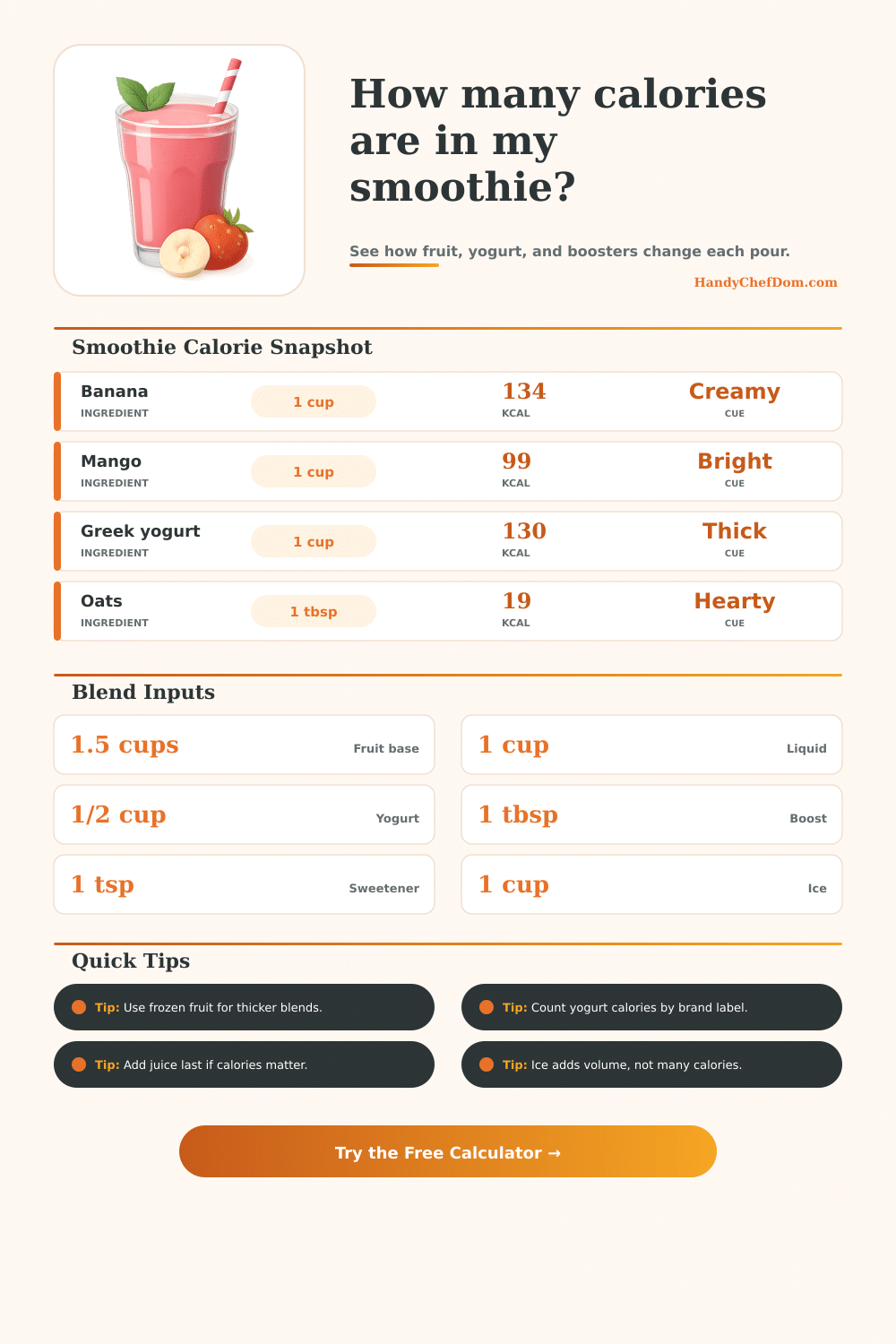
| Banana | 1 cup | 134 | Creamy base |
| Strawberry | 1 cup | 53 | Bright and light |
| Blueberry | 1 cup | 85 | Deep berry tone |
| Mango | 1 cup | 99 | Juicy lift |
| Pineapple | 1 cup | 82 | Sharp sweetness |
| Peach | 1 cup | 61 | Soft aroma |
| Kiwi | 1 cup | 110 | Tangy green pop |
| Mixed berry | 1 cup | 70 | Rounded fruit mix |
| Watermelon | 1 cup | 46 | Very light |
| Cherry | 1 cup | 87 | Rich red finish |
| Spinach | 1 cup | 7 | Green, low cal |
| Liquid | Portion | kcal | Note |
|---|---|---|---|
| Water | 1 cup | 0 | Pure dilution |
| Almond milk | 1 cup | 30 | Very light body |
| Oat milk | 1 cup | 120 | Creamier pour |
| Dairy milk | 1 cup | 122 | Classic richness |
| Coconut water | 1 cup | 45 | Fresh and lean |
| Orange juice | 1 cup | 112 | Brighter sweetness |
| Kefir | 1 cup | 110 | Tangy creaminess |
| Coconut milk bev. | 1 cup | 45 | Silky, lighter |
| Yogurt or Boost | Portion | kcal | Note |
|---|---|---|---|
| Greek plain | 1 cup | 130 | Thick finish |
| Greek vanilla | 1 cup | 210 | Sweet cream |
| Regular plain | 1 cup | 150 | Softer body |
| Skyr | 1 cup | 140 | Lean protein |
| Chia seeds | 1 tbsp | 58 | Thickens fast |
| Oats | 1 tbsp | 19 | Breakfast lift |
| Peanut butter | 1 tbsp | 94 | Heavy cream |
| Protein powder | 1 scoop | 120 | Workout boost |
| Flax seed | 1 tbsp | 37 | Nutty fiber |
| Cocoa | 1 tbsp | 12 | Dark accent |
| Style | Fruit | Liquid | Texture cue |
|---|---|---|---|
| Light sip | 1 cup | 1.5 cup | Thin and fast |
| Breakfast bowl | 1.5 cup | 1 cup | Spoonable |
| Recovery pour | 1 cup | 1 cup | Higher protein |
| Tropical lift | 1.5 cup | 1 cup | Sunny and loose |
| Green refresh | 1 cup | 1.5 cup | Cool and crisp |
| Dessert swirl | 1.5 cup | 0.75 cup | Rich and thick |
This calculator estimates smoothie calories from fruit, liquid, yogurt, ice, and boosters so you can compare blends quickly, then adjust servings for breakfast, recovery, or dessert goals.
When you prepare a smoothie, you must account for the total number of calories in the smoothie. Smoothies can contains more calories than you may initially expect. Smoothies are a mixture of ingredients that contribute to the total amount of energy in that smoothie.
You can control the number of calories in a smoothie by choosing specific fruit, liquids and source of protein. Fruit is one of the main components that goes into a smoothie. The type of fruit that you use will have an impact on the total number of calories that are present in the smoothie.
How to Make a Low-Calorie Smoothie
For instance, bananas is high in calories compared to fruits like strawberries or peaches. Therefore, using bananas will increase the total calorie of the smoothie compared to using strawberries or peaches. Fruits like berries and peaches are lower in calories compared to other fruits so they are a more better choice if you are looking to make a low-calorie smoothie.
The type of liquid that you use will also have an impact on the total number of calories in the smoothie. Water contains zero calories so if you use water you will not increase the total calories of your smoothie. Other liquids like plant milks add calories to your smoothie; for example oat milk has more calories than almond milk.
Juices like orange juice add much calories to the smoothie due to their high carbohydrate and sugar content. Therefore, if you use orange juice you will increase the total calories of the smoothie quick. You must select a liquid for your smoothie based off the thickness and the calorie content that you want to adding to your smoothie.
You can use yogurt as an ingredient to add thickness and protein to a smoothie. However, it also increases the calorie content of your smoothie. For example, plain Greek yogurt has a high number of calories compared to vanilla yogurt; plain yogurt contains no added sugar while vanilla yogurt does contain added sugar.
Therefore, plain Greek yogurt will add more calories to your smoothie than vanilla yogurt. By using yogurt you can increase the thickness of your smoothie so it will last longer; however, you must take care to use an appropriate amount of yogurt since it will affect the total calorie content of your smoothie. You can add boosters to your smoothie to increase the nutritional value of the smoothie.
For example, nut butter such as peanut butter contain a high amount of fat. Therefore, they add alot of calories to the smoothie. Oats contain dietary fiber and can provide a slow release of energy to the body.
Chia seeds are another booster that contains nutritional value and can also thicken the smoothie. You can use these add-ons to increase the value of your smoothie. However, you must use sweeteners like honey or maple syrup sparingly due to their high calorie content.
Smoothies can be categorize into different profiles. For example, a breakfast smoothie profile may use fruits, yogurt and oats to create a thick smoothie. A light smoothie profile would use water and berries to create a smoothie that is low in calories.
Using servings it is also possible to determine how many calories are in a smoothie so you can determine if it is a meal or snack. For example, you can consider any smoothie containing more than 200 calories per cup a meal rather then a snack. Smoothie makers often make mistakes when they are preparing a smoothie.
One mistake is using too many calorie-dense ingredients. For example, using too much banana or fruit juice will increase the calories of the smoothie. Other mistakes are using too much yogurt or protein powder as these ingredient can contain high levels of calories.
Using more frozen berries and less banana will reduce the total calories in your smoothie. Always read the ingredient label as some brands of products may contain more calories than others. Those that regularly exercise may want to use protein powder to aid in muscle repair but still be mindful of the total calories that the smoothie contain.
In order to prepare a smoothie and manage the total calories that it contains, follow these steps. First, determine what type of fruit to use for the desired level of calories in your smoothie. Second, determine which type of liquid to use for the thickness and calorie level you would like for the smoothie.
Third, add yogurt or some other source of protein if you would like the smoothie to remain satiating. Fourth, use boosters like nut butter if you need an increased amount of energy. Finally, be sure to measure out all smoothie ingredient so you are aware of the total number of calories your smoothie will contain.