🦃 Boneless Turkey Breast Cooking Time Calculator
Turn weight, oven heat, and roast style into a practical turkey breast timetable with rest, yield, and carve-ready timing.
Use the setup that matches your roast, then var the calculator adjust the base minutes per pound for oven heat, start temperature, and pan choice.
| Temp | Base | 3 lb | Note |
|---|---|---|---|
| 300F | 28 min/lb | 1h24 | Low and slow |
| 325F | 24 min/lb | 1h12 | Classic roast |
| 350F | 21 min/lb | 1h03 | Mainstream pick |
| 375F | 19 min/lb | 57m | Fast browning |
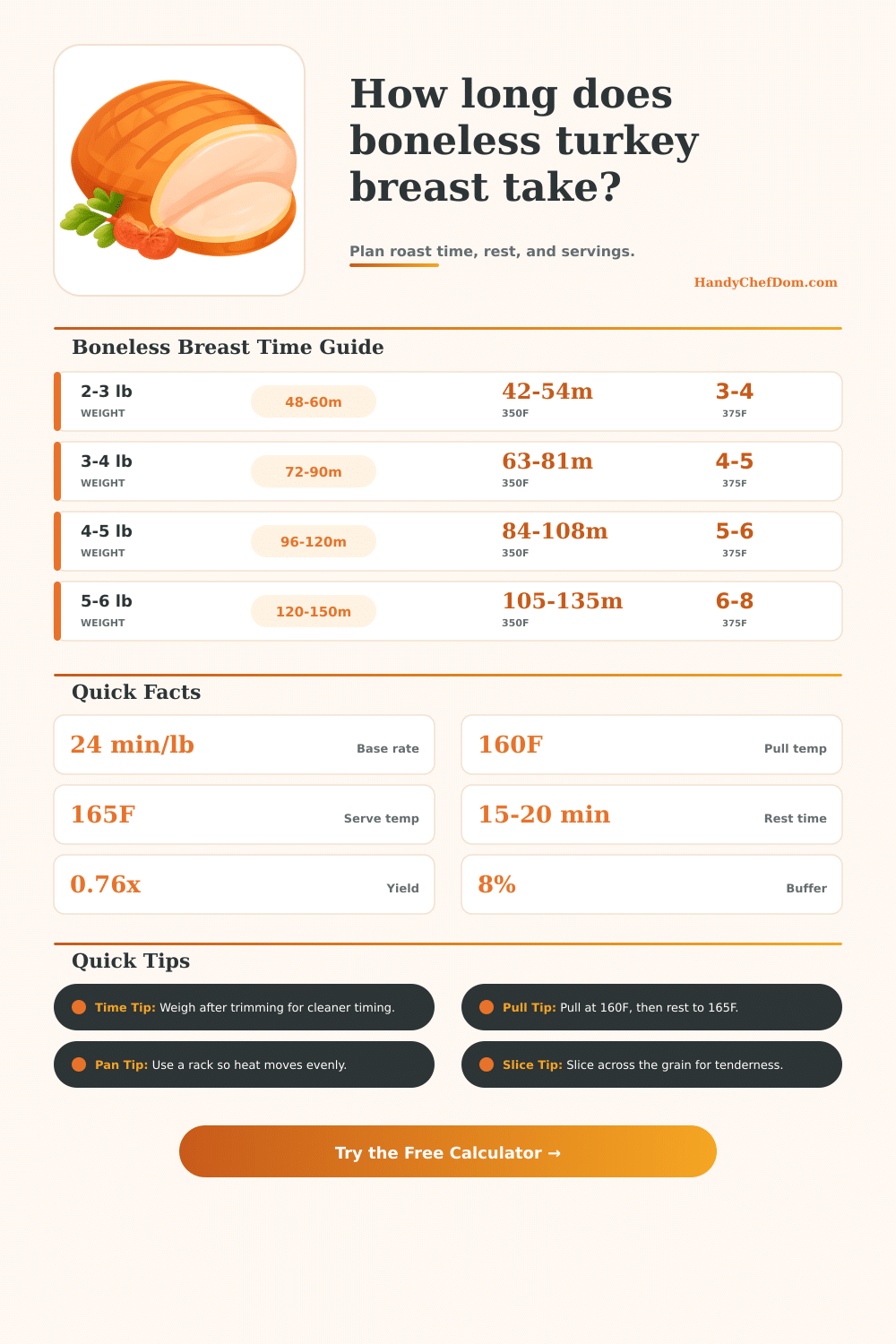
| Weight | 325F | 350F | 375F |
|---|---|---|---|
| 2 lb | 48-60m | 42-54m | 38-48m |
| 3 lb | 72-90m | 63-81m | 57-72m |
| 4 lb | 96-120m | 84-108m | 76-96m |
| 5 lb | 120-150m | 105-135m | 95-120m |
| Profile | Time | Yield | Note |
|---|---|---|---|
| Standard | 1.00x | 0.76x | Baseline |
| Tied | 1.04x | 0.75x | Denser center |
| Rolled | 1.06x | 0.74x | Neat slices |
| Dry-brined | 0.96x | 0.77x | Faster finish |
| Cooked wt | Servings | Raw wt | Note |
|---|---|---|---|
| 0.5 lb | 1-2 | 0.7 lb | Snack tray |
| 1.0 lb | 2-3 | 1.3 lb | Dinner plate |
| 1.5 lb | 3-4 | 2.0 lb | Family meal |
| 2.0 lb | 4-5 | 2.6 lb | Buffet bowl |
Use this calculator to estimate boneless turkey breast oven time by weight, temperature, and roast style. It also shows rest time, yield, and a simple carve-ready window for dinner.
Roasting an boneless turkey breast require planning because the weight and the temperature of the turkey breast will affect the cooking time of the turkey breast. If the cooking time are not planned correctly, then the turkey breast may be either too dry or undercooked. Both the weight of the boneless turkey breast and the starting temperature of the turkey breast should be consider prior to cooking the turkey breast.
The starting temperature of the turkey breast impact the cooking time of the turkey breast. If the turkey breast has been stored in the refrigerator and placed directly into the oven, the exterior of the turkey breast will heat much faster then the center of the turkey breast. To avoid this issue, you should allow the turkey breast to sit at room temperature for a period of time prior to roasting the turkey breast.
How to Roast a Boneless Turkey Breast
Additionally, the pan in which the turkey breast will be roasted can also impact how the turkey breast cook. For instance, using a roasting rack allow for air to circulate around the turkey breast allowing it to cook more even, while a covered pan will trap the steam that exits the turkey breast. Oven temperature is another factor that will impact how the turkey breast cook.
If turkey breast is roasted at a high temperature, the exterior of the turkey breast may actualy toughen prior to the interior of the turkey breast reaching the proper cooking temperature. Using a lower oven temperature will allow the turkey breast to cook more slow, but will allow for more even juiciness to cook throughout the turkey breast. Additionally, using dry brine technique with salt will allow the turkey breast to cook more efficient due to the way that salt draw moisture out of the turkey breast.
Many individuals makes mistakes when roasting a turkey breast due to not weighing the turkey before roasting. The cook should weigh the turkey after the fat and silver skin have been trim from the turkey breast. Additionally, the turkey will continue to cook after it is remove from the oven, a process known as carryover cooking.
Therefore, the turkey breast should be allowed to rest for 15-20 minutes after being remove from the oven. During this time, the juice will redistribute within the turkey breast. If the turkey breast is remove from the oven and sliced without allowing it to rest, the juices will escape from the turkey breast.
Another thing to consider prior to roasting the turkey breast is that the roasted turkey breast will shrink in mass. The turkey breast will lose some of it mass due to the evaporation of some of its fluids, as well as the rendering of the fat within the turkey breast. For instance, a four-pound turkey breast may only weigh three pound after roasting.
To determine when the turkey breast reach the proper cooking temperature, a probe thermometer should be used to insert into the thickest part of the turkey breast. Using this thermometer, the turkey breast should reach an internal temperature of 160 degrees Farenheit in the center of the turkey breast. Additionally, the turkey breast should reach a final temperature of 165 degrees Farenheit after resting covered for fifteen to twenty minute.
Finally, the turkey breast should be sliced in such a way that it will remain tender when roasted. The fibers of turkey are arrange in the turkey breast in a manner that allow the turkey to be roasted in an even fashion. Therefore, the turkey breast should be sliced across these fibers so that the roasted turkey breast is easier to chew.
By following these step prior to roasting a boneless turkey breast, the turkey will be safe to eat and will be juicy.