Water Heating Time Calculator
Estimate how long water needs to reach the right temperature, then compare kettles, pans, and pots with one clean layout.
| Task | Volume | Start | Target |
|---|---|---|---|
| Tea cup | 0.25 L | 20 C | 96 C |
| Kettle | 1.0 L | 18 C | 100 C |
| Saucepan | 1.5 L | 20 C | 90 C |
| Stock pot | 3.0 L | 18 C | 95 C |
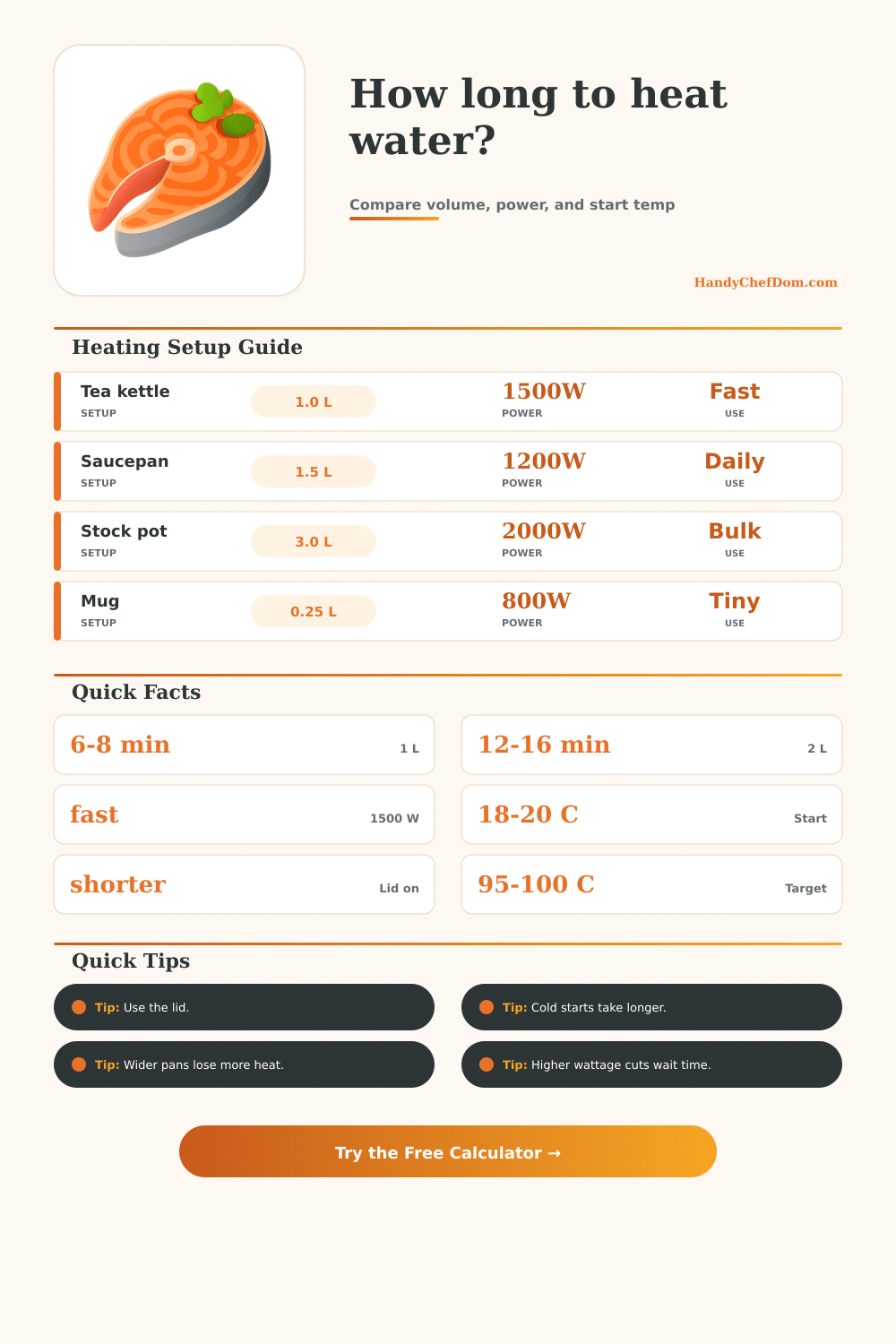
| Power | 1 L | 2 L | Use |
|---|---|---|---|
| 800 W | 11 min | 22 min | Slow |
| 1200 W | 7 min | 14 min | Balanced |
| 1500 W | 6 min | 12 min | Fast |
| 2000 W | 4 min | 8 min | Strong |
| Vessel | Factor | Loss style | Note |
|---|---|---|---|
| Kettle | 1.12 | Closed | Quick heat |
| Saucepan | 0.88 | Wide open | More steam |
| Stock pot | 0.80 | Tall body | Bulk heat |
| Double boil | 0.72 | Indirect | Gentle rise |
| Start | Delta | Feeling | Use |
|---|---|---|---|
| Cold tap | 10-15 C | Big jump | Winter start |
| Cool tap | 16-20 C | Normal | Daily use |
| Room temp | 21-24 C | Small | Fastest |
| Hot tap | 25-35 C | Tiny | Rinse only |
Water heating time are the length of time that it takes for water to reach the desire temperature. By understanding water heating time, an individual can accurate plan the cooking tasks that they will perform in the kitchen. Water heating time is influenced by several different physical factor relating to the water that is to be heated, such as the volume of water, the starting temperature of the water, the wattage of the heating element that is utilized to heat the water, and the shape of the vessel in which the water is heated.
The starting temperature of the water is one of the primary factor that can influence the time that is required for the water to heat. Water that begin at a lower starting temperature will require more energy to heat the water to the boiling point than water that begins at a more higher starting temperature. For instance, starting with cold tap water in the winter will require more energy to heat to a boiling point than starting with water that begins at a room temperature in the summer.
What Affects How Long Water Takes to Heat
Another of the factors that can influence the water heating time is the volume of the water that is to be heated. The larger the volume of water that are to be heated, the more energy that is required to heat that water to the desired temperature. For instance, it will take more energy to heat three liter of water to a boiling point than it will take to heat one liter of water to that same boiling point.
The power of the heating element that is used to heat the water is another of the factors that can influence the water heating time. The higher the wattage of the heating element, the less time that will be required for the water to boil. For instance, using a 2000 watt heating element will heat the water to a boiling point in less time than using a 1200-watt heating element.
However, the effective power of that heating element may be less than the wattage of the element due to the loss of heat from the vessel in which the water is contained. The shape of the vessel in which the water is heated and the use of a lid can also impact the amount of heat that is lost from the water. Using a tall and narrow vessel, such as a kettle, instead of a wide and shallow vessel, such as a saucepan, can lead to the water heating in a shorter period of time due to the lessening of the amount of surface area of the water that is exposed to the air.
Additionally, using a kettle and covering the kettle with a lid will result in shorter period of water heating than if a lid did not cover the wide saucepan. Finally, external environmental factors, such as the altitude at which the water is heated and the temperature of the kitchen in which the water is heated, can have an impact upon the time that is required for the water to heat. At higher altitude, the atmospheric pressure of the air is lower.
Lower atmospheric pressure result in the boiling point of water decreasing. Therefore, the water will boil at a lower temperature at high altitudes. Finally, if the kitchen is cold, the rate at which heat is lost from the vessel will increase, leading to longer water heating time.
An individual can manage the water heating time by adjusting the settings of the appliance according to the volume of the water that is to be heated. For instance, using a massive pot and a weak burner will result in longer water heating times than if a small amount of water are heated in a small vessel. Many appliance include preset settings for different cooking tasks, such as “pasta water” or “coffee” settings.
These preset settings allow for the appliances to account for the amount of water and the power of the appliances to heat the water to boiling in a shorter time period. By understanding each of these variable, an individual can more accurate plan the tasks that they will perform in the kitchen to account for the specific water heating time that is required for their specific setup.