Servings Calculator
Plan guest counts, portion totals, and batch yields with a pink themed servings calculator that keeps the math tidy for everyday meals.
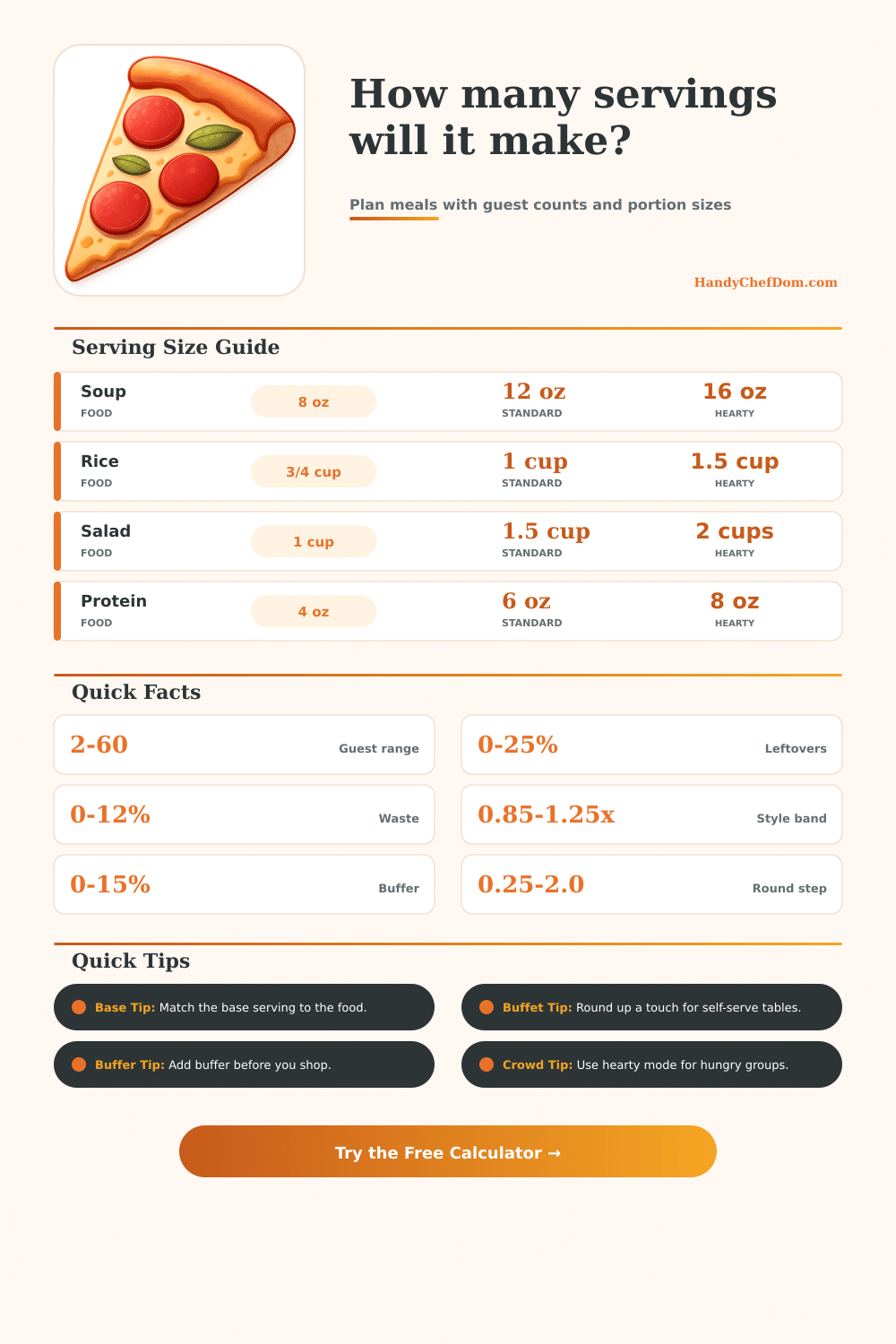
| Food | Imperial | Metric | Note |
|---|---|---|---|
| Soup | 12 oz | 355 ml | Brothy meals |
| Rice | 1 cup | 240 ml | Side dish |
| Pasta | 2 oz | 56 g | Dry measure |
| Salad | 2 cups | 120 g | Loose greens |
| Protein | 6 oz | 170 g | Main plate |
| Vegetables | 1 cup | 130 g | Side bowl |
| Fruit | 1 cup | 150 g | Fresh bowl |
| Dessert | 1 slice | 90 g | Sweet finish |
| Style | Factor | Portion | Note |
|---|---|---|---|
| Plated | 0.95x | Tight | Seated meal |
| Family | 1.00x | Balanced | Shared bowls |
| Buffet | 1.15x | Loose | Self-serve line |
| Potluck | 1.10x | Safe margin | Carry-in dish |
| Guests | Light | Standard | Hearty |
|---|---|---|---|
| 4 guests | 32 oz | 48 oz | 58 oz |
| 8 guests | 64 oz | 96 oz | 116 oz |
| 12 guests | 96 oz | 144 oz | 174 oz |
| 20 guests | 160 oz | 240 oz | 290 oz |
| Unit | Metric | Imperial | Shortcut |
|---|---|---|---|
| 1 cup | 240 ml | 8 oz | Liquid measure |
| 1 oz | 28.35 g | 0.06 lb | Weight check |
| 1 lb | 453.6 g | 16 oz | Batch scale |
| 1 tbsp | 15 ml | 0.5 oz | Small add |
To calculate food portions, you needs to account for many differents variables. Each of the many different variable will impact how much food that a person will consume. Some of those variables includes the type of food that will be served, the appetite of the guests, the style in which the food will be served, and whether or not you must account for potential waste or leftovers.
The type of food that will be served will impact the baseline portion of that food that you serve. For example, soups and stews often requires a baseline of twelve ounce per serving. Additionally, rice and other grain side may require a baseline of one cup per serving.
How to Calculate Food Portions
Proteins like meat or fish may requires a baseline of six ounces per serving. Salads may require a baseline of two cup per serving. Each of these is the starting points for the amount of each type of food that is needed per guest.
However, you may need to adjust these baselines according to the appetite of the guests. If the guests has hearty appetites, you may need to increase the baseline portion by twenty percent or more of the baseline amount for those food. The style in which the food will be served will also have an impact on how much food is required for the event.
For instance, the cook may require to prepare less food for meals that are to be plated. However, for family style meals, in which the guests will eat from the same dishes, the amount of food that is prepared does not need to be increased. For buffet style meals, however, the cooks may need to prepare fifteen percent more of the food that is to be served at the event.
Finally, for potluck meals, in which the guests will transport there meals to a different location where the guests will eat, twenty percent more food will be required to account for the food that may be lost during transport or the decrease in quality of that food during transport. In addition to accounting for food that will be lost during transport and while eating, some food may be wasted during the meal. In this case, three to twelve percent of the food may need to be prepared as waste.
Additionally, the amount of food that will be left behind after the meal is completed is known as the leftover. Thus, if you intend for there to be leftover food after the guest eats the meal, an additional five to twenty percent of food will need to be prepared. Buffers are an additional amount of food that the cook prepares to account for other variables at the event, such as the potential for additional guest that may show up at the home after the initial guest have been accounted for.
To calculate the amount of food that will be needed for the event, use the following steps. First, determine the baseline portion of each type of food. Second, determine the amount of each food that will need to be prepared according to the appetite of the guests.
Third, determine how much of each food will be needed according to the style of the meal that will be served. Fourth, determine the amount of food that will need to be prepared to account for waste and travel of food. Fifth, determine the amount of food that will need to be prepared to account for potential leftovers after the meal or for any additional guests that may show up at the home.
For example, if twenty people is to attend a buffet dinner, the baseline portions of six ounces of protein may need to be increased by twenty percent for the hearty appetites of the guests and then increase again by fifteen percent for the buffet style meal. Many people makes mistakes when they attempt to calculate the portions of food that will be needed for an event. For example, they may forget to account for the styles of the meal that will be served.
If they do, they may find themselves with food shortage at the buffet line. Additionally, they may not account for the waste of food that may happen at the dinner. Thus, they may find themselves with food shortages due to this oversight.
Finally, they may not account for the number of guest that may show up at the home. In this case, there may be a lack of food for those additional guest. It is important to account for each of these variable.
Additionally, when determining the amount of food that will be needed, you may need to round that number to the nearest practical amount. For instance, it isnt practical to prepare food for 17.3 guest. Finally, using the proper units of measurement for each food item will ensure that you have accuracy when following the recipe for each type of food.