Servings Per Container Calculator
Estimate how many servings fit in a jar, tub, cup, bottle, or tray by tuning fill level, waste allowance, and portion size.
Volume mode uses cups or ml; weight mode uses oz or g. The serving estimate also respects the selected food type.
| Container | Capacity | Servings | Use |
|---|---|---|---|
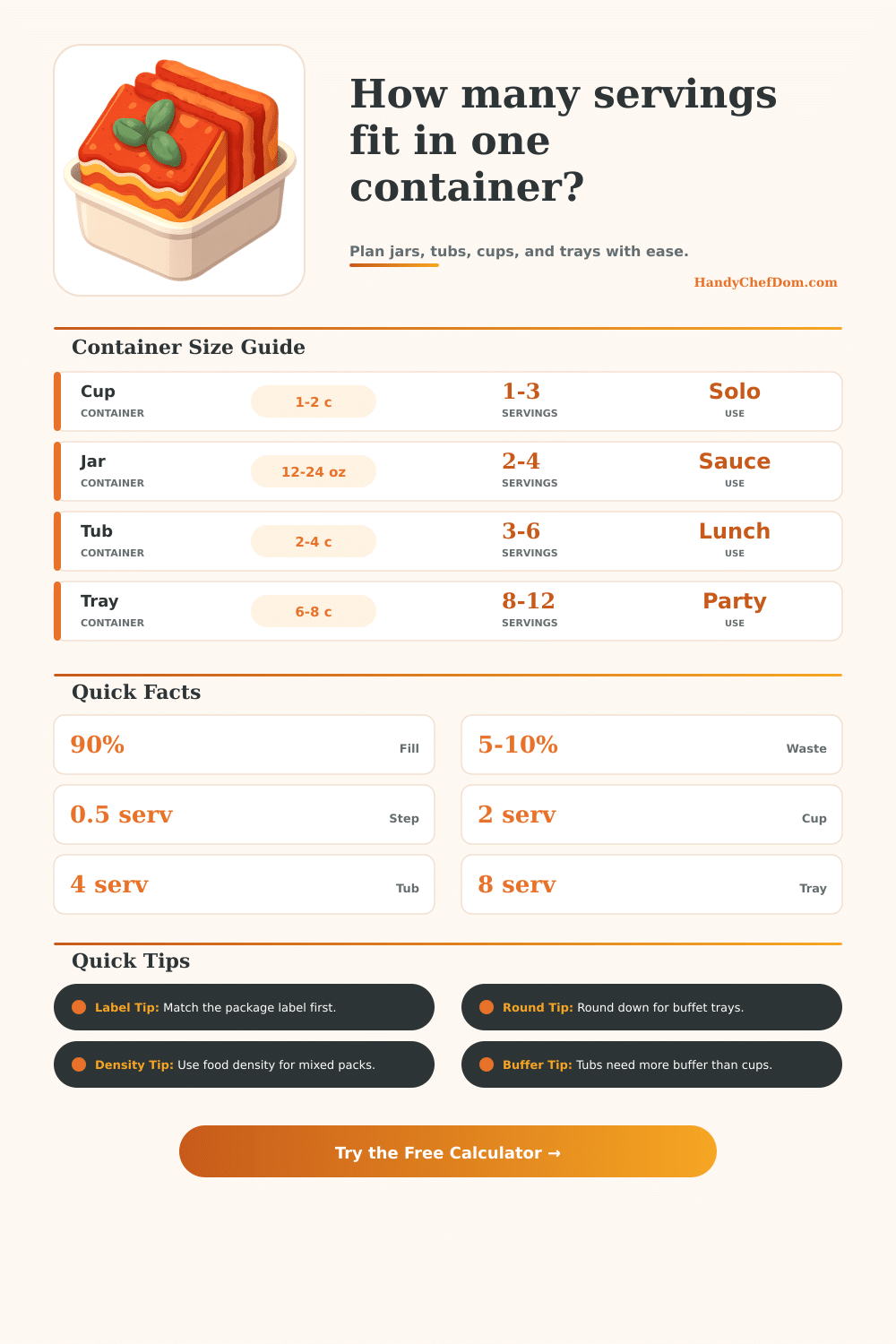
| Cup | 1-2 c | 1-3 | Solo |
| Jar | 12-24 oz | 2-4 | Sauce |
| Tub | 2-4 c | 3-6 | Lunch |
| Tray | 6-8 c | 8-12 | Party |
| Food | Volume | Weight | Note |
|---|---|---|---|
| Soup | 1 c | 8 oz | Level fill |
| Yogurt | 2/3 c | 6 oz | Spoonable |
| Cereal | 1 c | 1 oz | Airy grains |
| Rice | 1 c | 5.6 oz | Settles down |
| Fill | Usable | Waste | Note |
|---|---|---|---|
| 80% | 0.80x | 0-5% | Loose pack |
| 90% | 0.90x | 5% | Good fill |
| 95% | 0.95x | 5-8% | Tight pack |
| 100% | 1.00x | 10% | Top-off only |
| Conversion | Metric | Imperial | Use |
|---|---|---|---|
| 1 cup | 240 ml | 8 fl oz | Volume |
| 1 oz | 28 g | 1 oz | Weight |
| 1 qt | 946 ml | 32 fl oz | Tray |
| 1 lb | 454 g | 16 oz | Bulk |
To calculate the number of servings that a container can hold, you must take into account the volume of the container, the density of the food, the fill levels of the containers, and the allowances for waste when serving the food. Many times, people will estimate the number of servings that a container can hold by taking a look at the total volume of the container. However, the total volume of the container dont necessarily indicate how much food can be contained within the container; the shape of the container and the type of food that is contained within the container can have an impact on the amount of food that is actualy available for eating from that container.
The shape of the container can impact the amount of food that can be contained within that container. For instance, a container that features a tapered top will have less of the food contained within the container compared to a container that features straight sides. Additionally, the type of food that is contained within a container can also impact the way that the container is filled.
How to Calculate Servings in a Container
For instance, liquids will typically fill to the brim of the container to which they are poured; however, dry foods will leave some air within the container that prevents the food from becoming fully contained within the container. Therefore, a container of food like cereal will contain less of the food than a container of liquid that has the same volume as the container of cereal. The density of the food is another factor to consider in determining the number of servings that may be contained within a container.
Density is the weight of a specific volume of food. For instance, one cup of rice will weigh around 5.5 ounces, but one cup of salad greens may only weigh around three ounces. Thus, when using volume as a means of measuring the food, it is possible to create a miscalculation regarding the amount of food that may be found within a container.
For these reasons, it is better to use weight as the measurement for bulk items, the weight of the food is a more accurate measurement for food items than the volume of the food. Another factor to consider is the fill level of the containers. The fill level accounts for the amount of space that is left within the container for the food to be served.
In most cases, containers should be filled to a 90% fill level. A 90% fill level allows for food to be easily scooped out of the container without causing the food to overflow from the container. A 95% fill level can be used for sauce jars, but this fill level may lead to spills of the food from the container.
Finally, if containers are filled to 100%, there will be increased waste of the food due to the food potentially sticking to the container during the serving of the food. Another consideration for the preparation of food containers is for waste allowances. Some waste allowances for food sticking to the containers and to eating surfaces should be considered within the calculation for the number of servings of food that will be contained within each container.
A waste allowance of 5% is common for tubs that will be cleaned after use. For party trays, however, a 10% waste allowance is appropriate because people will be dipping into the food for serving. Therefore, providing for a waste allowance for the food will ensure that there is enough food to provide for all who may wish to eat the prepared food.
The number of servings that can be contained within a container is calculated by dividing the usable volume of the container by the desired portion size. For buffets, where the food portions is large, it is best to round the number of servings down to the nearest half-serving to ensure that each person receives there portion of food. There is different types of containers for different serving needs.
For instance, solo cups are best used for food and beverage servings for one person. Lunch tubs can contain three to six servings. Finally, containers that are prepared to be family-sized may contain eight servings.
Individuals who do not account for the density of the food or the shape of the container may make mistakes in calculating the number of servings that can be contained within a container. For instance, food like nuts may be airy whereas food like soup is much denser. Thus, these two types of food should not be treated the same within the calculation of the number of servings of food that can be contained within each container.
One additional common mistake is to fill each container to 100% of the containers capacity. A 100% fill level will create waste of the food. By accounting for the shape of the containers, the waste of the food, the density of the food, and the number of servings that are to be contained within each container, the person can accurately determine the number of servings of food that can be contained within each container.