Cups to Servings Calculator
Turn a measured cup total into realistic servings for soups, grains, pastas, salads, and drinks with a buffer that keeps guests covered.
Enter volume in cups, then compare it with a serving style that fits the food you are portioning.
Serving snapshot
See how many portions your cups can make and how much you need for the target batch.
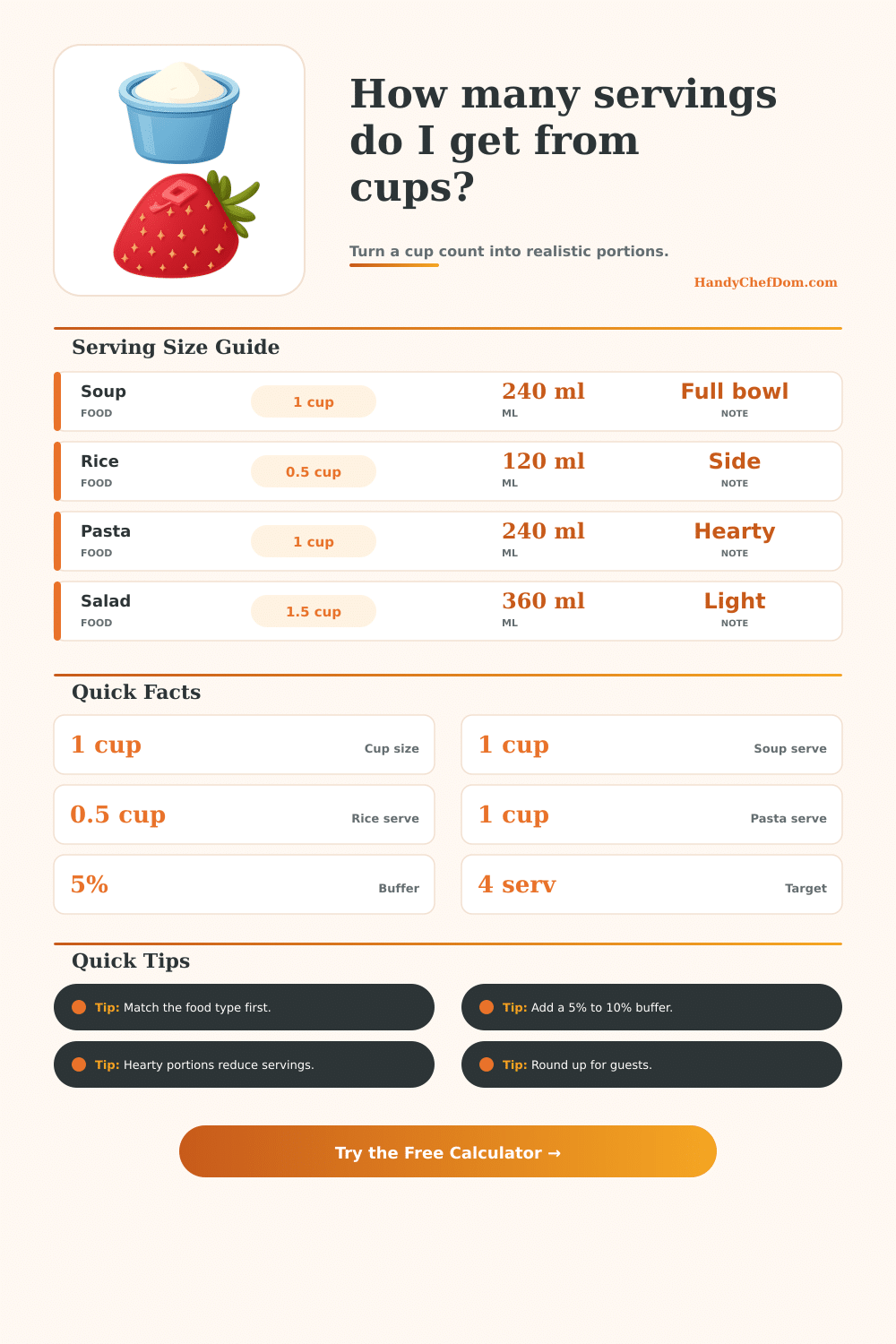
| Food | Cup/Serve | ml | Note |
|---|---|---|---|
| Soup | 1 cup | 240 ml | Full bowl |
| Rice | 0.5 cup | 120 ml | Side dish |
| Pasta | 1 cup | 240 ml | Main bowl |
| Salad | 1.5 cup | 360 ml | Light plate |
| Style | Factor | Feel | Best For |
|---|---|---|---|
| Light | 0.85x | Small | Apps |
| Standard | 1.00x | Normal | Family |
| Hearty | 1.25x | Big | Dinner |
| Buffet | 1.50x | Large | Events |
| People | Soup | Rice | Buffet |
|---|---|---|---|
| 2 | 2 cups | 1 cup | 3 cups |
| 4 | 4 cups | 2 cups | 6 cups |
| 8 | 8 cups | 4 cups | 12 cups |
| 12 | 12 cups | 6 cups | 18 cups |
| Cups | Pint | Quart | Note |
|---|---|---|---|
| 2 | 1 pint | 0.5 qt | Small dish |
| 4 | 2 pints | 1 qt | Family bowl |
| 8 | 4 pints | 2 qt | Party tray |
| 12 | 6 pints | 3 qt | Big batch |
Calculating food portion requires that you understand the difference between volume and serving size. Volume is the total amount of space that the foods takes up. Yet, serving size is the amount of food that should be provide to one person.
The type of food that you are preparing is also one of the factors that you must consider when determining serving size. For instance, soup is a liquid food that often serve as the main course for a meal; one cup of soup is typically considered to be one serving. Rice is a grain that typically serve as a side dish to the main course; half a cup of rice is typically considered to be one serving.
How to Calculate Food Portions
Pasta is a starch that often serve as the main course for a meal, so servings of pasta are typically larger than servings of rice. Lastly, salad is a vegetable that is typically light in weight, so servings of salad are often one and a half cup. The portion style also change the amount of the food that the individuals are to eat.
For instance, a light portion style implies that small amount of food will be served to the individuals; these portions are used as snacks or appetizers. A hearty portion style indicates that large amounts of food will be served to each individual, typically served as the main course of the meal. A buffet portion style indicates that there will be a very large amount of food provided to the individuals, allowing them to serve themselves from one large dish.
The portion sizes of food can also change according to the individuals that is to eat the food. For instance, childrens portions should be smaller than those of adults due to the smaller appetite of children. In addition to the type of food and the portion styles, the portions of food can be further adjusted with the inclusion of a buffer portion of food.
A buffer is an additional amount of food that is provided beyond the calculation of how much food is required to feed the individuals that will eat the food. This extra amount of food is typically provided in the range of 5 to 10% of the calculated portion of food. A buffer is used to account for the possibility that the individuals will spill some of the food, that food may be scooped with uneven scoop when portioning the food, or that some individuals have larger portions of food than others.
Thus, by including a buffer of food, you ensure that there is enough food for each individual that will eat the food. Another factor to consider when calculating food portion is the density of the food. Density is a measurement of the relationship of the weight of the food to the volume of the food.
Foods that contain more liquid will have higher density than foods that are fluffy and contain less liquid. For instance, fluffy cooked rice will have a low density, while a thick sauce will have a high density. Another factor to consider is that some foods will change in size during the cooking process.
For instance, vegetable will shrink when cooked as they wilt. Thus, if cooked vegetables are to be provided for the individuals, more raw vegetable must be prepared than would otherwise be the case. The portions of food can be calculated through a few different mathematical calculations.
For instance, one can calculate the total number of serving that can be provided from a known volume of food. Additionally, the total volume of food that is required to provide a target number of servings can be calculated. For instance, if there are four cups of rice, and servings of rice are half a cup, there will be eight serving of rice.
Additionally, the amount of rice that is required to feed a number of individual can also be calculated through the multiplication of the number of individuals that will eat the food by the size of the portion of rice. If there are eight individuals to be fed, each of whom will eat half a cup of rice, there will be four cup of rice that are required. In order to avoid mistake in calculating food portions, it is important to ensure that foods are not treated as if they have the same portion sizes.
For instance, it is common for food portion to be applied to foods as if they were all the same, such as treating rice (a grain) as if it were the same as soup (a liquid). Using the portion size of soup to portion rice will provide too much rice to the individuals. Additionally, the use of reference table for recipes will allow cooks to ensure that the recipes are measured correctly.
For instance, reference tables can help cooks to remember that two cups of a food is the same as one pint, and that four cups of a food is the same as one quart. Thus, by using these tables along with calculating the buffer for food portions, cooks can ensure that there will be enough food for the guests, and that the food will not be wasted.