Batch Size Calculator
Scale sauces, doughs, soups, dressings, and fillings without losing your ratio or overfilling the containers.
🍽Quick Presets
⚙Batch Controls
Pick a batch style, set the target yield, and the calculator will show the scaling factor, portions, and container needs in one clean view.
Batch snapshot
See the adjusted batch, scaling factor, servings, and container count in one clear view.
📊Reference Tables
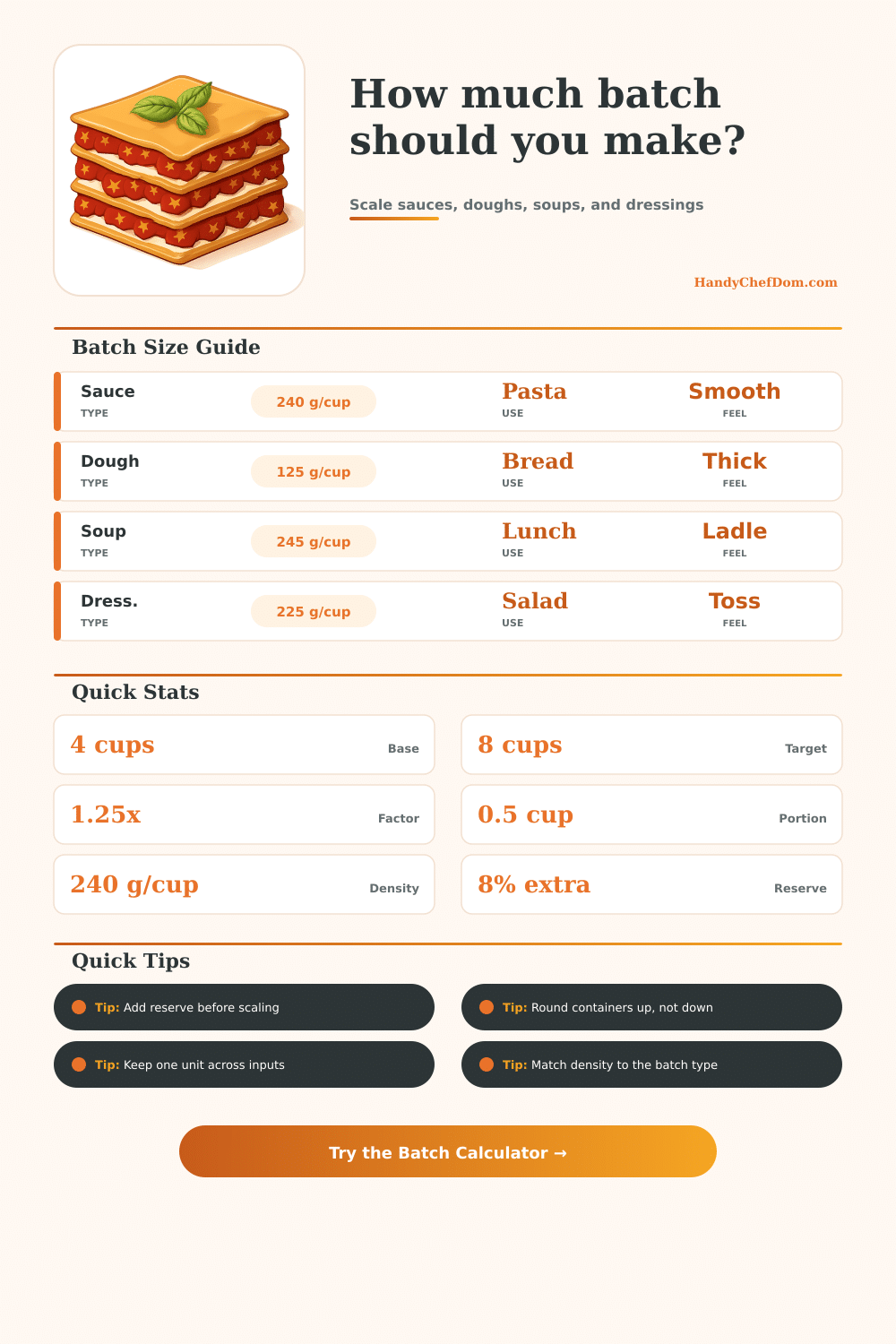
| Batch Type | Density | Use | Texture |
|---|---|---|---|
| Sauce | 240 g/cup | Pasta | Smooth |
| Dough | 125 g/cup | Bread | Firm |
| Soup | 245 g/cup | Lunch | Ladle |
| Dressing | 225 g/cup | Salad | Toss |
| Volume | Tablespoons | Fluid Oz | Milliliters |
|---|---|---|---|
| 1 cup | 16 | 8 | 237 |
| 1/2 cup | 8 | 4 | 118 |
| 1/4 cup | 4 | 2 | 59 |
| 1/8 cup | 2 | 1 | 30 |
| Target Batch | Portion | Servings | Use Case |
|---|---|---|---|
| 2 cups | 1/4 cup | 8 | Test batch |
| 4 cups | 1/3 cup | 12 | Family meal |
| 8 cups | 1/2 cup | 16 | Party tray |
| 12 cups | 3/4 cup | 16 | Buffet run |
| Container | Holds | Best For | Note |
|---|---|---|---|
| Jar | 2 cups | Dressing | Fridge |
| Tub | 4 cups | Soup | Stackable |
| Jug | 8 cups | Drink mix | Easy pour |
| Pan | 12 cups | Tray bake | Wide fill |
💬Quick Tips
Scaling a recipe require a systematic approach because scaling a recipe is not simply a matter of multiplying every ingredient by a specific number. To scale a recipe properly, a person must account for two variable: volume and density. Volume refer to the amount of space that a food item take up.
For example, an liquid might take up a small volume if it is contained in a small jar. But if the same liquid is of a larger volume, it may require a much larger bucket to contain that liquid. The second variable are density.
How to Scale a Recipe
Density is the weight of the food item in relation to the volume of that food item. For instance, a pound of lead will take up much less space then a pound of marshmallows. But if a person dont account for these variables, a person may experience spills with the ingredients or find themselves wasting space in the container that they use to store the recipes product.
One way to avoid these problem when scaling a recipe is to follow a batching system. First, a person should determine the yield that they would like to create and the base yield of the recipe. By determining these two value, a person can find the scaling factor that will allow the recipe to still taste the same.
By using the scaling factor to multiply the number of each ingredient in the recipe, the person will maintain the ratios of the ingredients. Using the scaling factor will ensure that the flavor of the recipe remain the same. Using a calculator to determine the scaling factor will eliminate the need for mental math.
Using a calculator will also allow a person to determine whether the scaling factor will work with the measuring tool that they own. Thus, using a calculator will make the scaling process more efficient. A person must also account for two additional variable when scaling a recipe: waste margin and reserve margins.
Food often gets stuck to the sides of the bowl or blenders. Furthermore, food often gets stuck to the side of ladles. Thus, a person will not end up with the amount of food that they calculate in the recipe.
To account for this, a person should make adjustments to the recipe to account for a small percentage of food for waste and another small percentage of food to set aside as a reserve. This small percentage will ensure that the portion size of the recipe is correct when the cooks in the kitchen finally prepare it. The texture of the food item will dictate the type of container in which that food item is stored.
For instance, a thin glaze will go into a narrow squeeze bottle. But a thick filling will go into a wide tub so that it is easy to scoop it out of the container. When calculating the number of container in which a person wants to store the food item, it is better for a person to have a container that is only half full of the food item than to have a food item that does not have any container to go into.
Another variable that can impact the scaling of a recipe is density. A cup of heavy dough will weigh more than a cup of vinaigrette. The weight of the food item will impact the way in which a person handle the food item.
For instance, if a person decides to measure the food item in grams per cup, then a person can use a digital scale to measure the ingredient. Using a digital scale to measure the food item will allow more precision than if a person use a measuring cup. Using more precision when measuring the food item will allow a person to replicate the recipe perfectly each time that they attempt to cook the dish.
The main goal of batching food item is to create consistency in the kitchen. By ensuring that the portion size of the food item is the same for every person that consume the food, a person can avoid giving one person a larger portion of food than they give to another person. By locking in the portion size and the total yield of the food item, a person can create a predictable rhythm of the kitchens food preparation.
By having this predictable rhythm of the food preparation, a person can avoid wondering if they have enough food to feed each person in the kitchen. Instead, they can focus on prepare the food to ensure that it taste great. Finally, a person should of account for waste margin, reserve margin, portion size, and account for total yield so that their preparation process for food is more streamlined and efficient.