Food Scale Calories Calculator
Weigh the bowl, choose the closest food, and see calories, macros, and serving math in one clean pink workspace.
📌Quick Presets
⚖Calculator Inputs
The scale reads one number; the calculator turns it into meal math, portion counts, and a macro snapshot.
Food scale summary
These cards update with your chosen food, unit system, adjustment, and portion split.
📊Nutrition Snapshot
📑Reference Tables
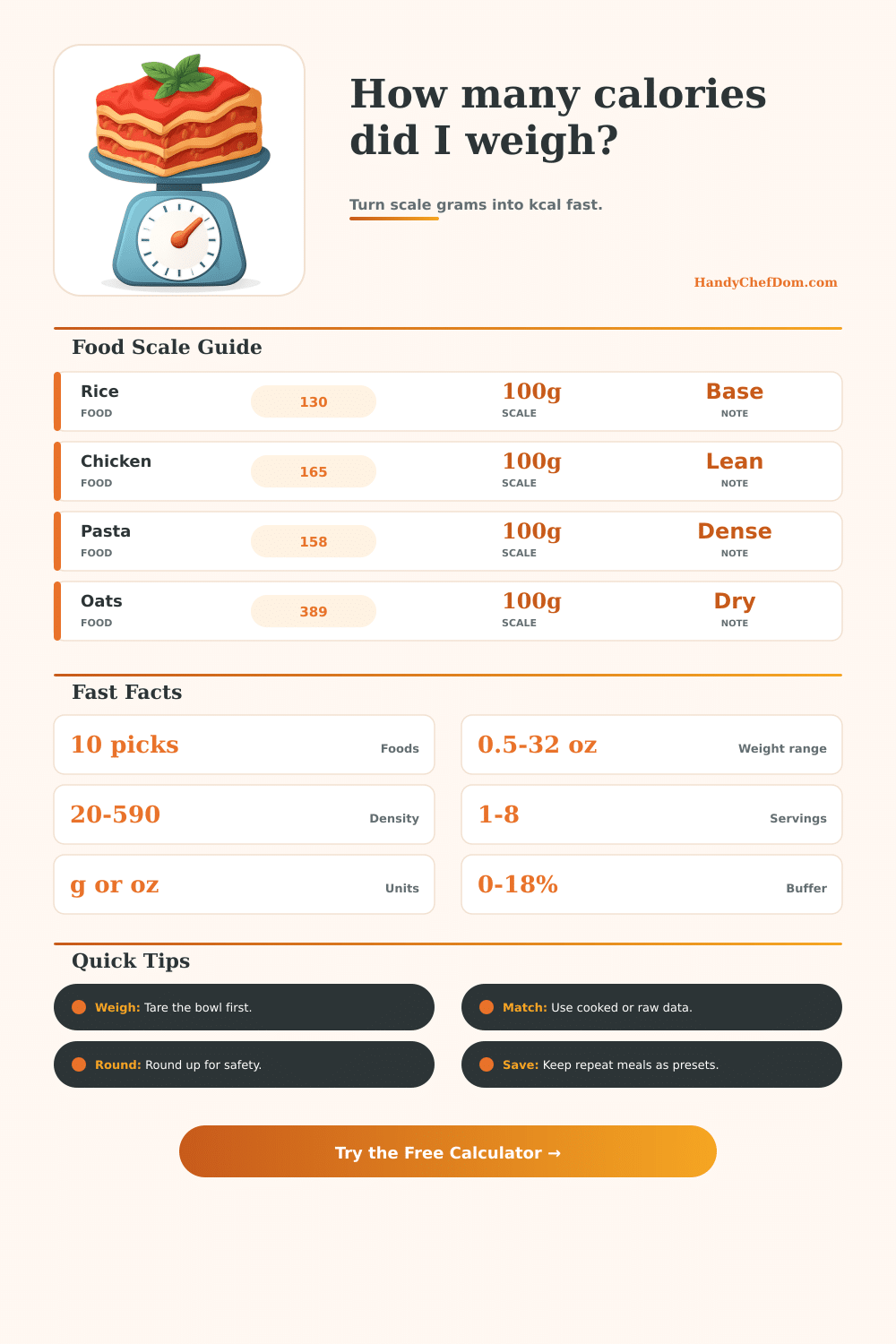
| Food | 100 g | Serve | Note |
|---|---|---|---|
| Rice | 130 | 158 g | Base |
| Chicken | 165 | 85 g | Lean |
| Pasta | 158 | 140 g | Dense |
| Oats | 389 | 40 g | Dry |
| Oz | Grams | Scale | Note |
|---|---|---|---|
| 1 | 28.35 | Small | Nibble |
| 4 | 113.4 | Mid | Side |
| 8 | 226.8 | Large | Meal |
| 16 | 453.6 | Bulk | Prep |
| Goal | Weight | Kcal | Use |
|---|---|---|---|
| Snack | 80 g | 100-180 | Light |
| Lunch | 150 g | 200-350 | Normal |
| Dinner | 220 g | 350-550 | Full |
| Prep | 300 g | 500-700 | Buffer |
| Preset | Food | Serves | Style |
|---|---|---|---|
| Snack Box | Apple | 1 | Light |
| Rice Bowl | Rice | 2 | Shared |
| Chicken Plate | Chicken | 1 | Clean |
| Meal Prep | Mixed | 4 | Batch |
💡Helpful Tips
Using volume tool to measure food can be problematic because volume dont always equate to weight. A cup of brown rice can be packed tightly or it can be loose, and the packed cup contains more calories than the same volume of loose brown rice. Thus, using a volume tool to measure food could lead to add extra calories to your daily intake without you knowing.
Furthermore, using a digital scale to measure the weight of foods is more accurate than using a measuring cup to measure volume because digital scales measure the mass of food. A digital scale allows you to know exactly how much food you are eating. Using manual calculations to determine the nutritional content of the food you eat can be difficult.
Why use a digital scale to weigh food
The nutritional information for many food is based on a serving size that is different than the amount of food that you may eat. Furthermore, if you have to perform mental math to determine the amount of calories in the meals that you eat, you may make mistakes in your calculation. Using a nutrition calculator can help you to avoid these errors, as the nutrition calculator will calculate the nutritional content of the meals that you input into the nutrition tool.
Thus, using a nutrition calculator will save you from the difficulty associated with manual calculations of the calories that you consume. When using a digital scale, you will have to account for the weight of the container in which you will measure your food. If you place a heavy ceramic bowl on a digital scale, for instance, the digital scale will register the weight of the bowl.
To account for this, the digital scale has a tare function that will allow you to remove the weight of the bowl from the digital scales total. Thus, when you use a digital scale and tare the food container, the digital scale will only measure the weight of the food that you are measuring in the container. Furthermore, if you have already placed the food into the container, you can input the weight of that container into a nutrition tracking tool.
The nutrition tracking tool will automatically subtract the weight of the container from the total weight. Thus, taring the digital scale ensures that the digital scale only measure the weight of the food, and that the caloric calculation based on that weight are accurate. It is important to understand the difference between the weight of raw food versus cooked food.
Raw food and cooked food can contain different amount of calories due to the difference in the weight of each type of food. For instance, pasta and rice can absorb water while they are being cooked; thus, cooked pasta and cooked rice will weigh more than raw rice and raw pasta. In this situation, if you weighed the cooked rice, but used the calorie count of raw rice, you would think that you consumed more calories than you did actualy consume.
Furthermore, the same is true of meat. When meat is cooked, it can lose some of its water weight; thus, cooked meat is more calorie dense than raw meat. Therefore, you must remain consistent with whether you weigh raw food or cooked food; mixing the two will make your nutritional calculations inaccurate.
In some instances, you may choose to use a buffer when you are weighing the food that you prepare for yourself. A buffer allows for food that might be difficult to weigh (like oil) or food that you may have added to the food that you prepare (like seasoning) to be accounted for. Thus, using a buffer will allow you to make adjustment for these hidden variables in your meals.
Furthermore, by using a buffer, you will ensure that you are not eating more calories than you have accounted for in your logs. In instances where you prepare food in large batch for several days, the use of a digital scale and nutrition tracking tool will make it easier to divide the prepared food into the containers in which you will store the food. For instance, if you prepare a large batch of chili, the nutrition tracking tool can help you to divide the chili into five container.
The nutrition tool will tell you the number of calories per portion of chili, which will help you to streamline the meal preparation process. All you must do is weigh the food with a digital scale and input the number of portions that you desire into the nutrition tracking tool; the tool will provide the caloric information for each portion. Not all foods have the same density.
Food density can affect how much space that the food will occupy in a given area. For instance, peanut butter is a dense food; thus, a small weight of peanut butter can contain a large number of calories. Leafy salad mixes, on the other hand, are not a dense food; thus, a large volume of leafy salad mixes may contain very few calories.
Therefore, because food volume can be unreliable, mass is a more reliable measurement of the food that is being tracked; a digital scale will not care whether the food that is being measured is fluffy or dense. The purpose of using a digital scale is to achieve calibration of the food that you prepare for yourself. If you weigh the food that you eat for several week, for instance, your body will develop an understanding of the weight of the food that you eat.
Thus, after you have used a digital scale to measure the food that you eat, you will be able to measure the food without using a digital scale. Your eyes will have calibrate to the food that you prepare.