Boiling Point of Water Calculator for Real Kitchens
Estimate your true boiling temperature from altitude, barometric pressure, salt, and thermometer offset, then plan simmer range and cook-time adjustments in one view.
Formula model: base boil at altitude + pressure shift + salinity lift + lid behavior + thermometer correction. This is tuned for practical kitchen planning, not lab calibration.
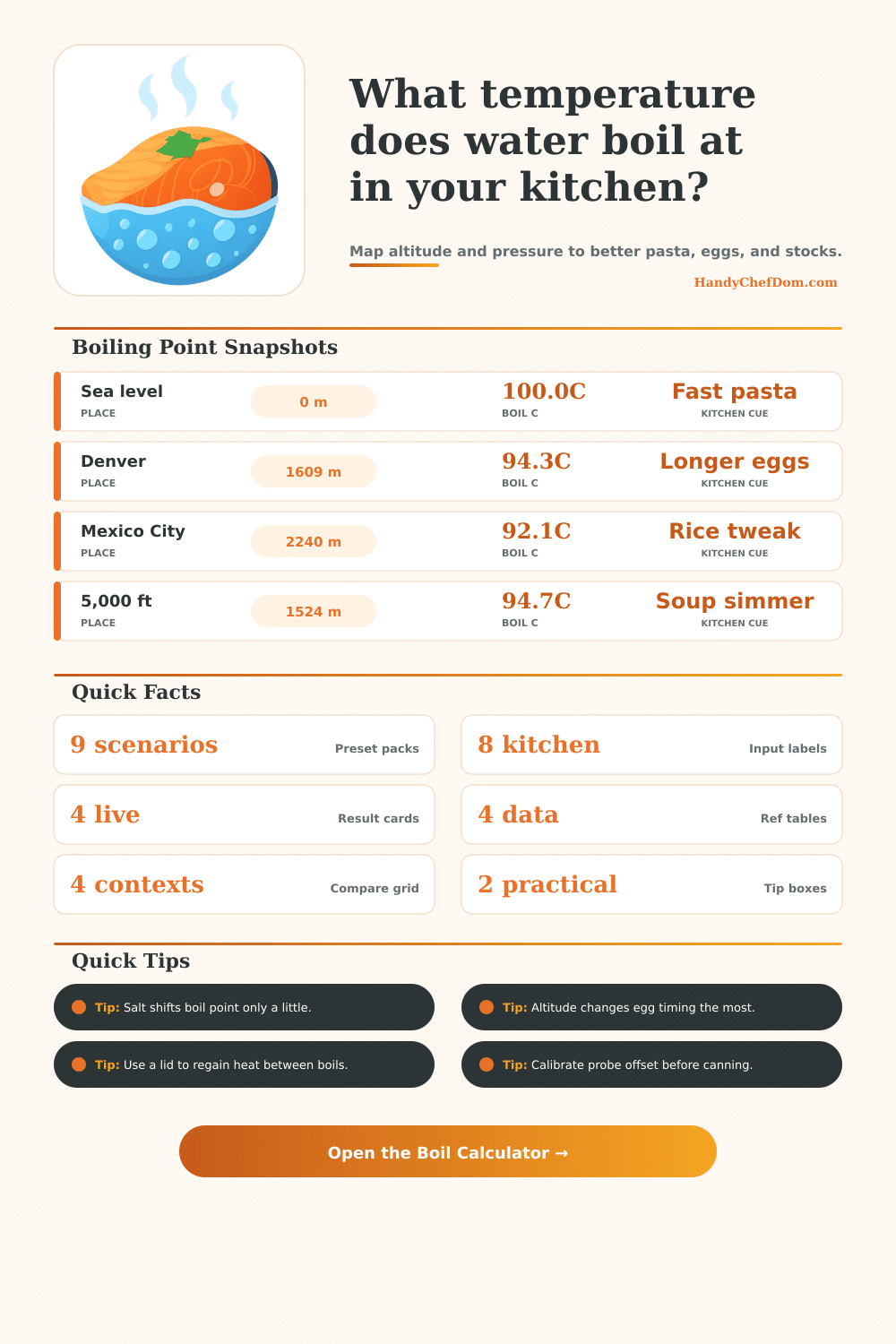
| Altitude | Meters | Boil C | Boil F |
|---|---|---|---|
| Sea level | 0 | 100.0 | 212.0 |
| 3000 ft | 914 | 96.8 | 206.2 |
| 5000 ft | 1524 | 94.7 | 202.5 |
| 7000 ft | 2134 | 92.5 | 198.5 |
| 9000 ft | 2743 | 90.4 | 194.7 |
| Condition | kPa abs | Boil C | Kitchen note |
|---|---|---|---|
| Stormy day | 98 | 99.1 | Slightly longer boils |
| Standard air | 101.3 | 100.0 | Recipe baseline |
| Dry high day | 104 | 100.8 | Faster bubbles |
| 10 psi cooker | 170 | 115.6 | Fast bean softening |
| 15 psi cooker | 203 | 120.9 | Canning range |
| Food | Boil style | Simmer band C | Typical note |
|---|---|---|---|
| Pasta | Rolling | 96-100 | Keep full movement |
| Eggs | Gentle | 90-96 | Reduce shell cracks |
| Rice | Start high | 92-98 | Cover after boil |
| Potatoes | Steady | 94-99 | Even core cook |
| Green veg | Brief high | 97-100 | Bright color set |
| Stock | Low simmer | 88-95 | Clearer broth |
| Salt % | Lift C | Use case | Taste cue |
|---|---|---|---|
| 0.0 | +0.00 | Plain water | Neutral |
| 0.5 | +0.09 | Egg water | Lightly seasoned |
| 1.0 | +0.18 | Rice start | Mild savory |
| 2.0 | +0.36 | Pasta pot | Classic pasta |
| 3.0 | +0.54 | Blanch brine | Restaurant style |
This boiling point of water calculator is built for home and pro kitchens where altitude and weather keep changing results. Use it to set realistic boil cues, tighten simmer control, and avoid undercooked centers when you cook above sea level.
Boiling waters changes in temperature according to an altitude of the location where the water is boiling. Because temperature change affect food that is cooked in boiling water, the change in temperature of water that boils at different altitude can impact the cooking process. Many peoples believe that water that is boiling reaches 100 degree Celsius, but the temperature of water that is boiling only reach the temperature of the surrounding atmosphere.
At high altitudes, there is less air that is pressing against the water molecules, allowing those molecules to exit the water more easy. As a result, boiling water at high altitudes reach temperatures that are more lower than 100 degrees Celsius. The temperature of boiling water have an impact on the cooking process.
How Altitude Affects Boiling Water and Cooking
If the water is at a lower temperature due to high altitude, then the food will take longer to cook due to the lower transfer of energy to those food item. While it may appear that increasing the heat of the stove will increase the temperature of the boiling water, increasing the heat will actualy only create more steam without increase the temperature of the water. Salt can alter the temperature of boiling water.
The addition of salt to boiling water increases the boiling point of the water slightly due to the difficulty of water molecules to exit the liquid and become steam. While the increase in temperature is slight, the addition of salt do increase the temperature of the water that is boiling. Additionally, covering the pot with a lid also increase the temperature of boiling water.
By placing a lid over the water, the lid traps steam within the pot. By trapping steam, the pressure within the pot increase, which leads to an increased temperature of the water within that pot. For those who perform the process of canning food, it is essential to ensure that the water reaches a specific temperature to kill the bacteria within the food being canned.
At high altitudes, the water may boil at a temperature that does not kills the bacteria within the food jar. In this case, it is important to ensure that the water reach the correct temperature. The temperature of the water can be measured with a thermometer, but kitchen thermometer are often not accurate in their measurement.
To ensure accuracy, use a thermometer that has been offset to the boiling point of the water to calibrate the thermometer prior to measuring the water temperature. This calibration will ensure that the water is hot enough to safely preserve the food. In adjusting cooking recipe according to a cook time factor, the cook time factor will indicate the percent that cooking will take longer than the time listed on the food package.
For instance, if the cook time factor is 1.15, the food will take 15% longer to cook than stated on the package. Using a larger pot of water or adding more water to the food cant change the cooking time. The time required to cook the food can only be changed by allowing for the food to cook for longer due to the lower cooking temperature of the boiling water at high altitudes.
Boiling is a physical state of water, while cooking is a thermal process. Many people believe that if the water is boiling then the food is being cooked, but the physical state of boiling does not ensure that the water is hot enough to cook the food. By taking into account the altitude of the location, the pressure within the area, and the salt content of the water, it is possible to understand the amount of energy that is being transfer to the food being cooked.
By understanding these factor it is possible to cook food according to the actual temperature of the water being used rather than the time listed on a food package.