Energy Star Commercial Kitchen Equipment Calculator
Compare annual kWh, standby draw, and service-shift load patterns across busy commercial kitchen equipment.
Pick a preset or edit the fields below to model a single appliance, a bank of equipment, or an entire station.
| Class | Typical W | Duty | Notes |
|---|---|---|---|
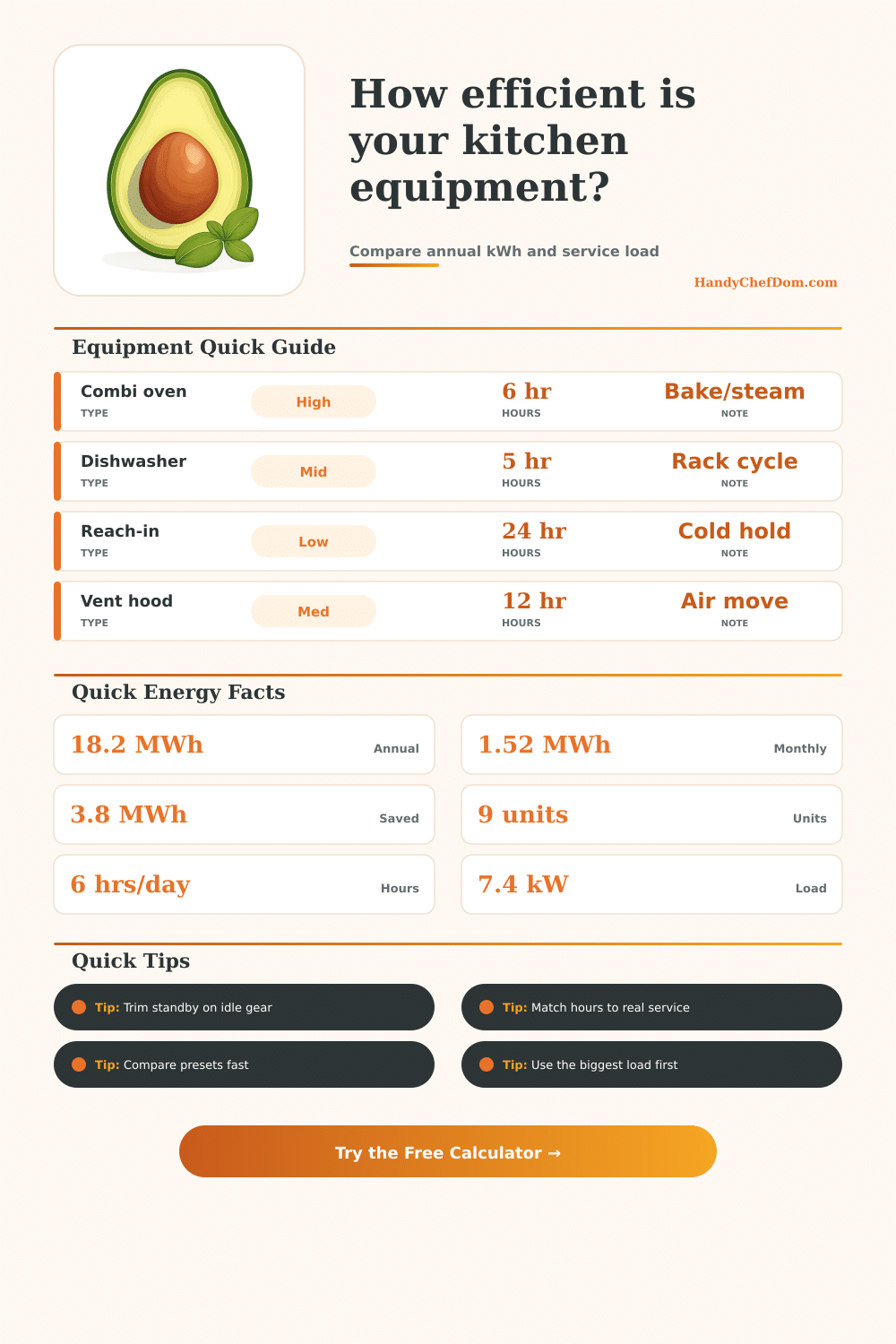
| Reach-in fridge | 300-600 | 24/7 | Cold hold |
| Combi oven | 7000-10000 | 5-8 hr | Steam bake |
| Dishwasher | 2500-4500 | 3-6 hr | Rack wash |
| Vent hood | 700-1500 | 8-14 hr | Air move |
| Band | Active Use | Gain | Best For |
|---|---|---|---|
| Starter | Low | 0-10% | Baseline |
| Qualified | Lean | 10-20% | Busy line |
| High | Tight | 20-30% | Heavy shift |
| Best | Very tight | 30%+ | Top tier |
| Shift | Hours | Load | Pattern |
|---|---|---|---|
| Breakfast | 4-6 | Short | Fast peak |
| Lunch rush | 6-8 | High | Short gaps |
| Dinner | 7-10 | Mixed | Steady use |
| Banquet | 10+ | Heavy | All day |
| Item | Rule | Use | Note |
|---|---|---|---|
| 1 kW | 1000 W | Load | Simple |
| 1 day | 24 hr | Run time | Daily |
| 1 week | 7 days | Schedule | Scale |
| 1 year | 365 days | Annual | Plan |
Many commercial kitchen use a significant amount of electricity. The commercial kitchens contains many machines that use electricity from an electrical grid. Although many peoples believe that the cost of electricity for commercial kitchens is a fixed cost, the cost of electricity is actualy a variable cost because each of the machines in the kitchen can use a different amount of electricity.
For instance, the reach in cooler in a commercial kitchen could require more electricity if it is too close to the roasting oven. Because the roasting oven produce heat, the heat can make the reach-in cooler work harder to maintain it’s temperature. In order to understand how much electricity is used in a commercial kitchen, one must examine each machine’s electrical draw.
How Much Electricity Do Restaurant Machines Use?
Each machine dont use a constant amount of electricity. Thus, the amount of electricity used by a restaurant can fluctuate during the day. One can measure the effective load of each machine to determine how much electricity the machine uses during its operations.
For instance, the combi oven will use more electricity when roasting food than when idling on the low steam setting. One of the biggest problem with wasted electricity in the commercial kitchen is the standby draw of the appliances. Many focus on the maximum wattage of the commercial kitchens appliances.
However, no one consider the electricity that the appliances continuously use while they are in standby mode. One of the appliances that uses a significant amount of standby draw is the reach-in fridge and the ice machines. These appliances must run around the clock.
While the standby draw of one appliance might seem small, the total standby draw of all the appliance in the restaurant can lead to alot of wasted electricity. When determining the electricity draw of the appliances, many people will refer to the nameplate on the appliance to determine its maximum wattage. However, this does not indicate the amount of electricity that will be drawn while in standby mode.
Another way to identify the appliances that use the least amount of electricity is by looking at the Energy Star certification of the appliances. Appliances that has received the Energy Star certification use better insulation and feature better compressors. These features will lead to the appliances using less electricity, especialy wasted electricity.
The percentage of energy saved by appliances that are Energy Star certified will indicate the amount of electricity that the restaurant will save by using these appliances instead of the current ones in use. Although a percentage of energy saved of 10% may seem impressive for some appliances, such as a ventilation hood, the percentage saved by using Energy Star certified appliances could be more greater. In order to decide which appliance to replace in the restaurant, one must calculate the total cost of electricity that is used by each appliance in a year.
Even though a kitchen might desire to replace one of its ovens, if the old oven is only used for a few hours a day, the cost of electricity could be significantly less than if the kitchen replaces its refrigeration bank. By calculating the amount of electricity that each machine use in a year, the kitchen can determine the priority in which they should of replace the appliances. The most expensive appliance to purchase does not necessarily mean it will be the most expensive to operate.
By creating reference tables for each machine in the restaurant, one can determine the duty cycle for each machine. The duty cycle is the measurement of how often the machine performs at its peak electricity usage. According to these reference tables, some of the appliances will have high peak load and long run times.
For instance, the dishwasher will have a high peak load because it will only be used for short periods of time. However, the appliance with the longest run time would be the ventilation hood because it will be in operation for many hours. These can be matched to the restaurants shifts to determine how much electricity each machine will use.
By measuring the electricity that is used by the commercial kitchen, it is possible to shift from managing electricity reactively to managing it predictively. By modeling the electricity usage of the commercial kitchen, restaurants can predict the cost of adding new kitchen appliances or replacing old appliances. For instance, by using predictive management, a kitchen can ask the ventilation hood vendor for a specific percentage of energy savings.
Furthermore, by measuring the electricity that each machine uses, the kitchen can verify if that percentage of energy savings will justify the purchase of those new kitchen appliances. By measuring the electricity use of each machine in the restaurant, the kitchen can determine which machines are the most costly to operate. With this information, the kitchen can manage its electricity more effective.