Food Fiber Calculator
Weigh a meal, compare the fiber total, and keep everyday portions aligned with your daily target in a bright pink workspace.
📌Quick Presets
⚖Calculator Inputs
Start with the closest food entry, then set the weight, servings, and target. The calculator keeps the fiber math visible from bowl to plate.
Fiber summary
These cards update with your chosen food, unit system, goal mode, and planning buffer.
📊Reference Tables
| Food | Fiber | Serve | Note |
|---|---|---|---|
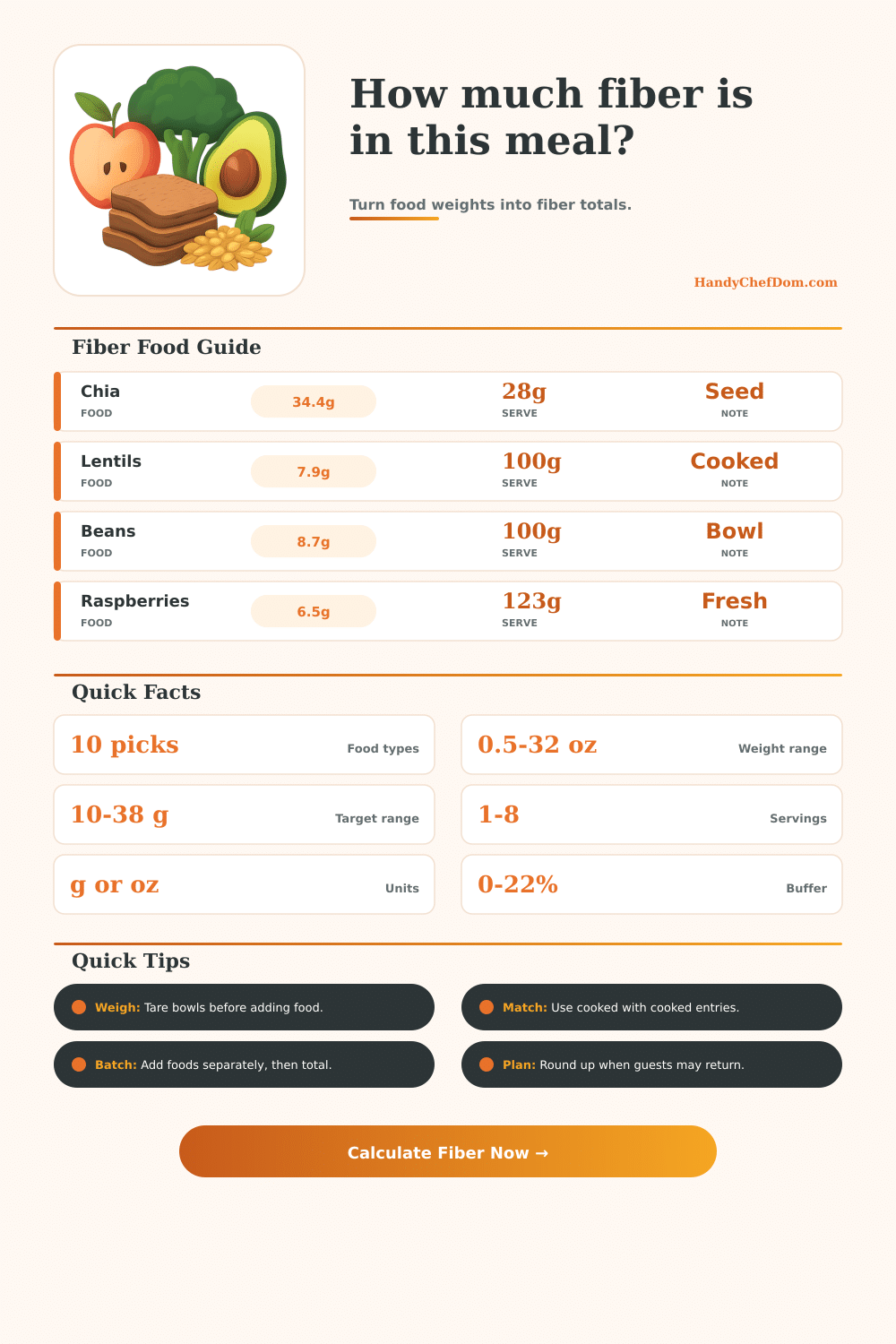
| Chia | 34.4 | 28 g | Seed |
| Oat bran | 15.4 | 40 g | Dry |
| Lentils | 7.9 | 100 g | Cooked |
| Black beans | 8.7 | 100 g | Bowl |
| Food | Fiber | Serve | Note |
|---|---|---|---|
| Raspberries | 6.5 | 123 g | Fresh |
| Avocado | 6.7 | 100 g | Creamy |
| Broccoli | 2.6 | 91 g | Green |
| Apple | 2.4 | 182 g | Skin on |
| Goal | Fiber | Meal | Cue |
|---|---|---|---|
| Women | 25 g | 1-2 | Daily |
| Men | 38 g | 2-3 | Daily |
| Teens | 26-31 g | 1-2 | Growing |
| Kids | 19-25 g | 1-2 | Gentle |
| Preset | Food | Target | Style |
|---|---|---|---|
| Seed Boost | Chia | 25 g | Per serving |
| Bean Salad | Beans | 20 g | Shared bowl |
| Family Tray | Lentils | 30 g | Whole meal |
| Meal Prep | Mix | 22 g | Buffer |
💡Helpful Tips
Use this calculator to translate food weight into fiber grams, compare the meal with daily goals, and choose a portion that feels filling without overloading the plate or prep list.
Fiber is an nutrient that is important for the digestive systems, and fiber is necessary for maintaining steady energy levels in the body. Although many people attempts to consume enough fiber each day, it can be difficult for many individuals to determine if they are consuming enough fiber each day. For instance, an individual may believe that the large salads that they ate contains a high amount of fiber, but the small serving of beans may contain more fiber than that large salad.
Because the amounts of fiber that foods contain can vary so greatly from one food to the next, it is difficult to rely upon the visual estimation of the foods eaten to determine fiber intake. Fiber come in two main types: soluble fiber and insoluble fiber. Soluable fiber has the ability to turn into a gel within the digestive system, and soluble fiber can help to manage the cholesterol levels of the body.
How to Use a Scale and Fiber Calculator
Insoluble fiber does not turn to a gel within the digestive system, but insoluble fiber can help to move the food through the digestive tract. Because we eat foods that contain each of these types of fiber in different concentrations, it is important to measure the food that is eaten to ensure that we are meeting the fiber goals that we have established for ourselves. One of the best methods of measuring the food that is eaten is to use a scale to weigh the foods.
Using a scale to weigh the food removes the guesswork of using different serving sizes for different foods. The fiber calculator performs the mathematical calculations after you have determined the weight of the food. You dont have to remember the tables of fiber content for different foods, as the fiber calculator can calculate these values for you.
In order to use the fiber calculator, it is important that you use the tare function on your scale. The tare function will allow you to subtract the weight of the bowl in which the food is contained. If you do not use this function, you may mistakenly include the weight of the bowl in your weight of the food that you ate.
Food contains different amounts of fiber relative to its weight. The density of fiber within the food is referred to as the fiber density of that food. For instance, foods like chia seeds has high fiber densities, which means that they contain a large amount of fiber within a small weight of that food.
Broccoli, on the other hand, contains a lower fiber density than chia seeds, meaning that it must be eaten in larger weights to provide the same amount of fiber as a small weight of chia seeds. A reference table within the fiber calculator can help you to understand the fiber density of foods. By understanding the fiber densities of foods, you can better decide which foods to eat to help you achieve your fiber goals.
If you are preparing meals for the entire week, you will have to calculate the fiber content of the batch of food that you are preparing, not the fiber content of a single meal. To determine the fiber content of the entire batch, you can divide the total weight of the cooked food by the number of containers of food that you will prepare for your meals. The goal mode on the calculator will allow you to switch between calculating the fiber content of a single serving of food versus preparing meals for the week.
Additionally, you should prepare an extra amount of fiber than that which you calculate for your meals. This extra amount is referred to as a planning buffer. By preparing an extra amount of fiber, you ensure that your portion sizes may end up being larger than you calculate, and you will not fall short of your fiber goal.
In order to increase the amount of fiber that you consume, it is important that you do so gradually. If you increase the amount of fiber that you consume rapidly, you may begin to experience bloating or discomfort within your digestive system. Your goal should be to use your fiber tracking tool to slowly increase the amount of fiber that passes through your digestive system over the course of several weeks, allowing your gut bacteria to adapt to the changes in the type and amount of fiber that you consume.
In addition to increasing the amount of fiber that you consume, you should also increase the amount of water that you drink. Fiber requires water in order to function correct within the human body. If you increase the amount of fiber that you eat but do not drink more water, you may begin to feel heaviness or sluggishness within your digestive system.
To prevent this from happening, ensure that you drink an extra glass of water with each meal that contains high amount of fiber. Through the consistent use of a scale and the use of the fiber calculator, you will eventualy develop an intuition for the amount of fiber that is contained in the foods that you eat.