🍳 Recipe Ratio Converter
Scale a recipe from one yield to another, convert a single ingredient amount, and keep practical kitchen rounding visible before you cook.
Use original servings and target servings when you know the recipe yield. The converter will calculate the ratio and scale the ingredient you enter.
For a smaller test batch.
For meal prep or guests.
For parties or freezing.
Your current target amount.
| Goal | Ratio | Example | Kitchen note |
|---|---|---|---|
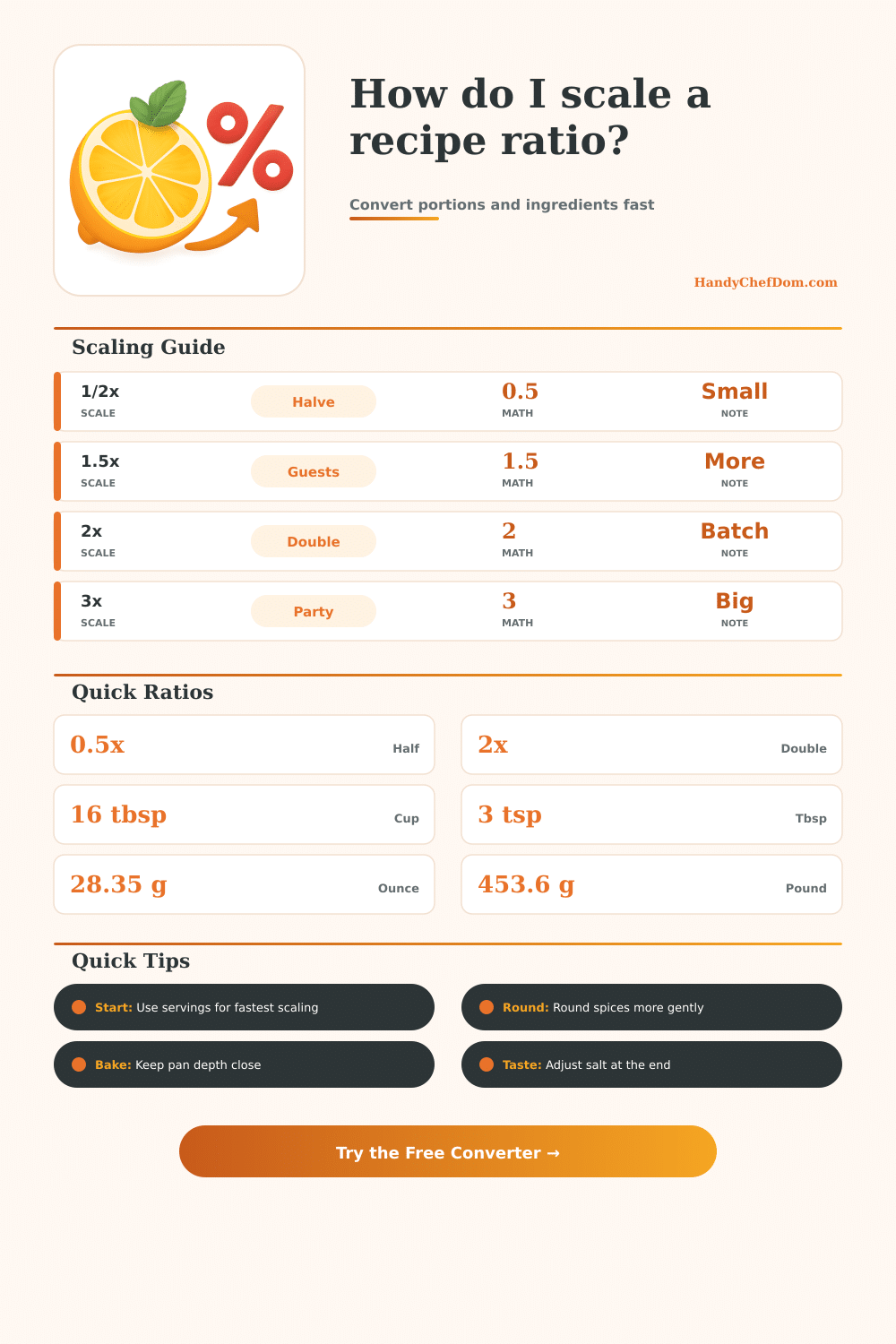
| Half batch | 0.5x | 4 servings to 2 | Good for testing a new recipe before committing ingredients. |
| One and a half | 1.5x | 4 servings to 6 | Useful when two extra people join dinner. |
| Double batch | 2x | 6 servings to 12 | Usually easy for soups, sauces, stews, grains, and roasted vegetables. |
| Party batch | 3x | 8 servings to 24 | Check bowl size, pan size, cooling room, and storage space first. |
| Ingredient match | target / current | 3 cups flour to 5 cups | Handy when you want to use up a partial bag or package. |
| Decimal | Fraction | Cups | Spoons |
|---|---|---|---|
| 0.125 | 1/8 | 1/8 cup | 2 tbsp |
| 0.25 | 1/4 | 1/4 cup | 4 tbsp |
| 0.333 | 1/3 | 1/3 cup | 5 tbsp plus 1 tsp |
| 0.5 | 1/2 | 1/2 cup | 8 tbsp |
| 0.667 | 2/3 | 2/3 cup | 10 tbsp plus 2 tsp |
| 0.75 | 3/4 | 3/4 cup | 12 tbsp |
| 1 | 1 | 1 cup | 16 tbsp |
| Measure | Teaspoons | Tablespoons | Milliliters |
|---|---|---|---|
| 1 teaspoon | 1 | 0.333 | 4.93 ml |
| 1 tablespoon | 3 | 1 | 14.79 ml |
| 1/4 cup | 12 | 4 | 59.15 ml |
| 1/2 cup | 24 | 8 | 118.29 ml |
| 1 cup | 48 | 16 | 236.59 ml |
| 1 quart | 192 | 64 | 946.35 ml |
| Measure | Grams | Ounces | Best use |
|---|---|---|---|
| 1 ounce | 28.35 g | 1 oz | Small weight conversions and garnish portions. |
| 4 ounces | 113.4 g | 4 oz | Butter sticks, cheese, chocolate, and meat portions. |
| 8 ounces | 226.8 g | 8 oz | Common package size for many dairy ingredients. |
| 1 pound | 453.6 g | 16 oz | Batch cooking, proteins, flour bags, and produce. |
| 1 kilogram | 1000 g | 35.27 oz | Large batch planning or bakery formulas. |
This converter is designed for home kitchen planning. For canning, candy making, preserving, medical diets, and commercial food production, follow tested formulas and food safety guidance rather than freely scaling acid, sugar, salt, or processing time.
A recipe ratio converter is a tool that allow you to convert the amount of food that a recipe will make. You will want to use a recipe ratio converter if the number of servings that a recipe will make dont match the number of people who will be eating the recipe. A recipe ratio converter allows you to input the number of servings that a recipe will originally make and the number of servings that you would like to make.
Based off these two numbers, the recipe ratio converter will calculate a multiplier. The recipe ratio converter can also allow you to input the amount of one ingredient that you would like to use in the recipe. Based upon the amount of that ingredient, the recipe ratio converter will calculate the amount of each ingredient that should be used in the recipe in order to maintain the proper ratio of ingredients.
How to Use a Recipe Ratio Converter
There are different ways to utilize a recipe ratio converter. One way is by using the servings to servings method, which requires the recipe ratio converter to know the number of people that the recipe will originally serve and the number of people that you would like to serve. Another way to use a recipe ratio converter is with the direct multiplier method, which is used if the recipe itself states that it should be doubled or increase by some other number of servings.
Finally, the recipe ratio converter could be used in the ingredient matching method, which is used to calculate the amount of each ingredient needed in a recipe if the amount of only one ingredient is known. Some recipe ratio converters include settings to allow for food loss and rounding styles. Food loss is an important setting to include because some of the food will be lost during the cooking process.
For instance, some of the sauce may stick to the spoon with which it was measured, or some of the liquid may evaporate during simmerming. Rounding styles allow for the recipe ratio converter to display the values in a variety of formats. For instance, the recipe ratio converter can display the numbers in exact decimals, though this may be difficult in measuring the ingredients.
Alternatively, the recipe ratio converter can calculate the ingredients to use kitchen-friendly measurements instead. Additionally, the recipe ratio converter can account for the fact that salt and spices does not always scale linearly with the rest of the recipe. When scaling a recipe, it is common to also scale the amounts of salt and spices with the rest of the ingredients.
However, scaling these ingredients linearly may lead to the prepared food having too much salt or spice. Therefore, the recipe ratio converter may allow for gentle scaling of these ingredients to prevent them from being too strong in the scaled recipe. The recipe ratio converter would be able to inform the chef that some adjustment of the spices may be necessary before cooking the food, but it cant taste the food to ensure that the seasoning is appropriate.
Another factor that a recipe ratio converter cannot account for are the types of pans and burners that will be used to cook the food. However, a recipe ratio converter may include information that alerts the chef that some adjustments will need to be made to the cook settings. For instance, if deeper pans are to be used for cooking, the center of the food will take longer to cook than the edges of the food.
Additionally, if the recipe is to be cooked in larger volumes, such as soup in a large pot, the heat will take longer to reach the simmer level. Therefore, the cook must adjust the cooking times for the food based on the size of the recipe. Another group of tables that may be included in a recipe ratio converter include tables of volume and weight measurements.
Volume tables allow the chef to decide whether they would like to use metric measurements or imperial measurements for the recipe. For instance, the chef may select liters over gallons, or milliliters over fluid ounces. A weight table allows the chef to understand the weight of the various ingredient in the recipe.
For instance, four ounces of butter may weigh differently than four ounces of flour. These tables allow the recipe ratio converter to work in conjunction with the physical tools that may be in the kitchen. A recipe ratio converter must be used with some judgment.
For instance, some ingredients do not readily scale well to other amounts. An ingredient like yeast is not easily doubled in amount if the recipe is doubled in size. The yeast will hold heat differently in a doubled batch of dough.
While liquids will often scale well in amount, the amount of time that is required to reduce a soup that is doubled in size may need to be increased in order to thicken the liquid to the desired strength. Additionally, other factors related to preparation of the recipe should be considered with the use of a recipe ratio converter. For instance, a larger recipe may require more freezer space to prepare the food in advance, or more serving dish may be required to allow the prepared food to be served.
Additionally, a larger recipe may require a larger mixing bowl. Additionally, cooking a larger casserole in a deep dish will result in the casserole taking longer to cool than if the same amount of food were cooked in two shallow dishes. The recipe ratio converter should be used prior to beginning to prepare the food.
By running the numbers with the recipe ratio converter prior to beginning to cook the food, a chef can decide if the recipe of that size is worth the additional time and cleanup that it may require. Finally, the recipe ratio converter allows the chef to alter the recipe to fit the chef’s needs, rather than forcing the chef’s meal preparations to fit the original recipe card.