Catering Food Quantity Calculator
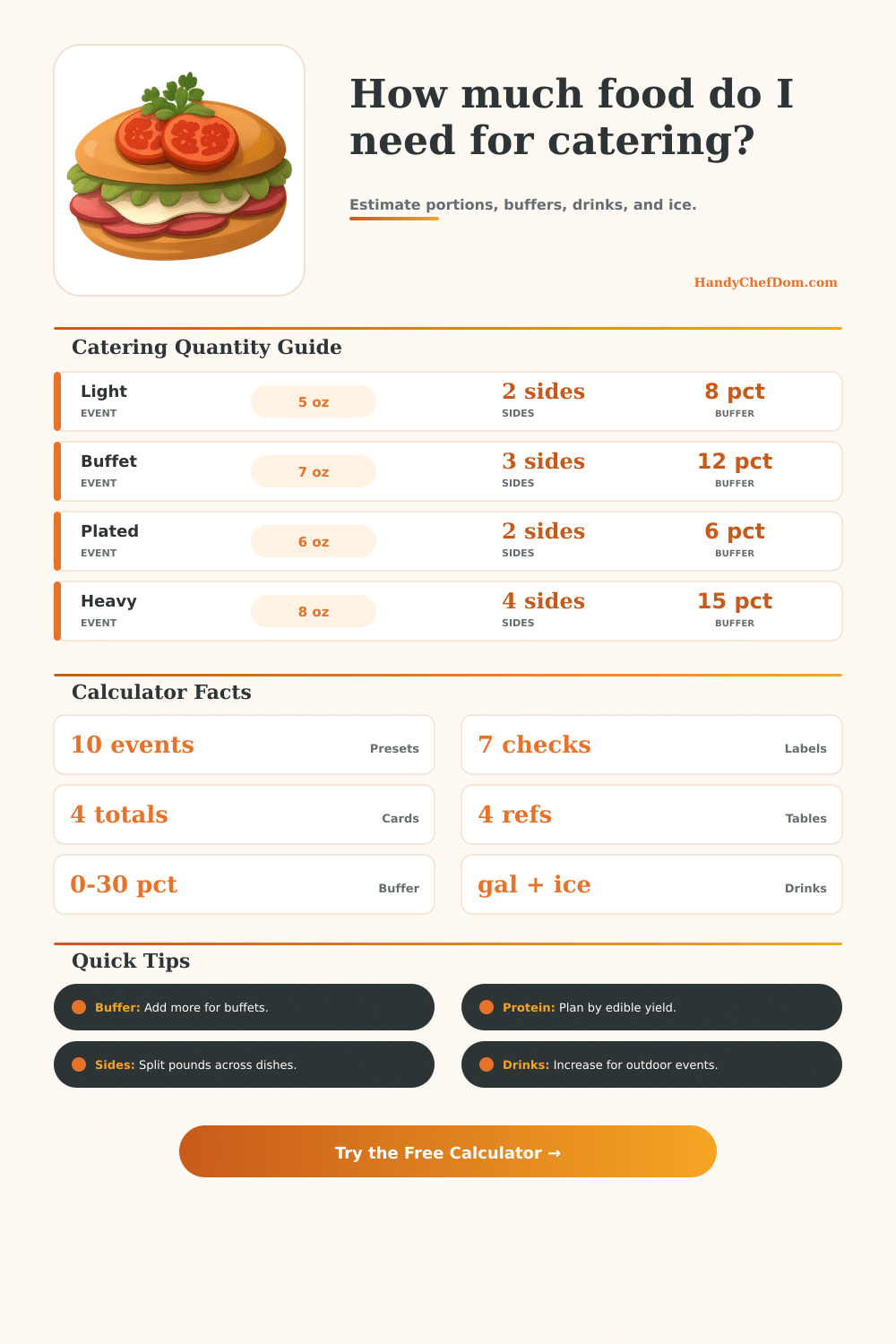
Plan how much food to order or prepare for a catered event with realistic portions, buffet safety buffers, protein yield, side dish splits, appetizers, dessert, beverages, and ice.
Choose a starting event or enter your own plan. The calculator separates edible portions from purchased weight so buffet trays, proteins, sides, and drinks are easier to sanity-check.
Your catering quantity plan
Best when portions are controlled by the kitchen or serving team.
Guests serve unevenly, so pans need visible backup and extra sides.
Use more appetizer pieces when there is no full dinner plate.
Heat, games, and long service increase beverages and ice first.
| Event style | Entree edible oz | Sides total oz | Best buffer |
|---|---|---|---|
| Cocktail hour only | 0 to 3 oz | 0 to 4 oz | 12 to 18 pct, mostly in bites. |
| Light lunch | 4 to 5 oz | 5 to 7 oz | 8 to 12 pct for sandwiches, salads, and bowls. |
| Classic buffet | 6 to 7 oz | 8 to 10 oz | 10 to 15 pct because guests self-serve. |
| Plated dinner | 5 to 7 oz | 6 to 8 oz | 5 to 8 pct with controlled portions. |
| BBQ or feast | 7 to 9 oz | 10 to 14 oz | 12 to 18 pct for seconds and grazing. |
| Dessert reception | 0 oz | 0 to 2 oz | 10 to 15 pct in sweets and coffee. |
| Protein | Typical yield | Buy more when | Planning note |
|---|---|---|---|
| Chicken pieces | 68 pct | Bone-in pieces or mixed sizes | Good buffet default because it portions cleanly. |
| Beef roast or steak | 72 pct | Trimming or carving loss is high | Slice thinly for buffets to protect the count. |
| Pulled pork | 60 pct | Bone-in shoulder or long holding | Sauce and buns can stretch perceived portion size. |
| Fish fillet | 82 pct | Skin removal or delicate plating | Plan tighter timing because leftovers are less flexible. |
| Pasta main | 95 pct | Guests expect it as the main dish | Use cooked weight thinking, not dry pasta alone. |
| Vegetarian main | 90 pct | It is the only hearty option | Add beans, tofu, eggs, or cheese for staying power. |
| Side category | Adult portion | Quart estimate | Best use |
|---|---|---|---|
| Potato, pasta, or rice side | 4 to 5 oz | 1 qt feeds about 5 to 6 | Reliable buffet anchor with good holding quality. |
| Cooked vegetables | 3 to 4 oz | 1 qt feeds about 6 to 8 | Keep crisp vegetables slightly underdone before holding. |
| Green salad | 2 to 3 oz | 1 qt feeds about 4 to 5 | Dress lightly or serve dressing separately. |
| Fruit salad | 3 to 4 oz | 1 qt feeds about 5 to 6 | Add close to service so it does not weep. |
| Bread or rolls | 1 to 2 pieces | Not quart based | Order extra for saucy mains and BBQ. |
| Condiments and sauces | 1 to 2 oz | 1 qt gives 32 oz | Put backups behind the line to avoid waste. |
| Item | Starting amount | Increase for | Practical check |
|---|---|---|---|
| Nonalcoholic drinks | 2 to 3 cups per adult | Heat, spicy food, long events | One gallon gives 16 eight-ounce servings. |
| Coffee | 1 cup per adult | Breakfast, dessert, meetings | Keep decaf and hot water separate if possible. |
| Ice for drinks | 1 lb per guest | Outdoor service or coolers | Separate clean drink ice from chilling ice. |
| Full-size steam pan | Usually 15 to 25 servings | Dense sides or heavy portions | Use smaller pans for premium proteins. |
| Appetizer trays | 50 to 75 bites each | Passed service or no dinner | Stagger trays so they look fresh. |
| Dessert trays | 36 to 60 pieces each | Mini sweets or mixed bars | Label nuts, dairy, and gluten clearly. |
How this catering calculator thinks
The calculator starts with effective guest count: adults count fully, kids count partially, and staff meals count lightly unless you choose a very generous plan. It then applies the meal style, service format, and leftover goal before converting edible protein portions into purchased weight.
For sides, appetizers, desserts, drinks, and ice, it gives practical order quantities instead of a single mystery total. Use the breakdown to discuss tray counts, backup pans, and refill timing with a caterer or kitchen team.
When planning a catered meal, you must balance the amount of foods that you will provide to the guests with the amount of food that you dont want to waste. You want to provide enough for every guest to be satisfied, yet you also do not want to provide too many food to your guests that will result in too many leftovers. Many people use they’re instincts to plan the number of portions that they will prepare for their guests.
However, using instincts can result in inaccuracy, partcularly if the number of guests change or if the style of service for the meal changes. The style of service for the meal can impact the amount of food that the guests consume. For example, plated dinners are a type of service style in which the kitchen prepares a specific amount of foods to be placed on each plate.
How Much Food to Make for a Catered Meal
In this type of dinner, the food can be portioned to ensure that there is a small margin of error in relation to the amount of food that will be consumed by the guests. However, buffet style dinners allow the guests to serve themself. Therefore, the guests who arrive at the buffet line first may consume more food than those who arrive later in the meal.
Thus, the cook may need to make the preparation of backup food for proteins, sides and salads. In addition to the number of guests that will attend the dinner, the amount of food that must be prepared also needs to account for the number of child and staff members that will be eating at the dinner. Children typically eat smaller portions than adults, yet they may eat the same number of sides and desserts as adults.
Additionally, although the staff may eat the same type of simple boxed meals, those meals must still be accounted for in the food calculations to ensure that the buffet does not dry up before all of the table have been served. Calculators are available that account for the number of adult portions that is equivalent to a specific number of children. These types of calculators can make it so that you no longer have to perform mental math calculations regarding the number of children and staff members that will be attending the dinner.
The weight of the protein that is purchased will not necessarily be the same as the weight of the protein that is served to the guests. The protein will lose some of its weight due to the presence of bone in the protein, due to the trimming of the protein, and due to the shrinkage of the protein during the cooking process. If you do not account for this protein yield when calculating the amount of protein that you need for the guests, you may not have enough protein for all of the guests.
The protein yield can vary depending on the type of protein that will be prepared, such as chicken pieces or pulled pork. The pounds of side dishes that will be prepared must also be accounted for. For example, if there are three side dish that will be prepared, some side dishes may be more important than others.
Additionally, some side dishes retain their temperature better than other side dishes when they are prepared on a steam tray. Some side dishes may be more important than others in relation to any dietary restrictions of the guests that will attend the dinner. Calculators are available that can calculate how much weight of side dishes must go into each of the side dish that will be prepared for the guests.
The preparation of appetizers and desserts can require different calculation from the other dishes of the dinner. For instance, dinners that include cocktail hours may include more appetizers and servings of food than dinners that do not include cocktail hours. Additionally, guests may eat more meatballs during a standing reception than they will eat slice of cake during a seated dinner.
Tools are available that can calculate the number of servings of appetizers and desserts based on the type of dinner that will be prepared. In addition to the food that will be prepared, the number of drink and the amount of ice that will be prepared for the guests must be planned. Particularly for outdoor events, guests will consume more drinks and ice due to the increased temperature of the outdoor environment and the length of time that guests will be at these events outdoors.
Ice will be used to chill the drinks and to keep the backup food item cold. Therefore, planning for ice is essential to ensure that there is enough ice available at the drinks station to chill the guests beverage. Some of the most common mistake in catering events are treating each event as if they are the same.
For instance, a backyard barbecue may require a larger buffer amount of food than a lunch that lasts for only one hour. Additionally, weddings may require more food to be prepared for the guests due to the gap between the wedding ceremony and the dinner. The calculators allow for the service format and the amount of food that is left over to be changed to account for these and other variable.
It is recommended that the food caterer runs the calculations twice to ensure that the catering plan is accurate. The cook can first perform the calculations according to the ideal catering plan for the host, and then the cook can perform the calculations a second time with alternative service styles for the catered meal. By running the calculations twice, the caterer can determine whether he or she will need to alter the amount of protein or the amount of ice that will be prepared for the guests.
The goal of the catering chef in planning the food for the guests is to ensure that there is enough food for the last guest to eat, yet there is not too much food that will be left over for the caterer to clean up after the guests have finished eating.