🧂 Brine Salinity Calculator
Build a precise kitchen brine by weight, volume, salt type, food weight, sugar, buffer, and brining style.
Use weight whenever possible. Cover brines salt only the liquid, equilibrium brines salt the food and liquid together, and injection brines size salt to the injected liquid.
| Food | Salt | Time | Cue |
|---|---|---|---|
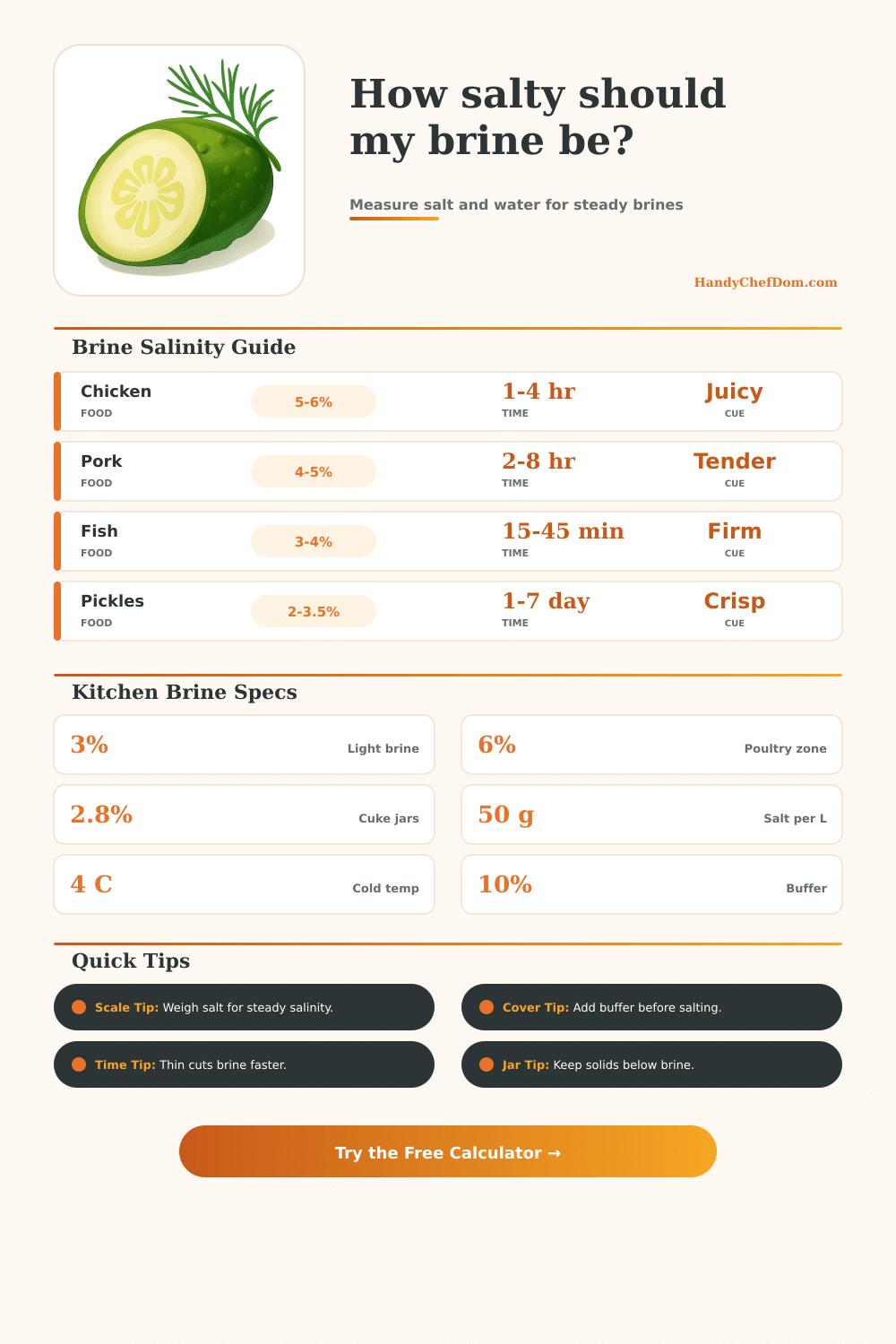
| Chicken | 5-6% | 1-4 hr | Juicy |
| Turkey | 5-8% | 8-24 hr | Deep |
| Pork | 4-5% | 2-8 hr | Tender |
| Fish | 3-4% | 15-45 min | Firm |
| Shrimp | 2-3% | 15-30 min | Snappy |
| Cucumber | 2-3.5% | 1-7 day | Crisp |
| Veg mix | 2-3% | 2-10 day | Bright |
| Feta tofu | 5-8% | Hold | Seasoned |
| Salt | g/tbsp | g/cup | Best use |
|---|---|---|---|
| Diamond | 8.5 | 136 | Meat |
| Morton kos | 15 | 240 | Meat |
| Table | 18 | 288 | Small jar |
| Fine sea | 18 | 288 | Pickles |
| Pickling | 19 | 304 | Clear brine |
| Coarse sea | 10 | 160 | Light cup |
| Method | Math | When | Risk |
|---|---|---|---|
| Cover | Water only | Fast meat | Oversalt |
| Equil | All weight | Long rest | Slow |
| Pickle | Jar brine | Veg | Dilution |
| Inject | Injected | Roasts | Pockets |
| Hold | Liquid | Cheese | Dry edge |
| Quick | High pct | Seafood | Rubbery |
| Jar item | Salt | Acid | Note |
|---|---|---|---|
| Cucumber | 2-3.5% | 0-50% | Crisp |
| Carrot | 2-3% | 0-40% | Crunch |
| Chili | 3-5% | 0-20% | Stable |
| Olive | 6-10% | 0-10% | Firm |
| Feta | 6-8% | 0% | Hold |
| Egg | 5-8% | 20-50% | Tangy |
Brining use salt and liquid to change how meat and vegetables holds water. When meat is brined, the salt move into the meat via osmosis. Osmosis is a process of salt moving from the liquid to the meat.
As the salt move into the food, it changes how the proteins in that food hold onto water. Thus, properly made brines will make chicken more juicier, but poorly made brines could make the chicken too salty. Brining salt by weight instead of volume will offer more accurate results because different types of salt has different weights.
How to Brine Food
You must choose the type of brining that will work best for the food you will be treating. There are four main types of brining: cover wet brines, cover wet brines are fast methods for salting chicken thighs and pork chops. Equilibrium brines use the weight of the food in the brine, and is used for items like turkeys or large roasts.
The salt will even out throughout the food. Injection brines use salt to calculate the amount of liquid that gets injected into the meat. A pickle jar brine add extra liquid to submerge the vegetables in the brine.
Each type of brine use a different amount of salt to achieve the same salinity. The type of salt you use can have an impact on your brining because the different types of salt has different weights. For instance, fine table salt weighs more than coarse kosher salt.
A brine calculator will convert the percentage of salinity to grams because grams is a measurement of weight instead of volume. You can add sugar and acid to your brine. Sugar balance out the salt in the brine, and helps the food to brown.
Acid add tang to the brine, and slows the growth of bacteria. These ingredients are measured in percentages of the volume of the brine. Calculating these percentages according to the volume of the brine ensures that the flavor of the brine remains the same, regardless of the amount of the food you are brining.
You should ensure that the food gets covered in the brine with a coverage buffer. A coverage buffer ensures that the food remains covered in the brine. Adding ten or fifteen percent extra liquid to your brine ensures that your food remain covered in the brine.
If the food is not covered in the brine, it could develop mold on the food. You will lose a portion of the brine when you drain the food of the brine. A drain loss buffer to the brine account for this loss.
Another factor to consider during brining is temperature and time. If you are using warm water to brine the food, the salt will move through the liquid faster. Warm liquids is a safety hazard though, so it is necessary to keep the brine at a refrigerator temperature.
A short brine in cold water will preserve the texture of shrimp, but the same brining process for a turkey breast will lead to mushy turkey if the temperature of the brine is too high. The length of time that food is brined should be relative to the typical time range for that type of food. People often make mistakes when brining by using weight measurements for salt instead of volume measurements.
For instance, a five percent salinity brine may taste much stronger after the food is done brining because the remaining liquid concentration is higher. An equilibrium brine avoid this problem by treating the weight of the food as part of the salt calculation. However, a cover brine do not consider the weight of the food, which means the salinity will be much stronger for food than if the brine was only calculated according to the volume of the brine.
Brining vegetables works in the same way as brining meat. The vegetables will displace some of the liquid from the brine. This means that the vegetables will lower the salinity of the brine.
In pickling, a buffer percentage is added to the brine to account for the displacement of the vegetables. An acid field is used to find the correct amount of vinegar and salt to use in the brine. Reference tables lists the amount of salinity that should be applied to different vegetables.
To use this process, you must first determine the food that you will brine. The type of brine will depend on the amount of time you have to brine the food. Weights and volumes of ingredients is entered into a brine calculator, which will convert the type of salt into the appropriate units.
The brine calculator will tell you the amount of grams of salt, the amount of liquid after the buffer amount is added, and a cue that will tell you if the salinity and time for brining is appropriate for the ingredient that you are using. You can also use this recipe to add sugar and acid to the brine to adjust the flavor. You can adjust the buffer if the container that you are brining the food in is not of the same size as the recipe states.
Once you have successfully used this brine recipe for your food, you can scale the recipe however many time you like.