🍾 Champagne Calculator
Estimate bottles, pours, flute size, service style, event hours, buffer, and alcohol totals for a toast or full reception.
Use toast mode for one ceremonial pour, reception mode for ongoing service, or combined mode when the same event needs both.
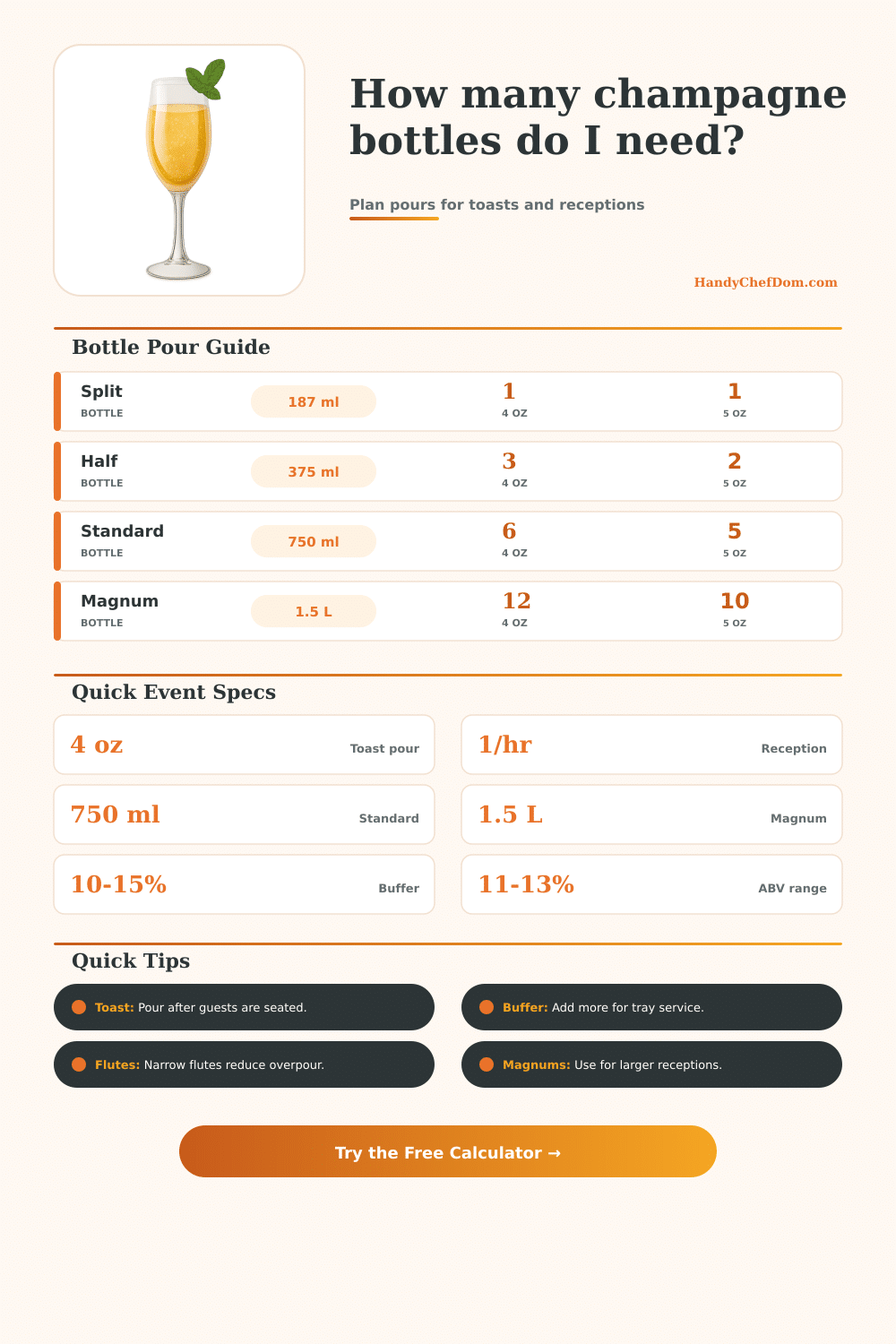
| Bottle size | Volume | 4 oz pours | 5 oz pours |
|---|---|---|---|
| Split | 187 ml | 1 flute | 1 flute |
| Half bottle | 375 ml | 3 flutes | 2 flutes |
| Standard | 750 ml | 6 flutes | 5 flutes |
| Magnum | 1.5 L | 12 flutes | 10 flutes |
| Jeroboam | 3 L | 25 flutes | 20 flutes |
| Methuselah | 6 L | 50 flutes | 40 flutes |
| Event style | Typical pour plan | Suggested pour | Buffer cue |
|---|---|---|---|
| Toast only | 1 pour per guest | 3.5 to 4 oz | 8 to 12% |
| Short reception | 0.7 pour per hour | 4 oz | 10 to 15% |
| Full reception | 1 pour per hour | 4 to 5 oz | 12 to 18% |
| Dinner pairing | 0.5 to 0.75 per hour | 3.5 to 4 oz | 8 to 12% |
| Brunch bubbles | 0.6 to 0.8 per hour | 3 to 4 oz | 12 to 18% |
| Countdown toast | 1 to 1.5 pours | 4 oz | 15 to 20% |
| Guests | Toast only | 2 hour reception | 3 hour reception |
|---|---|---|---|
| 20 guests | 4 bottles | 7 bottles | 10 bottles |
| 40 guests | 8 bottles | 14 bottles | 20 bottles |
| 60 guests | 12 bottles | 21 bottles | 30 bottles |
| 80 guests | 16 bottles | 28 bottles | 40 bottles |
| 100 guests | 20 bottles | 35 bottles | 50 bottles |
| 150 guests | 30 bottles | 53 bottles | 75 bottles |
| Flute size | Best use | 750 ml yield | Service note |
|---|---|---|---|
| 3 oz | Small toast | 8 pours | Best for speeches |
| 3.5 oz | Tray service | 7 pours | Easy to carry |
| 4 oz | Classic toast | 6 pours | Most flexible |
| 4.5 oz | Reception | 5 pours | Generous feel |
| 5 oz | Dinner service | 5 pours | Fewer refills |
| 6 oz | Large coupe | 4 pours | Use with care |
To plan for champagne at an event, there are many different variable that must be accounted for in the planning process because many different variables will affect the total amount of champagne that is require for the event. Variables to consider include the number of guests who will attend the event, the length of the event, the style of service for the champagne, the size of the champagne flute that will be used at the event, and the amount of champagne that should be poured into each flute. Failure to account for each of these variables may lead to either not having enough champagne to provide to each guest, or providing too much champagne to guests and leaving overmuch champagne at the event.
The calculator that is provide will allow you to enter each of these different variables, after which the calculator will determine the total number of bottles of champagne that should be purchased for the event. The first of the variables that you must enter are the service style for the champagne. For example, if the event include a banquet or an wedding ceremony, the service style will likely be a ceremonial toast.
How to plan champagne for an event
In this case, there will only be one pour of champagne per guest. However, if the event is a reception, the service style will likely be a reception because guests may want multiple serving of champagne during the event. The style of service will change the hourly pour rate for the champagne at the event.
The next variables that you must enter are the fill style and flute size. For example, if the flute size is a narrow flute, it can hold less champagne than a wide flute. Additionally, if the fill style is a light pour of champagne, there will be less champagne in each flute than if a generous pour was selected.
Both of these factors will impact the total amount of bottles of champagne that are required for the event. The calculator will adjust for this variable so that you dont have to calculate the number of bottles of champagne yourself. A buffer percentage is another variable that must be entered into the calculator.
During the event, some champagne may be wasted. For example, guests may abandon there flute of champagne halfway through the event. Additionally, the server may pour a heavy amount of champagne into each flute.
Additionally, there may be an unexpected number of guests that show up to the event. To account for these variables, it is recommended that you add a buffer of ten or fifteen percent to the total number of bottles of champagne that is calculated. The tool will add this percentage to the total number of bottles that is calculate by the tool.
Another variable that can be selected are the different sizes of the bottles of champagne. For example, bottles of champagne come in sizes smaller than 750 ml, such as 375 ml bottles. However, other bottles may be larger size, such as magnum bottles.
Each size of bottle contain a different number of servings of champagne. For example, a 750 ml bottle may contain 12 servings of champagne, whereas a magnum bottle may contain 15 servings. Each bottle size comes with a table that shows the number of servings of champagne that each bottle size will provide.
Larger bottles may be purchased for guests who are attending the event in large groups because larger bottles will stay fresh for a longer period of time after they are opened. The alcohol content of the champagne is another variable that you may wish to consider when planning for champagne at the event. Most champagne has an alcohol content between 11% and 13%.
The alcohol content of champagne may be important to consider if the event will last for many hour at the event. The alcohol content will help determine the total alcohol load that the guests who attend the event will consume. Another variable that may be important is the percentage of guests who will drink champagne at the event.
Not all guests at the event will necessarily drink champagne. The percentage of guests who will drink champagne can be entered into the calculator so that an accurate estimation of the total amount of champagne that will be need at the event. For example, if the event is a corporate event that include guests who will not drink champagne, the percentage of guests who will drink champagne may be lower then at an event that is for friends.
Finally, there are tables included in the calculator that help compare different scenarios. The tables illustrate the different options for bottles sizes and event styles. These tables can help you to decide what variables will create the changes in the number of bottles of champagne that are needed for the event.
For example, the tables can illustrate what changes in the length of the event will create changes in the number of bottles of champagne that will be needed. Additionally, the tables can show the changes in the number of bottles of champagne that will be needed if the number of guests changes. Thus, while the champagne calculator can help to provide you with the mathematical start to planning for champagne for your event, you will need to use your own judgement to plan for the champagne service at the event itself.