🍞 Fresh Yeast to Instant Yeast Converter
Convert fresh, active dry, instant, and osmotolerant yeast while adjusting for dough weight, sugar, fermentation time, temperature, hydration, and enrichment.
Enter the yeast you have and the yeast you want. Dough settings estimate whether the converted amount is likely light, balanced, or strong for your rise time and kitchen temperature.
| Starting Yeast | To Instant Yeast | To Active Dry Yeast | To Fresh Yeast | To Osmotolerant Yeast |
|---|---|---|---|---|
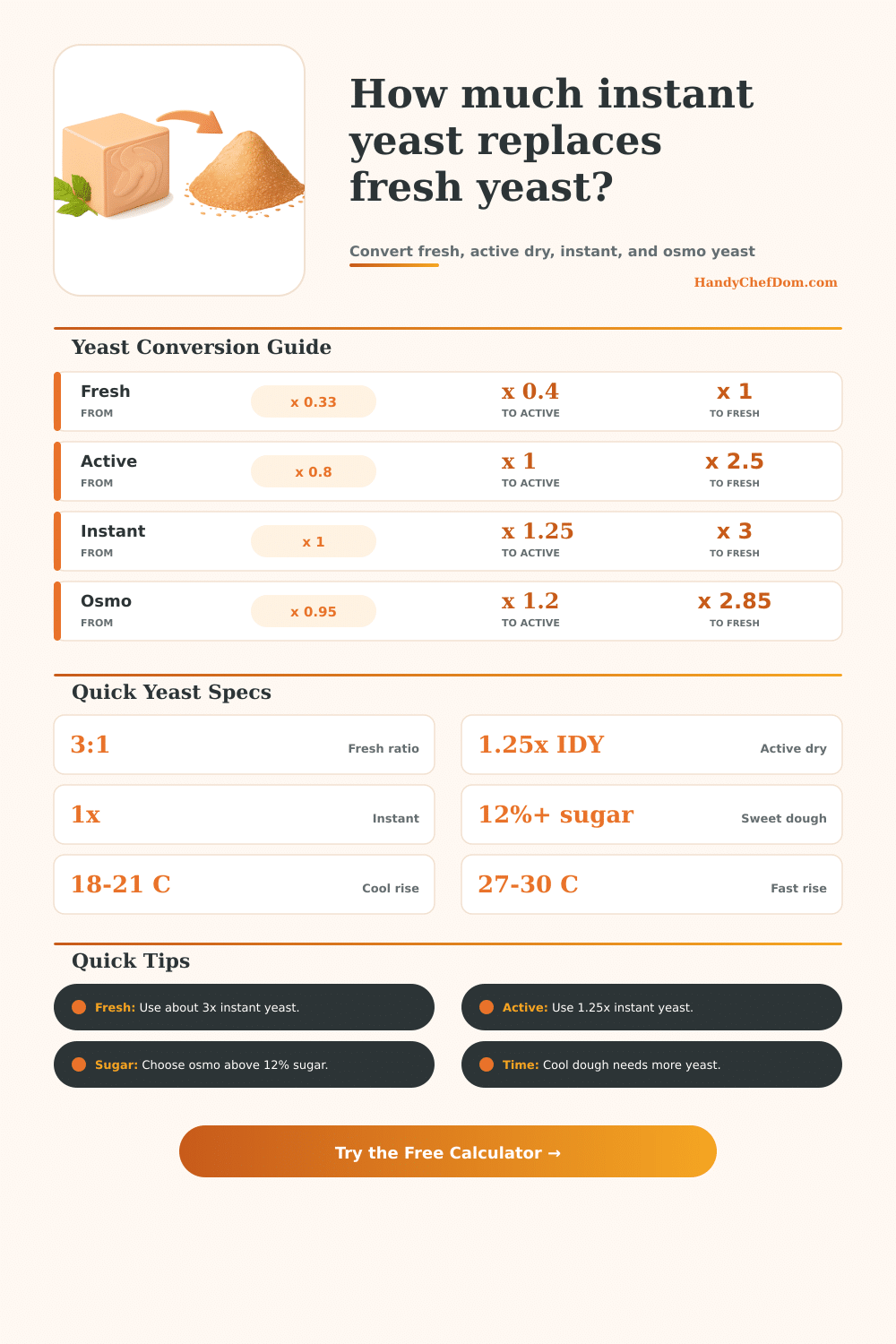
| Fresh compressed yeast | multiply by 0.33 | multiply by 0.40 | same amount | multiply by 0.35 in sweet dough |
| Active dry yeast | multiply by 0.80 | same amount | multiply by 2.50 | multiply by 0.83 in sweet dough |
| Instant yeast | same amount | multiply by 1.25 | multiply by 3.00 | multiply by 0.95 in sweet dough |
| Osmotolerant instant yeast | multiply by 0.95 for lean dough | multiply by 1.20 | multiply by 2.85 | same amount |
| One 0.25 oz dry packet | about 7 g instant | about 7 g active dry | about 21 g fresh | about 7 g osmo |
| Dough Style | Instant Yeast Range | Fresh Yeast Range | Typical Time | Use Note |
|---|---|---|---|---|
| Cold pizza dough | 0.05% to 0.25% | 0.15% to 0.75% | 18 to 72 hr | Long, cool flavor build |
| Lean bread | 0.4% to 0.8% | 1.2% to 2.4% | 3 to 6 hr | Balanced same day rise |
| Fast sandwich loaf | 0.8% to 1.5% | 2.4% to 4.5% | 1.5 to 3 hr | Quicker proofing window |
| Soft enriched bread | 0.8% to 1.8% | 2.4% to 5.4% | 2.5 to 5 hr | Fat slows fermentation |
| Sweet roll dough | 1.2% to 2.5% | 3.6% to 7.5% | 3 to 6 hr | Higher sugar slows yeast |
| Very sweet dough | 1.5% to 3.0% | 4.5% to 9.0% | 4 to 10 hr | Osmotolerant helps |
| Sugar Level | Regular Yeast Impact | Osmotolerant Impact | Best Target | Adjustment Cue |
|---|---|---|---|---|
| 0% to 5% | Normal activity | Not needed | Instant yeast | No sugar bump |
| 6% to 12% | Slightly slower | Optional | Instant or osmo | Add a small margin |
| 13% to 20% | Noticeably slower | Helpful | Osmotolerant | Use sweet dough mode |
| 21% to 30% | Strong slowdown | Preferred | Osmotolerant | Plan a longer rise |
| 31% to 45% | Can struggle | Strongly preferred | Osmotolerant | Use gentle warmth |
| Fermentation Temperature | Fermentation Pace | Yeast Direction | Typical Use | Calculator Signal |
|---|---|---|---|---|
| 4 C / 39 F | Very slow | Use far less for long rests | Retarded pizza or baguette | Cold factor rises for short targets |
| 18 C / 64 F | Slow | Use a little more for same day | Cool kitchen dough | Higher time-temp factor |
| 24 C / 75 F | Baseline | Use standard formula | Room temp proofing | Near 1.00 factor |
| 29 C / 84 F | Fast | Use less yeast for control | Warm proof box | Lower time-temp factor |
| 32 C / 90 F | Very fast | Reduce yeast or shorten time | Rich dough proofing | Fast cue likely |
Yeast activity varies by brand, age, dough temperature, salt, sugar, and mixing method. Treat the recommendation as a proofing target and adjust with dough observation.
As an ingredient for baking, yeast are a living organism that responds to the environment. Therefore, the amount of yeast that is needed for baking recipes will change with the conditions of the dough being made. Although many recipes may state that the fresh yeast can be swapped for instant yeast, the fresh yeast contain a high amount of water.
Thus, a larger weight of fresh yeast must be used to provide the same lifting power as an instant yeast with a smaller weight. Consequently, the weight of fresh yeast cannot be directly swapped for the weight of instant yeast without also considering the other ingredient of the dough. The environment in which the dough is made will change how the yeast performs within the dough, which changes the amount of yeast that is needed to prepare the dough.
How Much Yeast to Use in Baking
For instance, ingredient like sugar will slow the fermentation of the dough; fats will also slow the fermentation process; a high amount of salt will restrain the activity of the yeast. Additionally, the temperature of the dough and the length of time that the dough is allowed to ferment will impact the amount of yeast that is needed. Thus, a calculator that intends to provide a direct substitution of weights of different types of yeast will not account for these factor that will impact the amount of yeast required for the dough.
One of the main factor that will impact the amount of yeast that is needed to make the dough is the fermentation conditions. For instance, lean pizza dough that is fermented for a day in the refrigerator will require very little yeast to facilitate the fermentation process; however, a lean dough that is allowed to remain at room temperature will require more yeast in order to allow the dough to be ready within a few hours. Additionally, if the dough contain a large amount of sugar, the yeast will require more time to perform its process due to the osmotic pressure that the sugar will exert upon the yeast.
Should the dough contain more than twelve percent sugar by weight, ordinary instant yeast will struggle to complete its biological process; in this case, osmotolerant yeast must be used. Osmotolerant yeast contains genetically-modified yeast strain that can withstand high levels of sugar without slowing in its biological process. The calculator account for each of these factors.
For instance, the weight of the dough will allow the calculator to determine the amount of flour that is present in the dough, and the input of the weight of the dough accounts for the hydration level of the dough, the amount of sugar, the fat content of the dough, and the amount of salt. Additionally, the temperature of the dough and the fermentation time will allow the calculator to account for the activity of the yeast; the more time the dough is allowed to ferment, the less yeast that will be required. The strength of the yeast that is selected allows for the recipe to account for situations in which the kitchen may be cold; ordinary yeast will be active at a faster rate than osmotolerant yeast when the kitchen is warmer.
Thus, these factor do not change the conversion rate of the yeast types; however, they do impact the amount of yeast that should be used in the recipe. Although it may appear that the amount of yeast that is required for a recipe is a fixed variable, the amount of yeast can and should be treated as a range of variable that may change based off various circumstances. For instance, a range of weights can be established for the yeast that should be used in a recipe in a professional kitchen that is well-controlled and warm, but that same range may be outside of the parameter that should be used in a home kitchen in the winter during cold months.
Thus, while the calculator allows for the recipe to account for these variables, the recipe itself may also change with other variable, like the type of flour that is used in the recipe. Another factor of yeast that must be considered is its type. For instance, if active dry yeast is to be used, the yeast will be proofed in warm water in order to rehydrate the granule of the yeast.
However, proofing active dry yeast will not alter any of the fundamental feature or features of the yeast. The calculator allows for the baker to indicate whether the active dry yeast has been proofed or whether it is an older version; these factor will impact the amount of active yeast that is being added to the dough. Thus, if each packet of yeast is not the same as the next, the baking result may differ from batch to batch.
Another factor in the consideration of the amount of yeast that is required for a batch of dough is the fact that cold fermentation will allow for the use of smaller amount of yeast. Should large amounts of yeast be used in long fermentations with refrigeration, however, the dough may over-ferment and begin to collapse. The time and temperature variable allow the calculator to determine whether the amount of yeast that is indicated will be too aggressive for the dough that is to be fermented over such a long period of time.
The levels of sugar that are to be contained within the dough is another significant factor that must be considered. Even if the dough does not contain any sugar, or even if the dough is sweet tasting, the amount of sugar that is contained in the dough will slow the activity of the yeast. The calculator will indicate if the amount of sugar that is to be contained within the dough will require osmotolerant yeast to be used.
Additionally, the calculator will also indicate if ordinary instant yeast can be used in the recipe, however, only if more time is allowed for the dough to rise. The tables that are included with the calculator allow for the recipe to account for various type of recipes. For instance, recipes that are from European countries often use fresh yeast.
Thus, a table within the calculator will allow for the conversion of fresh yeast to instant yeast. Additionally, there is a comparison grid that indicates the relative potency of each type of yeast to the other type. For instance, the comparison grid indicates that the amount of fresh yeast will require roughly three times the weight of instant yeast to perform the same biological function within the dough.
These tables will allow bakers to more easily understand the changes in the amount of yeast that is required; however, the calculator is only a starting point for bakers. In order to perfect the amount of yeast that should be used in each batch of dough, the baker will have to account for each batch of dough individually. In addition to the factor that the calculator accounts for in its creation, there are other factor that may be considered.
For instance, a recipe that is published for a professional kitchen may require a certain weight of yeast to be used in the recipe. That same weight of yeast may not be appropriate for a home kitchen, especially if the home kitchen is significantly colder than the professional kitchen in which the recipe is published. The same recipe could behave differently in the summer months than it does in the winter months; the type of flour may also impact the amount of yeast that should be used.
These variable can be accounted for in the recipe according to the experience of the baker; however, there is no way to account for every variable in a recipe with the calculator that is provided. The type of dry yeast that is used in a recipe is another factor in the creation of the recipe. For instance, active dry yeast will be proofed prior to its use in a recipe; however, the proofing process will not change the features of the yeast.
The calculator allows for the baker to indicate if the active dry yeast has been proofed, or if it is an older version; these different factor will impact the amount of active yeast that will be added to the dough. Thus, if active dry yeast is used from different manufacturer, and the yeast is not stored the same, each batch of yeast may not have the same feature; the baker must account for this variable in each batch of dough that is prepared. Cold fermentation is another factor in the preparation of dough that must be considered by the baker.
Should the dough be fermented in a refrigerator for periods of eighteen to twenty-four hour, less yeast should be used. If large amount of yeast are used in such long fermentations, however, the dough may over-ferment. Such variable are taken into consideration in the recipe in order to indicate whether the amount of yeast indicated with the recipe is appropriate for the recipe.
The levels of sugar that will be contained in the recipe is another factor that must be considered. Should the level of sugar in the recipe be high enough, the yeast will be slowed in its performance of the recipe. The calculator will indicate if the amount of sugar that will be contained in the recipe is high enough to require the use of osmotolerant yeast.
Additionally, if ordinary instant yeast is to be used, the calculation will also indicate the length of time that the recipe will take to fully rise the dough. The tables included in the calculator will help to facilitate the understanding of the conversion of recipes. For instance, recipes from European countries often use fresh yeast.
Thus, one table will help the baker to understand how to convert recipes that use fresh yeast to recipes that use instant yeast. Additionally, the comparison grid within the tables will allow bakers to understand the relative potency of each type of yeast to the other type of yeast. For instance, the comparison grid will demonstrate that the amount of fresh yeast will require roughly three times the weight of instant yeast to fulfill the same role in the recipe.
Thus, each of these table will allow bakers to more easily understand the differences between each type of yeast. Consequently, bakers will be able to use the calculator to ensure that the amount of yeast that is used in each batch of dough is within the parameter that will allow for the dough to rise properly and fully. Additionally, the baker will also be able to use the information that is provided with the calculator to adjust the amount of yeast in future batch of dough.