🍖 Bone-In Ham Cooking Time Calculator
Estimate oven time, glazing window, target internal temperature, and rest timing for whole, half, spiral, fresh, smoked, and country-style bone-in hams.
Choose the wording closest to the package label. The calculator adjusts USDA-style 325 F timing bands for weight, oven temperature, starting chill, glaze time, covered cooking, and rest.
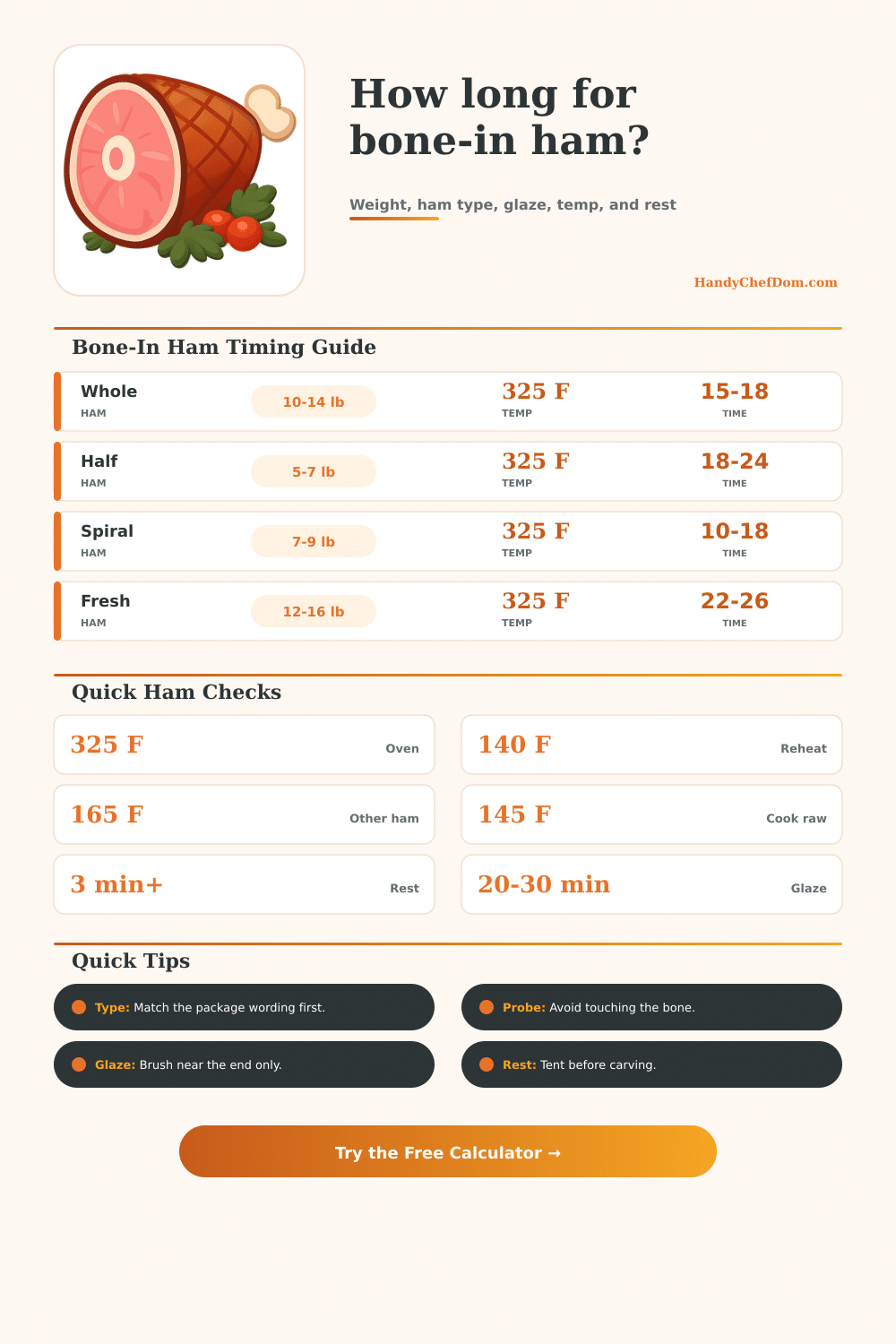
| Bone-In Ham Type | Typical Weight | 325 F Timing | Internal Target |
|---|---|---|---|
| Fully cooked whole bone-in | 10 to 14 lb | 15 to 18 min per lb | 140 F if USDA inspected |
| Fully cooked half bone-in | 5 to 7 lb | 18 to 24 min per lb | 140 F if USDA inspected |
| Fully cooked spiral sliced | 7 to 9 lb | 10 to 18 min per lb | 140 F if USDA inspected |
| Other fully cooked ham | Any label | Use package or calculator | 165 F for reheating |
| Smoked cook before eating, whole | 10 to 14 lb | 18 to 20 min per lb | 145 F plus rest |
| Smoked cook before eating, half | 5 to 7 lb | 22 to 25 min per lb | 145 F plus rest |
| Fresh Bone-In Cut | Typical Weight | 325 F Timing | Rest Rule |
|---|---|---|---|
| Fresh whole ham | 12 to 16 lb | 22 to 26 min per lb | At least 3 min |
| Fresh half ham | 5 to 8 lb | 35 to 40 min per lb | At least 3 min |
| Fresh shank portion | 3 to 4 lb | 35 to 40 min per lb | At least 3 min |
| Fresh butt portion | 3 to 4 lb | 35 to 40 min per lb | At least 3 min |
| Picnic shoulder style | 5 to 8 lb | 30 to 35 min per lb | At least 3 min |
| Country ham oven finish | After soaking | Short browning finish | Use label directions |
| Oven Setting | Calculator Effect | Best For | Glaze Note |
|---|---|---|---|
| 275 F | About 1.25x longer | Gentle reheating | Add glaze late |
| 300 F | About 1.12x longer | Large fully cooked hams | Allow extra finish time |
| 325 F | Baseline timing | Most ham charts | Glaze last 20 to 30 min |
| 350 F | About 0.90x shorter | Smaller halves | Watch sugar browning |
| 375 F | About 0.82x shorter | Final browning only | Use short glaze window |
| 400 F | About 0.76x shorter | Brief finish only | High burn risk |
| Glaze Plan | Suggested Window | Coverage Change | Timing Impact |
|---|---|---|---|
| No glaze | 0 min | Keep covered as preferred | No extra finish step |
| Light glaze | 20 to 25 min | Uncover near the end | Included in total time |
| Thick sugar glaze | 25 to 30 min | Uncover and baste once | Adds browning attention |
| Multiple coats | 30 to 40 min | Uncover, brush in stages | May need 5 extra min |
| High-heat finish | 10 to 15 min | Uncover only at finish | Use thermometer first |
| Spiral glaze packet | 10 to 15 min | Follow packet timing | Avoid drying slices |
This calculator is a planning tool. Package labels and a food thermometer should decide the final doneness, especially when the ham is labeled cook before eating or not USDA-inspected.
To cook an bone-in ham correctly, one must understand that the cooking time for a bone-in ham depend on the thickness of the ham’s meat and the location of the ham bone. The ham bone is located in the center of a bone-in ham. Because the ham bone is in the center of the ham, the thickness of the ham’s meat vary.
Depending on the varying thickness of the ham’s meat, the heat from the oven will not reach the outside of the ham at the same rate that the heat reaches the outside of a bone-in ham with even thickness throughout the ham. Therefore, one must manage the heat to ensure that the center of the ham reach the proper temperature while the outer portion of the ham does not become to dry. The calculation of the cooking time for a ham first depends on whether the ham is a fully cooked ham or a fresh raw ham.
How to Cook a Bone-In Ham
Because a fully cooked ham only need to be heated to the proper serving temperature, the cook will find that the cooking time for the ham will be less than a fresh raw ham that must be cooked until the center reaches the proper internal temperature. Ensuring the proper type of ham is selected for the calculator will ensure the proper cooking time for the ham; using the calculator for a fresh raw ham as if it were a fully cooked ham can lead to the center of the ham not reach the proper cooking temperature. Beyond the weight of the ham, there are other factor that impact the cooking time for a ham.
The starting temperature of the ham is one factor; a ham that starts at a lower temperature will require more cooking time than a ham that has been sitting at room temperature. The other factor to consider is the temperature of the oven in which the ham will be cooked; the higher the oven temperature, the more faster the ham will cook. A moderate oven temperature is the best temperature to use to cook the ham.
Managing the moisture of the ham is another factor to consider in cooking a ham. One way of managing the moisture of the ham is to cover the ham with a tent or a cover. Covering the ham will ensure that the ham retains its moisture while cooking, but the ham must be uncovered at the end of the cooking period in order to apply a glaze to the ham.
The glaze that is applied to the ham is typically sugary in composition, and the sugar will burn if the ham is left covered after the cooking period. Thus, using the glazing window provided in the calculator will allow the ham to be glazed at the proper time before it burn. The last two step in the cooking of a ham are measuring the internal temperature of the ham and allowing the ham to rest after cooking.
The internal temperature of a fully cooked ham should reach 140 degrees; however, a fresh raw ham must reach 145 degrees in the center. After the ham is removed from the oven, it must rest for at least five minutes; this resting period allow the ham to reach an internal temperature and for the meat to relax, making it easier to slice. Not all type of bone-in ham require the same cooking times.
For instance, spiral hams have more surface area than a bone-in ham because the ham is sliced. Because the spiral ham has more surface area for the heat from the oven to affect the ham, it will reach the serving temperature more quick than a standard bone-in ham. Additionally, a fresh bone-in ham will require more time to cook per pound than a fully cooked ham because the fresh ham must be cooked to reach a safe internal temperature.
Using a thermometer will provide the best measure of the internal temperature of the ham. It is not a good idea to solely use the oven and the cooking time to determine when the ham is done cooking; the resting period for the ham and the time required to set the dining table will impact the amount of time it take for the ham to be ready to be served. Providing a buffer for these time in the calculator will allow a cook to properly plan the meal.
The thermometer should be placed into the ham away from the ham bone because placing the thermometer against the ham bone will provide an inaccurate measurement of the temperature of the ham. Common mistakes with cooking a bone-in ham include treating every type of bone-in ham the same. For instance, some cooks may use the same time period as a fully cooked bone-in ham if the ham is actualy fresh raw; this mistake can result in the ham being undercooked in the center.
Using the calculator is a helpful tool to determine the cooking times; however, no cook should rely on the calculator as the guarantee of the cooking time for the ham; every oven and ham are different. Furthermore, the ham should be checked for internal temperature early in the cooking time to ensure the ham is cooked correct.