🌮 Taco Bar Meat Calculator
Estimate taco bar meat from adults, kids, big eaters, taco size, tacos per person, cooked yield, toppings buffer, service style, and planned leftovers.
Choose a real taco bar preset or enter your own crowd. The calculator returns cooked meat, raw meat to buy, tacos served, topping-adjusted portions, and leftover cushion.
Smaller tacos with lighter filling.
Default dinner taco size.
More meat per tortilla.
Bowl-style portions need more meat.
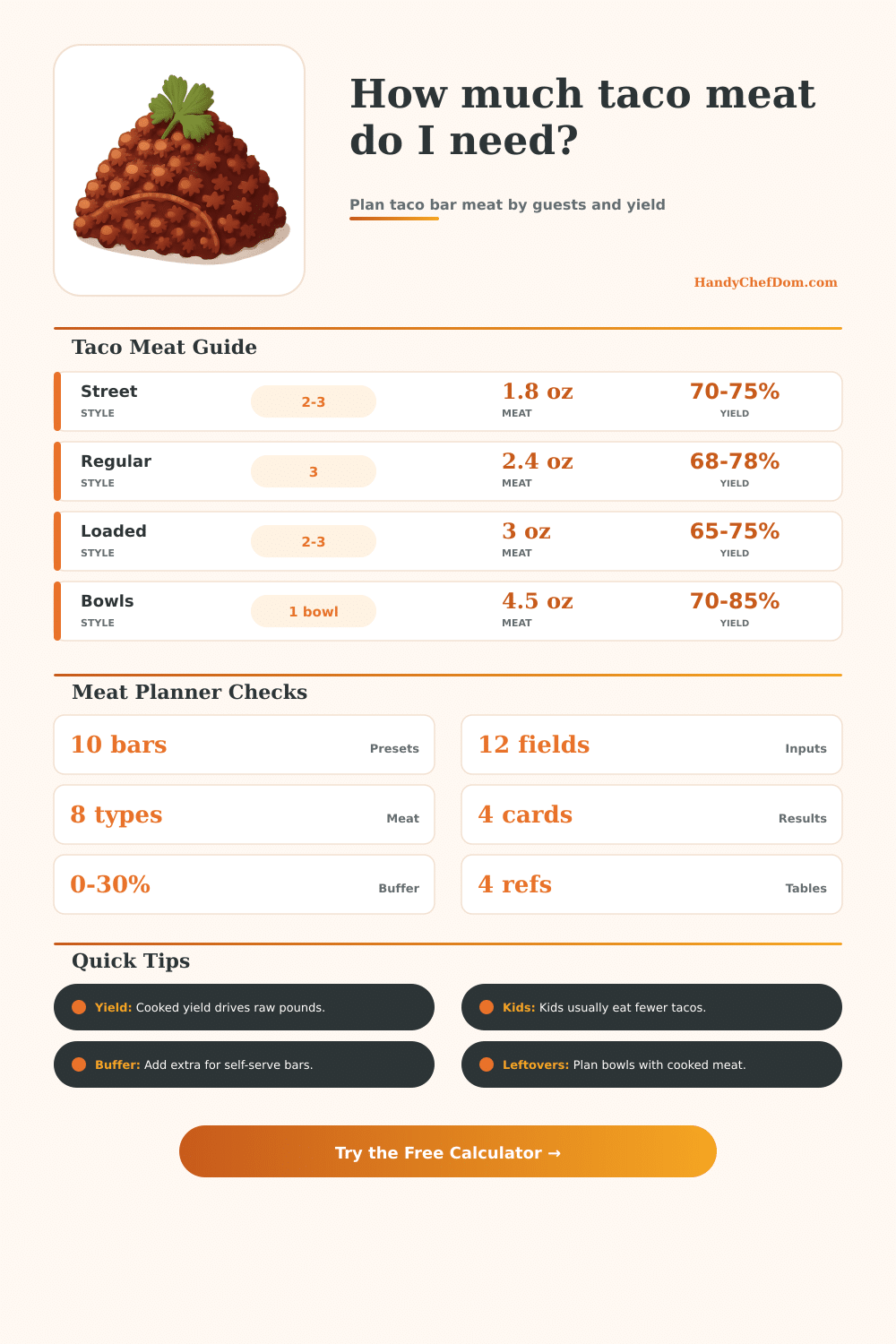
| Taco style | Cooked meat per taco | Typical tacos per adult | Cooked meat per adult | Best use |
|---|---|---|---|---|
| Street taco | 1.6 to 2 oz | 3 to 4 tacos | 5 to 8 oz | Late snacks, weddings, appetizers, and mixed taco trays. |
| Regular taco | 2.2 to 2.6 oz | 2.5 to 3.5 tacos | 6 to 9 oz | Family dinners, office lunches, and casual taco bars. |
| Loaded taco | 2.8 to 3.3 oz | 2 to 3 tacos | 6 to 10 oz | Hearty taco bars with fewer sides or bigger appetites. |
| Taco bowl | 4 to 5 oz | 1 bowl plus seconds | 6 to 10 oz | Bowl bars where rice, beans, and toppings share the plate. |
| Meat type | Typical cooked yield | Raw meat for 10 lb cooked | Use in calculator | Planning note |
|---|---|---|---|---|
| Ground beef or turkey | 72% to 78% | 12.8 to 13.9 lb | 75% default | Drain loss depends on fat level and how finely it is crumbled. |
| Shredded chicken | 70% to 75% | 13.3 to 14.3 lb | 72% default | Boneless thighs usually hold moisture better than breast meat. |
| Carnitas or pulled pork | 58% to 65% | 15.4 to 17.2 lb | 62% default | Pork shoulder loses more weight but reheats well for buffets. |
| Carne asada or steak | 68% to 74% | 13.5 to 14.7 lb | 70% default | Thin slices help guests portion fairly across the line. |
| Fish taco fillets | 76% to 84% | 11.9 to 13.2 lb | 80% default | Cook in batches so delicate pieces do not break down. |
| Shrimp filling | 80% to 88% | 11.4 to 12.5 lb | 84% default | Use peeled weight for the most useful taco estimate. |
| Barbacoa or brisket | 55% to 62% | 16.1 to 18.2 lb | 58% default | Long-cooked beef needs a larger raw buy weight. |
| Mixed taco meats | 68% to 76% | 13.2 to 14.7 lb | 72% default | Use a weighted average when splitting beef, chicken, and pork. |
| Guest count | Light street tacos | Regular taco dinner | Hearty loaded bar | Raw ground beef guide |
|---|---|---|---|---|
| 10 guests | 4 to 5 lb cooked | 5 to 6 lb cooked | 6 to 8 lb cooked | 7 to 11 lb raw, depending on taco style. |
| 25 guests | 10 to 12 lb cooked | 13 to 16 lb cooked | 16 to 20 lb cooked | 17 to 27 lb raw, before a larger buffet buffer. |
| 50 guests | 20 to 24 lb cooked | 26 to 31 lb cooked | 32 to 40 lb cooked | 35 to 53 lb raw, rounded by package and pan size. |
| 75 guests | 30 to 36 lb cooked | 39 to 47 lb cooked | 48 to 60 lb cooked | 52 to 80 lb raw, especially for self-serve bars. |
| 100 guests | 40 to 48 lb cooked | 52 to 63 lb cooked | 64 to 80 lb cooked | 70 to 107 lb raw, split across refill pans. |
| Planning choice | Meat effect | Suggested buffer | Leftover target | When to use it |
|---|---|---|---|---|
| Simple toppings | Guests rely more on meat | 10% to 15% | Minimal to host leftovers | Cheese, salsa, lettuce, and small sides. |
| Classic toppings | Balanced meat scoops | 12% to 18% | Host leftovers | Most family parties, offices, and casual buffets. |
| Loaded toppings | Meat per taco can drop slightly | 15% to 20% | Host leftovers | Guacamole, crema, pico, cabbage, and several salsas. |
| Heavy sides | Rice and beans reduce taco demand | 8% to 15% | Minimal leftovers | Buffets with rice, beans, salad, chips, and dips. |
| Open-house service | Uneven traffic raises backup need | 18% to 25% | Taco bowls | Graduations, game days, long parties, and drop-in events. |
When you plan a taco bar, you must determine the correct amounts of raw meat to purchase. Planning a taco bar can be challenging for many people because the amount of meat that is require for the taco bar depends on the type of meat that you are going to cook for the tacos, as well as the type of service that will be offered at the taco bar. The weight of the meat will change when it go from raw to cooked meat.
For instance, ground beef will lose some of its moisture and fats when it is cooked, which will reduce the amount of raw ground beef that is available when it is cooked. Pork shoulder will lose a significant amount of its moisture and fat when it is cooked. Therefore, you will need a larger weight of raw pork shoulder to allow for the amount of cooked pork that will be served.
How much raw meat to buy for a taco bar
Fish and shrimp will lose less weight during the cooking process. However, because the meat is fragile, you must handle it careful during the cooking process. In this instance, the cooked weight of the meat will be used to calculate the amount of raw meat that must be purchased.
To calculate the amount of raw meat that is require for the taco bar, you can use the meat calculator that is available to you. This calculator will allow you to input the number of adult guests that will come to the taco bar, the number of child guests, and the number of large eater. You can also select the type of toppings that you are using for your tacos.
For instance, if you are using many toppings, such as guacamole, crema, and salsa, guests will eat fewer taco. If there are fewer toppings, such as only cheese and salsa, people will consume more meat in there tacos. Additionally, the type of service that you will offer at your taco bar will impact the amount of meat that you have to purchase.
For instance, if you use a portioned line, you will ensure that the portions of meat that are prepared for customers will be the same, whereas with a self serve bar, you will lose meat due to the varying amount of meat that each customer take from the bar. The service cushion will allow you to provide for this loss in a self-serve bar. Furthermore, you can also select a setting that allow you to have extra meat for the next day.
The type of meat that you will use will also impact the amount of meat that will be cooked. For example, ground beef will have a higher yield of ground beef than pork or fish. The yield will be the weight of the cooked meat divided by the raw weight of the meat.
Ground beef will have a 75 percent yield because 25 percent will be lost during the cooking process. Carnitas or barbacoa will have a 60 percent yield because the meats are cooked for more longer periods of time so that the fat and moisture will leave the meat. You can adjust the yield percentage for each type of meat that is prepared for the tacos.
When buying meat in bulk, it is essential to adjust the percentage of yield to ensure that you have enough meat. The number of eaters will impact the total amount of meat that is require for the tacos. Children will eat less meat than adults.
Therefore, the number of children will have a smaller impact on the total amount of meat than the number of adult. Additionally, teens and large eater will eat more meat than the average guest. Toppings and the number of leftovers will also have an impact on the total amount of raw meat that will be needed for the taco bar.
The more higher the topping buffer, the more cooked meat and raw meat will be needed. The higher the leftover goal, the more cooked and raw meat will be needed to allow for these leftovers. Therefore, you must consider whether the extra cost of the meat is worth the benefit of having these extras.
The reference tables will show how many ounces of cooked meat that are used in different taco styles. These tables will also show the yield of cooked meat after the raw meat is cooked. These tables will be beneficial in determining if you want to prepare your tacos or loaded tacos.
When planning your taco bar, many people will make the mistake of only planning for the raw meat. You should calculate the amount of cooked meat that will be served and the raw weight of the meat that will achieve that cooked weight. Additionally, you must plan for the side dishes that will be offered with your tacos, such as rice, beans, and chips.
If these are served, individuals will eat fewer tacos. The veggie share setting will allow you to provide for these side dish. Finally, you must plan for how the meat will be held at the taco bar.
If the meat is held in warm pans, it may lose its moisture. By placing the meat in two different pans, you can ensure that the meat remains fresh for the customers. Using two pans for the cooked meat will keep the service line moving and ensure that there is enough meat for all the customers coming to the taco bar.