🍞 Sourdough Bakers Percentage Calculator
Scale sourdough formulas from total flour or target dough weight, including water, starter hydration, salt, add-ins, dough pieces, true hydration, inoculation, and baker's percentages.
Choose whether to scale from a flour amount or a target mixed dough weight. Flour is always 100% in baker's math; the calculator splits starter into flour and water before showing main flour, main water, inoculation, and the full formula.
0% added outside starter.
0% added outside starter.
0% of total flour.
0% of total flour.
0% of total flour.
Prefermented flour inside starter.
Water already carried by starter.
Based on hydration and flour blend.
| Ingredient | Baker percentage basis | Typical sourdough range | Calculator treatment | Formula note |
|---|---|---|---|---|
| Total flour | Always 100% | Any amount | Main flour plus starter flour | Every other ingredient is compared with this amount |
| Water | Water divided by total flour | 60 to 85% | Main water plus starter water | Controls dough softness and handling |
| Starter | Starter weight or flour inoculation | 10 to 35% starter | Split by starter hydration | Changes both fermentation speed and formula water |
| Salt | Salt divided by total flour | 1.8 to 2.4% | Calculated after flour is scaled | Small percentage changes are noticeable |
| Add-ins | Add-in weight divided by flour | 0 to 35% | Separate from hydration math | Seeds and grains may need soaking water |
| Sourdough style | Hydration | Inoculation | Starter weight at 100% | Handling cue |
|---|---|---|---|---|
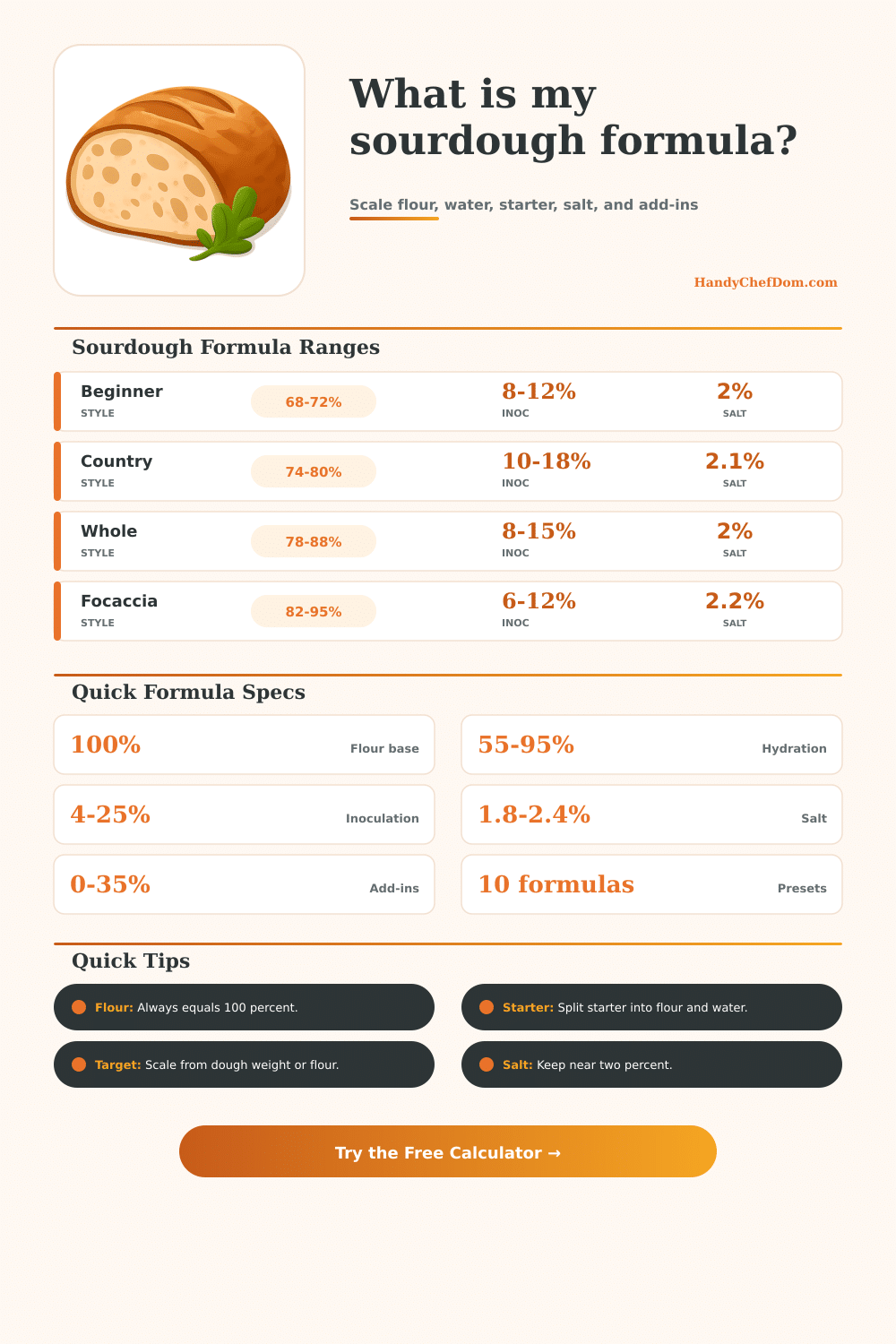
| Beginner boule | 68 to 72% | 8 to 12% | 16 to 24% of flour | Forgiving shape and score range |
| Country batard | 74 to 80% | 10 to 18% | 20 to 36% of flour | Use folds and gentle shaping |
| Open crumb loaf | 80 to 86% | 8 to 14% | 16 to 28% of flour | Best with strong flour and bassinage |
| Whole wheat loaf | 78 to 88% | 8 to 15% | 16 to 30% of flour | Rest the dough before judging water |
| Focaccia or ciabatta | 82 to 95% | 6 to 12% | 12 to 24% of flour | Pan support makes wet dough easier |
| Starter hydration | Flour in 100 g starter | Water in 100 g starter | Formula effect | Best use |
|---|---|---|---|---|
| 50% stiff starter | 66.7 g flour | 33.3 g water | Raises prefermented flour for the same starter weight | Firm doughs, pan loaves, mild builds |
| 60% stiff levain | 62.5 g flour | 37.5 g water | Keeps main water higher than liquid starter | Pizza, bagels, structured dough |
| 80% levain | 55.6 g flour | 44.4 g water | Moderate water contribution | Country loaves and mixed flour formulas |
| 100% liquid starter | 50 g flour | 50 g water | Simple equal split | Most home sourdough formulas |
| 125% liquid starter | 44.4 g flour | 55.6 g water | Contributes more water than flour | Loose levains and mild high-hydration dough |
| Add-in type | Common percentage | Water effect | Formula handling | Calculator cue |
|---|---|---|---|---|
| Dry seeds or grains | 5 to 20% | Absorbs dough water | Can make the same hydration feel dry | Use a soaker or extra reserve water |
| Soaked seeds | 10 to 30% | Brings some trapped water | Softens dough less sharply than dry seeds | Drain before weighing into the dough |
| Olives or pickled vegetables | 10 to 25% | Adds surface moisture | May loosen dough during folds | Fold in after gluten develops |
| Cheese, fruit, or nuts | 5 to 25% | Small to moderate effect | Adds weight more than formula water | Keep pieces evenly distributed |
| Cooked porridge | 10 to 35% | High bound water | Makes dough softer and heavier | Expect a tender crumb and longer handling |
This calculator plans sourdough formulas by weight. Flour absorption, starter maturity, dough temperature, mixing strength, and resting time can change the feel of the same baker's percentage.
Sourdough baking use baker’s percentages to calculate the ingredients needed. Baker’s percentages allow a person to understand the relationship between the ingredients in a sourdough. Flour is always 100 percent in baker’s percentages, and all other ingredients is given as a percentage of the weight of the flour.
By using baker’s percentages, a person can calculate the weight of the water, salt, and starter based on the weight of the flour. If a person change the amount of flour, the other ingredients will change with it, but the baker’s percentages will remain the same. Baker’s percentages allow dough to be adjusted to make as much dough as needed.
Baker’s percentages for sourdough baking
Baker’s percentages include the hydration of the dough. The hydration of the dough is the percentage of water in the dough relative to the weight of the flour. A high percentage of hydration mean the dough will contain a high amount of water.
High hydration dough will be soft and easy to spread on a surface. A low percentage of hydration means the dough will contain less water. Low hydration dough will be firm and easy to shape into desired forms.
The percentage of hydration will determine how a person will bake there sourdough bread. Another ingredient to calculate in baker’s percentages is the amount of starter. The percentage of the starter is given as a percentage of the flour weight.
Using baker’s percentages, the amount of starter will determine the fermentation rate of the dough. A high percentage of starter will create more starter for the dough to ferment at a faster rate. A lower percentage of starter will allow the dough to take long to ferment.
Because starter also contain flour and water, you must account for the baker’s percentage of the sourdough starter to maintain the hydration percentage. Another ingredient to calculate using baker’s percentages is the salt. Salt is given as a percentage of around 2% of the weight of the flour.
The salt in sourdough dough will affect the fermentation rate of the dough and the browning of the crust. Because salt is calculated as a percentage of the weight of the flour, the salt will increase in weight if the baker increase the weight of the flour. Any salt in add-ins to the sourdough dough must be considered in the recipe.
The add-ins for sourdough dough is calculated as a percentage of the dough as well. However, dry add-ins like seeds will absorb some of the water in the dough. This will make the dough feel less hydrated than baker’s percentages suggest.
Add-ins that contains soaked seeds or grains will add moisture to the sourdough dough. This will make the sourdough dough feel wetter than baker’s percentages suggest. Therefore, if add-ins are to be used in sourdough dough, the hydration percentage may have to be adjusted.
There are two method of using a calculator to manage baker’s percentages in sourdough baking. One method calculates the ingredients if a specific weight of flour is used. This method is helpful for bakers who would like to use a specific amount of flour.
The other method is to calculate the weight of flour if the baker targets the total weight of the sourdough dough. This method is helpful for bakers who would like to bake a specific amount of sourdough dough for there oven or stand mixer. The type of flour that is used will impact baker’s percentages.
For instance, bread flour will absorb more water than all-purpose flour. Flour that contain wheat bran will absorb more water than white flour. These differences in behavior mean that bakers may have to adjust the hydration percentage of their sourdough dough to achieve the same texture from different types of flour.
One of the most common mistake in baker’s percentages is to fail to account for the flour and water in the sourdough starter. If a person fails to account for the flour and water in the sourdough starter, the hydration percentage will be incorrect. If the baker does not account for the flour in the sourdough starter in the dough, the dough will contain more water than the percentage of hydration indicate.
If the water in the sourdough starter is not accounted for, the dough will end up drier than what was planned. Small percentages of dough gets stuck in the bowls during the mixing process. Therefore, the amount of dough will be less than the targeted baker’s percentage if the mixing loss is not accounted for.