🍪 Cookie Size Calculator
Balance dough weight, scoop size, spread factor, sheet capacity, target diameter, yield, and bake time before the first tray goes in.
Choose whether you want to size from a target baked diameter, a scoop, or a known dough weight. The calculator converts everything internally to grams and inches, then reports your preferred units.
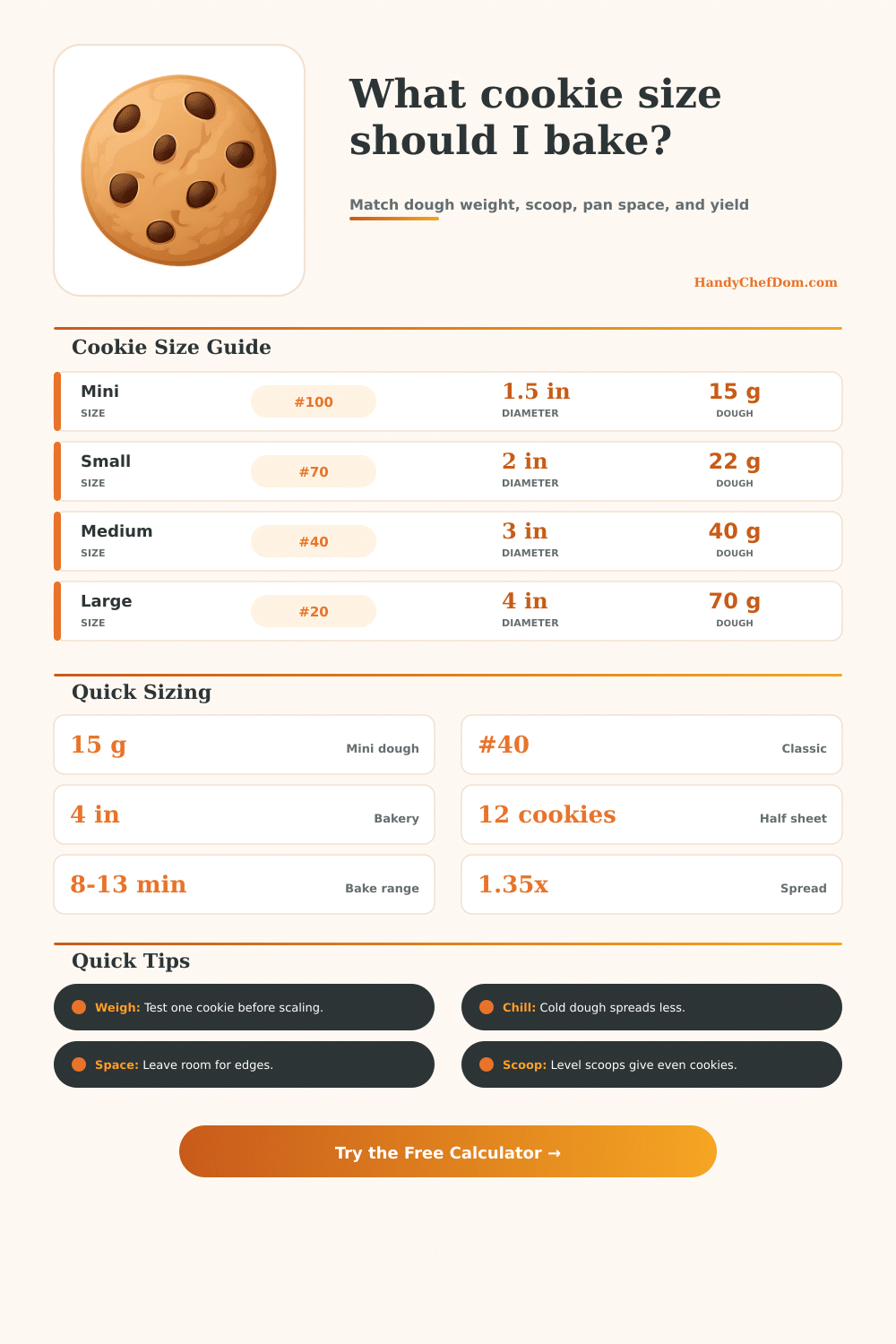
| Scoop | Level Volume | Typical Dough | Expected Diameter | Best Use |
|---|---|---|---|---|
| #100 | 9.5 ml | 14-16 g | 1.4-1.7 in | Mini cookie boxes |
| #70 | 13.5 ml | 20-24 g | 1.9-2.2 in | Lunchbox cookies |
| #60 | 15.8 ml | 24-28 g | 2.1-2.4 in | Small dessert trays |
| #50 | 18.9 ml | 30-34 g | 2.4-2.7 in | Snack-size cookies |
| #40 | 23.7 ml | 38-44 g | 2.8-3.2 in | Classic homemade cookies |
| #30 | 31.6 ml | 48-56 g | 3.2-3.6 in | Large sharing trays |
| #24 | 39.4 ml | 58-66 g | 3.5-3.9 in | Bakery-style stacks |
| #20 | 47.3 ml | 68-78 g | 3.8-4.3 in | Large bakery cookies |
| #16 | 59.1 ml | 86-98 g | 4.4-4.9 in | Extra-large cookies |
| #12 | 78.9 ml | 112-128 g | 5.1-5.8 in | Jumbo dessert cookies |
| Dough Style | Auto Spread | Base Weight | Base Diameter | Base Bake Time |
|---|---|---|---|---|
| Chocolate chip classic | 1.35x | 42 g | 3.0 in | 10 min |
| Oatmeal raisin | 1.22x | 44 g | 2.9 in | 11 min |
| Sugar cookie dough | 1.25x | 32 g | 2.6 in | 9 min |
| Peanut butter | 1.18x | 38 g | 2.7 in | 10 min |
| Shortbread style | 1.08x | 30 g | 2.3 in | 12 min |
| Thin and crisp | 1.55x | 34 g | 3.1 in | 9 min |
| Double chocolate | 1.28x | 45 g | 3.0 in | 10.5 min |
| Snickerdoodle | 1.38x | 36 g | 2.9 in | 9.5 min |
| Pan Size | Sheet Area | 2.5 in Cookies | 3 in Cookies | 4 in Cookies |
|---|---|---|---|---|
| Quarter sheet | 13 x 9 in | 8-10 | 6 | 4 |
| Jelly roll pan | 15 x 10 in | 10-12 | 8 | 6 |
| Half sheet | 18 x 13 in | 18-20 | 12 | 8 |
| Full sheet | 26 x 18 in | 35-40 | 24 | 15 |
| Toaster tray | 10 x 8 in | 4-6 | 4 | 2 |
| Batch Dough Mass | 25 g Small | 40 g Classic | 70 g Bakery | Notes |
|---|---|---|---|---|
| 1 lb / 454 g | 18 cookies | 11 cookies | 6 cookies | Small test batch |
| 2 lb / 907 g | 36 cookies | 22 cookies | 12 cookies | Family baking |
| 3 lb / 1.36 kg | 54 cookies | 34 cookies | 19 cookies | Two-tray batch |
| 5 lb / 2.27 kg | 90 cookies | 56 cookies | 32 cookies | Party tray batch |
| 8 lb / 3.63 kg | 145 cookies | 90 cookies | 51 cookies | Large prep batch |
Achieving the desired size of cookie is a difficult task due to the numerous variable that must be accounted for. People may find that one tray of cookies spread more than anothers tray of cookies due to the changes in the mass and the temperature of the cookie dough for each tray of cookies. As such, people must understand each of the factor that can impact the baking of cookies in order to ensure that each batch of cookies achieve the desired result.
The first of these factor is dough weight. Dough weight is the most important factor in the baking of cookies because dough weight will impact the diameter of the baked cookies and the time that the cookies take to bake. Cookies made from a heavier ball of dough will take more longer to bake than cookies made from a lighter ball of dough.
How to make cookies the right size
Because dough weight can impact both the size and time that it takes to bake a batch of cookies, it is critical that the baker measure the weight of the dough to ensure accuracy. The calculator that is provided ask for the target diameter for the baked cookies or the scoop size of the dough balls to be used in baking to determine the number of cookies that can be baked with a batch of dough of a given mass. The number of cookies that can be baked is referred to as the cookie yield and is based upon the weight of the batch of dough.
The spread factor for the cookies is another variable that must be accounted for. As such, baked cookies are often wider than the balls of raw dough from which they are baked. The spread factor is due to the melting of the butter and the dissolving of the sugar within the dough during the baking process.
For example, dough that includes chocolate chips will spread thirty-five percent more than dough that does not contain chocolate chip. The calculator automatically accounts for the spread factor upon selection of cookie dough style. However, the cook can manually adjust the spread factor for recipes that contain many mix-ins.
Another variable that may impact the baking of cookies is the temperature of the dough. Due to the fact that dough that is removed from the refrigerator will be of a similar temperature to the surroundings of the kitchen, the dough will spread more than dough that has been chilled. Additionally, because the chilled dough will be colder to the touch, it will require a longer baking time to heat through the center of the cookies.
However, the cookie calculator can account for this baking time so as to make it unnecessary to remember to adjust the baking time for dough that is not at room temperature. Pan size and spacing are another factor to consider when baking cookies. The finished cookies will take up more space on the baking pan than the raw balls of dough.
Therefore, the spacing between the cookies should be calculated according to the diameter of the finished cookies. Should the spacing between the cookies or the diameter of the cookies be altered, the number of cookies that can be baked is also subject to change. Therefore, the cookie calculator can determine the number of rows and the number of columns of cookie pans that will be required to bake the batch of cookies.
Another factor to consider within the cookie calculation is the percentage of mix-ins to the cookie dough. Because the percentage of mix-ins will increase the total weight of the dough, the weight of the scooped batch of dough will be greater if the percentage of mix-ins are increased. This extra weight will impact both the spread and the time that the cookies take to bake.
As such, the percentage of mix-ins to the cookie dough should be entered into the cookie calculator so that the cookie yield is accurate and realistic. The reference tables located on the calculator allow for the information to be easily read by the user. One table includes scoop size, the weights in grams of the scooped balls of dough, and the diameter of the baked cookies.
The second table includes pan dimensions and the number of cookies of given sizes that can be baked in a baking pan. The third table includes different types of cookie doughs, the spread of the cookies, the base weight of the cookies, and the time to bake the cookies. These tables can be used to make baking decision, but do not replace the judgement of the baker.
The information within the tables can help to avoid the need to perform any arithmetic calculations to make baking decisions. Many cooks may make mistake when baking cookies due to the fact that they only measure one variable of baking cookies but do not account for the other variables. For instance, people may measure the weight of the cookies to ensure that they each contain the same amount of dough but may not account for the fact that dough scooped from a warm counter will behave different than dough scooped from an area that is cooler in temperature.
Additionally, people may space the cookies according to the size of the raw dough balls but may not account for the spread of the dough when the cookies are baked. These types of error can be avoided by referring to the number provided by the cookie calculator. Due to the fact that batches of raw dough may not always yield the number of cookies as calculated by the calculator, it is important to account for the possibility of having leftover dough ball after baking the cookies.
The leftover field within the cookie calculator indicates the amount of dough that will remain in the batch after baking the number of cookies that can be made from that batch of dough. The calculator also asks for the total batch mass of the cookies, though it may not be fully utilized in the actual baking of the cookies. Another factor that may impact the baking of cookies is the humidity of the kitchen in which the cookies are baked.
Higher humidity level in the kitchen will make sugar cookie dough feel stickier to the touch. Cookies that are too sticky will spread more when baked. Lower humidity levels in the kitchen will make the dough feel stiffer.
Dough that is stiffer will take longer to spread when baked. These factor are more difficult to calculate, however. Therefore, baking one batch of cookies of the calculated amount first will allow the baker to see how the dough spreads when baked.
The remainder of the batch of dough can then be adjusted according to the result of baking the sample batch of cookies. The main goal of this calculator and the discussion of each of these factor is to allow cooks and bakers to understand how each of these factor relate to each other. With such an understanding, cooks can adjust one factor to determine the impact that it will have upon the other factor.
As such, cooks can use the calculator to determine how adjusting one factor will impact the others so as to allow them to bake the type of cookies that they would like to serve to others.