🧈 Butter in a Stick Calculator
Convert butter sticks to tablespoons, cups, grams, and ounces with style, salt, recipe scale, and softened or melted volume adjustments.
Enter butter in the unit you have on hand. The calculator converts through weight first, then adjusts the spoon and cup display for whipped, softened, melted, browned, or clarified butter.
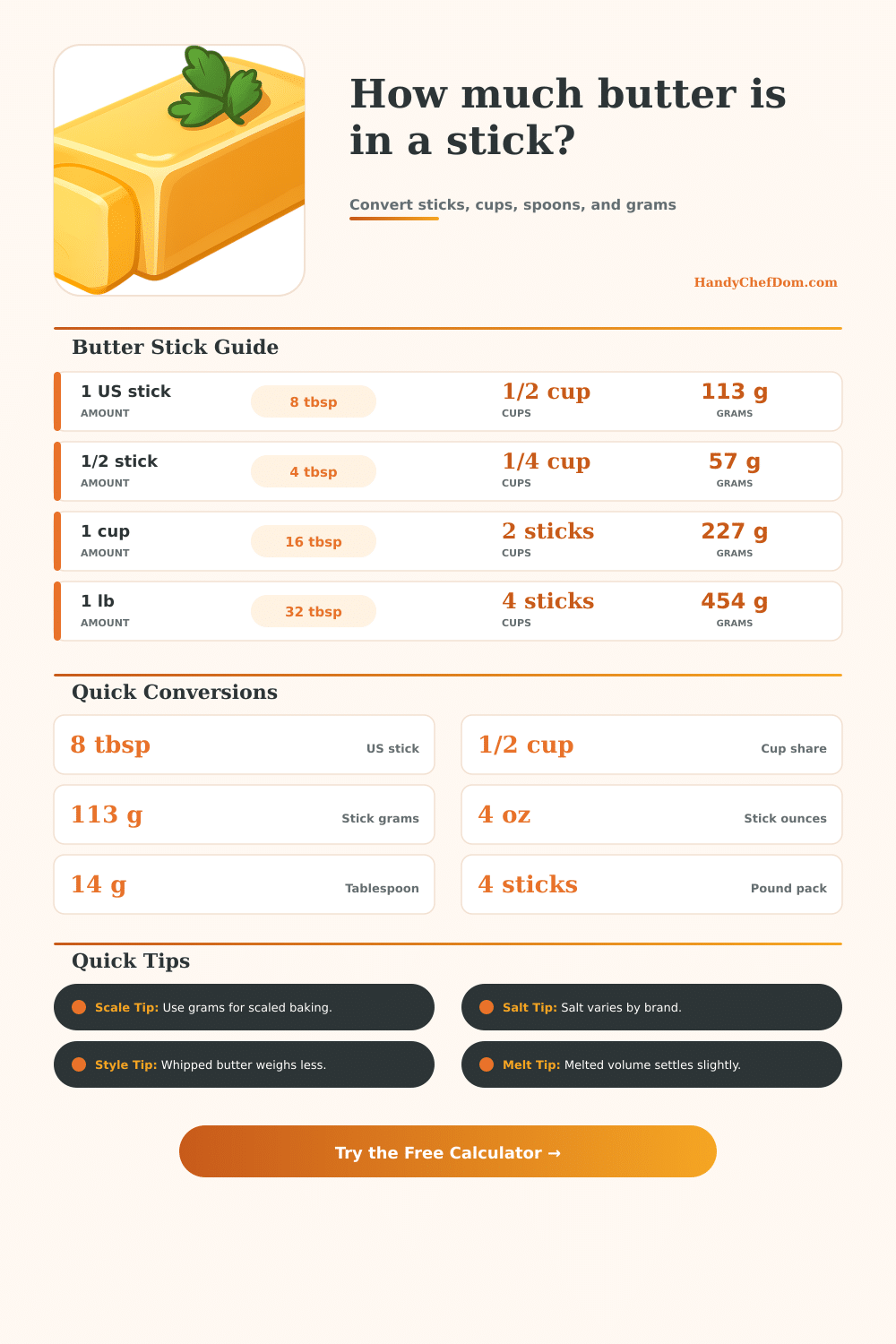
| Butter Amount | Sticks | Tablespoons | Cups | Grams |
|---|---|---|---|---|
| 1 tablespoon | 0.125 | 1 | 0.0625 | 14.2 g |
| 1/4 stick | 0.25 | 2 | 1/8 cup | 28.3 g |
| 1/2 stick | 0.50 | 4 | 1/4 cup | 56.7 g |
| 1 stick | 1.00 | 8 | 1/2 cup | 113.4 g |
| 2 sticks | 2.00 | 16 | 1 cup | 226.8 g |
| 4 sticks | 4.00 | 32 | 2 cups | 453.6 g |
| Butter Style | Approx g/tbsp | Volume Behavior | Best Conversion Note |
|---|---|---|---|
| Sweet cream stick | 14.2 | Standard | Use wrapper marks or weight. |
| European-style | 14.4 | Slightly dense | Weight is most precise. |
| Cultured block | 14.2 | Standard | Measure like regular butter. |
| Whipped butter | 7.1 | Airy | Do not swap cup for cup by weight. |
| Ghee | 13.6 | Liquid dense | Use after clarified yield loss. |
| Plant baking stick | 13.5 | Near standard | Check package baking label. |
| Salt Choice | Salt Estimate | Per US Stick | Recipe Use |
|---|---|---|---|
| Unsalted | 0% | 0 g | Best control for baking. |
| Lightly salted | 0.9% | 1.0 g | Good for table butter. |
| Salted | 1.4% | 1.6 g | Reduce added salt slightly. |
| Extra salted | 1.8% | 2.0 g | Useful for savory butter. |
| Recipe Scale | 1 Stick Recipe | Tablespoons | Grams | Cups |
|---|---|---|---|---|
| Half batch | 0.5 stick | 4 tbsp | 56.7 g | 1/4 cup |
| Regular batch | 1 stick | 8 tbsp | 113.4 g | 1/2 cup |
| Double batch | 2 sticks | 16 tbsp | 226.8 g | 1 cup |
| Triple batch | 3 sticks | 24 tbsp | 340.2 g | 1 1/2 cups |
| Party batch | 4 sticks | 32 tbsp | 453.6 g | 2 cups |
| Butter State | Volume Factor | Same Weight Looks Like | Calculator Use |
|---|---|---|---|
| Chilled stick | 1.00x | Wrapper marks | Default baking conversion. |
| Softened loose | 1.03x | Slightly fuller cup | Useful for spooned butter. |
| Softened packed | 1.00x | Standard cup | Closest to stick marks. |
| Melted settled | 0.96x | Slightly lower cup | Use for liquid butter volume. |
| Browned butter | 0.84x | Less water remains | Estimates post-browning yield. |
| Clarified butter | 0.82x | Milk solids removed | Estimates clarified yield. |
Butter is used in many recipes. The butter itself change based on its weight, its salt content, and its physical state. It is important for cooks to understand the diffrent types of butter because the type of butter used can change the volume and the salt level of the food that is prepared.
Depending on the type of recipe that is prepared, a cook may use unsalted butter or salted butter. Each of these types of butter contain different amounts of salt. Additionally, salted butter can change the flavor of a recipe if the other ingredients of the recipe dont contain no more additional salt.
Types of Butter and How to Measure It
The calculator allow cooks to easily convert one unit of measurement for butter to another unit of measurement for butter. The calculator also accounts for the different style of butter. A cook must input the unit of measurement of butter that is being used in the recipe, and the style of butter that is available to the cook.
For example, a standard stick of butter sold in America weigh four ounces. However, European style butter contains a higher concentration of fat than butter sold in America. The weight of European-style butter would differ from American-style butter.
Additionally, whipped butter contain air, and ghee is butter from which the water has been removed. Thus, the weight and volume of whipped butter and ghee will differ than butter. The physical state of the butter can also play a role in the volume of butter that can be measured.
For instance, butter that has been softened take up more space in a measuring cup than chilled butter. Additionally, melted butter and browned butter will contain less butter by volume than the butter that was used to prepare the food because water is lost during the browning of the butter. The state setting for butter on the calculator allow for these difference in volume between butter in different physical states to be accounted for in the recipe.
If cooks do not adjust the butter measurement according to the physical state of the butter, the amount of butter that is measured may not equal the amount of butter that is require for the recipe according to the instructions provided. The butter calculator also allows cooks to adjust for the scale of the recipe. If cooks are preparing a recipe that create a large number of servings of food, an increase in the amount of butter that is used will be required.
However, some of that butter will stick to the side of the bowl in which the cook uses the butter in the recipe. Thus, an overage field allow cooks to account for this extra amount of butter to ensure that there is enough butter to perform the recipe as described in the recipe instructions. After the overage is accounted for, the amount of butter is divided by the number of servings that the recipe will create.
This allows cooks to understand how much butter will be contained in each serving. Reference tables for butter are also provided on the calculator. These reference tables allow cooks to easily read the different unit of measurement for butter without having to use the calculator for each of the factors.
These reference tables provide information regarding the amount of sticks, tablespoons, cups, and grams of butter contains each unit. Additionally, the tables also provide information regarding how many grams of each style of butter are contained within each unit of measurement. These tables can also help cooks to understand how much salt is contained within different brand of butter, and to make purchasing decisions when people buy butter at a grocery store.
Overall, there are a number of factor related to the measurement of butter. The stability of the butter is measured in weight. However, the volume of the butter change based off the physical state of the butter, the temperature of the butter, and the type of butter.
Additionally, butter may or may not contain salt, and that factor must be accounted for in the preparation of the recipe. Each of these factors is made visible to cooks using the calculator to enable the cooks to adjust the butter according to the requirement of the recipe.