🥚 Egg White Per Egg Calculator
Convert egg sizes, shell counts, liquid egg whites, cups, ml, and separated weights for meringues, omelets, and baking prep.
Choose how you are measuring whites today. The calculator converts everything to grams, applies separation or transfer loss, and translates the result back into egg count, cups, ml, and recipe scale.
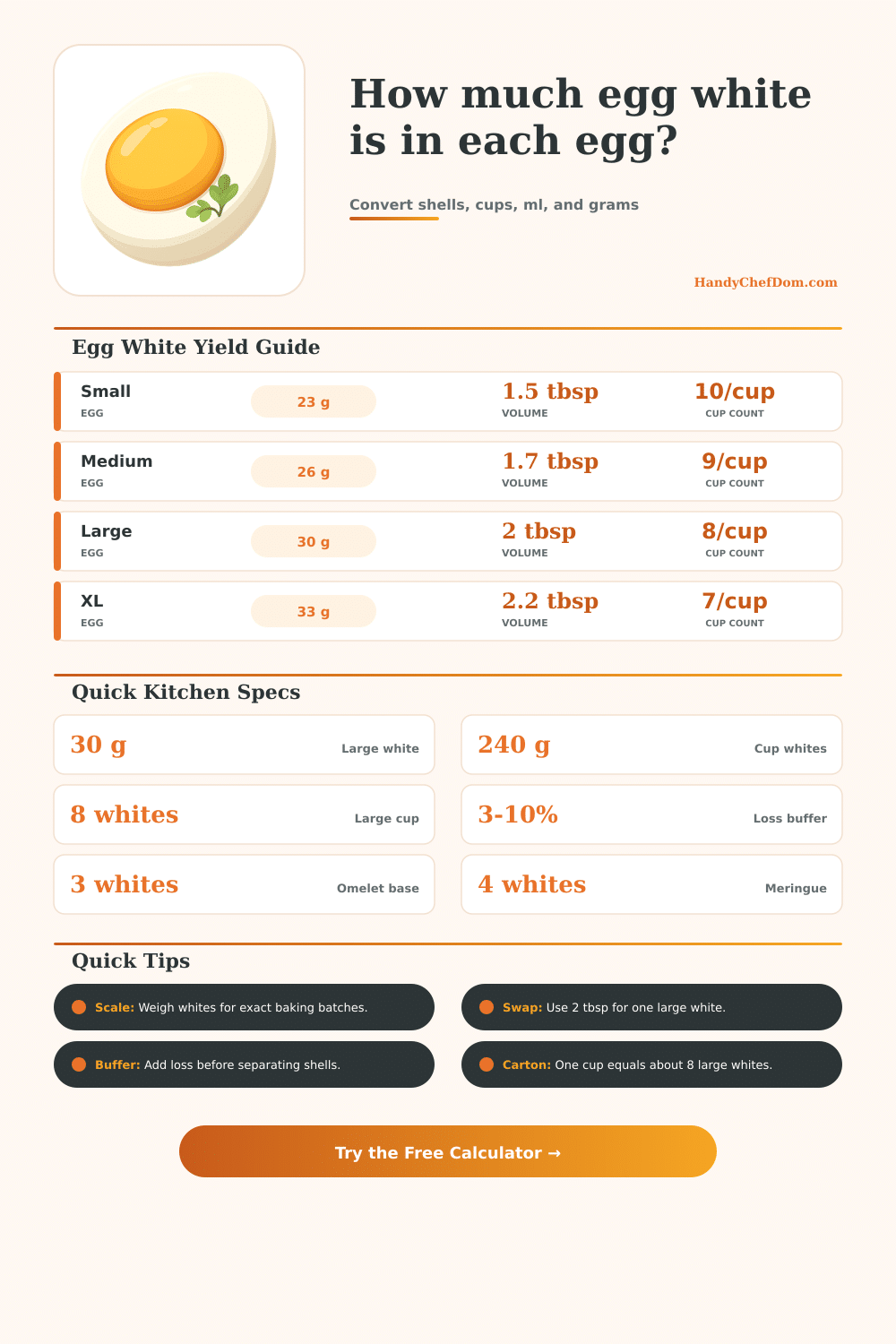
| Egg size | Whole egg | White weight | Yolk weight | White volume |
|---|---|---|---|---|
| Peewee | 35 g | 20 g | 12 g | 1.3 tbsp |
| Small | 38 g | 23 g | 13 g | 1.5 tbsp |
| Medium | 44 g | 26 g | 14 g | 1.7 tbsp |
| Large | 50 g | 30 g | 17 g | 2 tbsp |
| Extra-large | 56 g | 33 g | 19 g | 2.2 tbsp |
| Jumbo | 63 g | 38 g | 20 g | 2.5 tbsp |
| Liquid whites | Approx grams | Large white equivalent | Best calculator mode | Kitchen note |
|---|---|---|---|---|
| 1 tbsp | 15 g | 0.5 white | Liquid volume | Small adjustment |
| 2 tbsp | 30 g | 1 white | Liquid volume | One large white |
| 1/4 cup | 60 g | 2 whites | Liquid volume | Mini batch |
| 1/2 cup | 120 g | 4 whites | Liquid volume | Meringue base |
| 3/4 cup | 180 g | 6 whites | Liquid volume | Omelet prep |
| 1 cup | 240 g | 8 whites | Liquid volume | Carton swap |
| Use case | Typical whites | Typical grams | Suggested buffer | Why it matters |
|---|---|---|---|---|
| Macaron batter | 3 to 4 | 90 to 120 g | 5% | Precise ratios |
| Pavlova base | 4 to 6 | 120 to 180 g | 4% | Stable volume |
| Angel food pan | 10 to 12 | 300 to 360 g | 4% | Large batch |
| Royal icing | 2 to 3 | 60 to 90 g | 2% | Small shifts |
| Omelet plate | 3 to 5 | 90 to 150 g | 0% | Flexible meal |
| Drink foam | 0.5 to 1 | 15 to 30 g | 2% | Tiny amount |
| Recipe scale | Large whites called for | Needed grams | Needed cups | Large eggs to separate |
|---|---|---|---|---|
| Half batch | 2 whites | 60 g | 1/4 cup | 2 eggs |
| Standard batch | 4 whites | 120 g | 1/2 cup | 4 eggs |
| Double batch | 8 whites | 240 g | 1 cup | 8 eggs |
| Party batch | 12 whites | 360 g | 1 1/2 cups | 12 eggs |
| Sheet batch | 16 whites | 480 g | 2 cups | 16 eggs |
| Prep batch | 24 whites | 720 g | 3 cups | 24 eggs |
Egg whites is used in many recipes that require some level of lift, gloss, or structure. However, the actual amount of egg white that an egg contains can vary depending on the size of the eggs. A large egg contain around thirty grams of egg white.
Smaller eggs will contain less of these ingredient, while jumbo eggs contain more. Recipes that call for eight large egg whites may contain an entirely different outcome if the individual eggs used arent of the same size. Recipes that rely on the structural integrity and texture of the food made with those eggs require a level of precision in the amount of egg whites to be used in the preparation of the dish.
How to Measure Egg Whites for Recipes
Many people use tablespoons and cups to measure the amount of egg whites used in a recipe. It is common for people to believe that there is a standard ratio between the number of tablespoons of egg whites and the number of shell eggs required to achieve that amount of egg white. Two tablespoons of egg white will contain the same amount of egg white as one large egg white.
One cup of egg white will contain the same amount of egg white as eight large egg whites. However, the liquid egg whites that come in a carton may not behave the same as in the recipes due to the pasteurization of these eggs and the addition of other ingredients to help stabilize the product. The calculator that is provided can allow individuals to perform the math necessary to calculate how many egg whites is needed if the starting measurement is in the form of whole eggs, liquid egg white, or the amount of egg white required by the recipe.
The calculator can also account for the fact that some egg white will be lost when separating the eggs from their shells and when moving the egg white from one container to the next. The loss of egg white to the shells and bowls can range from three to ten percent of the total amount of egg white that came from the raw eggs. Additionally, the way in which cooks use the egg whites in the recipe will impact the amount of egg white that is required.
For recipes like meringues and pavlovas, it is beneficial to have a small amount of egg white set aside to account for the fact that the egg white will expand when beaten and the product will subsequently settle to form a meringue or pavlova. Recipes like omelets, however, dont require the extra amount of egg white to be reserved. The calculator also accounts for these different uses of egg whites, so that the outcome of the recipe will reflect the differences in how egg whites are used in different recipes.
Scaling a recipe introduces additional complexity to determining the amount of egg white needed for a given recipe. Recipes that are to be doubled, for example, might require a change in the number of large eggs that are used based off the size of the eggs that are available. Recipes that is converted from whole eggs to grams of egg white removes the guesswork that must be used when cooking with eggs.
The calculator includes the potential weight of the egg whites in grams as well as the number of individual shell eggs that must be separated in order to obtain the amount of egg white required by the recipe. Additionally, the recipe can also be calculated to determine the amount of yolk byproduct that will be created when the recipe is prepared. This can be beneficial for cooks that wish to use the yolks of the eggs for another recipe, or those interested in knowing how many containers will be necessary to hold the yolks of the eggs.
One of the most common mistake in cooking is the belief that all egg whites are the same and can be used in place of other egg whites. Factors like temperature, freshness, and humidity can impact the amount of egg white that is obtained when whipping the egg whites. While the amount of egg white can be determined prior to the whipping of the egg whites, the most accurate way of determining the amount of egg white prior to incorporating it into a recipe is to weigh the amount of egg white after it has been separated from its shell.
Volume measurements are acceptable for recipes that are to be prepared in larger quantities and for different individuals, but volume measurements may make it difficult to understand if there are any differences in the amount of egg white between batches of a recipe. In addition to the considerations of the type of recipe for which the egg whites will be used, cooks may also wish to account for the fact that some egg white may become clinging to the yolk or to the shell of the eggs. Though some cooks may choose to separate the eggs a second time to recover some of this lost egg white, most cooks wont perform this step.
The inclusion of a setting for the loss of egg white to the yolks and shells in the calculator allows individuals to account for this common practice by cooks, so that cooks can decide if they will use the extra egg required to account for lost egg white, or if they will simply prepare the recipe with the smaller amount of egg white. Carton egg whites are convenient in that they eliminate the need for cooks to separate the eggs. However, the ingredients that are added to carton egg whites can alter the way in which the egg whites are utilized in a recipe.
Recipes that were prepared using fresh, separated egg whites may not have the same outcome if carton egg whites are used in there place. Thus, cooks should calculate the amount of each type of egg white prior to beginning to cook, to determine if any adjustments are required. The calculator can also be utilized to reverse engineer a recipe based upon the amount of egg whites that the cook already has available in the refrigerator.
If, for example, a cook has three-quarters of a cup of egg whites in the refrigerator, the calculator can help determine how many eggs of each size is required for the recipe that also uses large egg whites. Thus, cooks can use the calculator to determine if they have enough egg whites for a recipe, or if they will need to utilize more egg whites from the carton. Additionally, the calculator can distribute the egg whites that are calculated to the different servings that are to be prepared, ensuring that each portion of the recipe contains the same amount of protein as the other portions.
In order to accurately prepare a recipe with egg whites, cooks should first decide what is to be measured in the recipe. Depending upon the use of the egg whites in the recipe, cooks may account for the loss of egg whites from the shells and bowls. Thus, cooks can account for these variables in the recipe using the calculator, which will ensure that each portion of the recipe that is prepared yields the same results as the other portions, whether they are using four egg whites for a royal icing or twelve egg whites for an angel food cake.