🫚 Ground Ginger per Fresh Ginger Calculator
Convert fresh ginger grams, tablespoons, inches, ground teaspoons, minced ginger, and paste while adjusting for recipe type, heat, servings, and moisture.
Enter the ginger amount you have or the fresh ginger amount your recipe lists. The calculator converts to ground ginger teaspoons, fresh equivalent, minced or paste swaps, and a moisture adjustment.
| Fresh Ginger Listed | Ground Ginger Swap | Paste or Fresh Minced | Moisture To Add |
|---|---|---|---|
| 1 teaspoon grated fresh | 1/12 teaspoon, a generous pinch | 1 teaspoon paste or minced | About 1/2 teaspoon liquid |
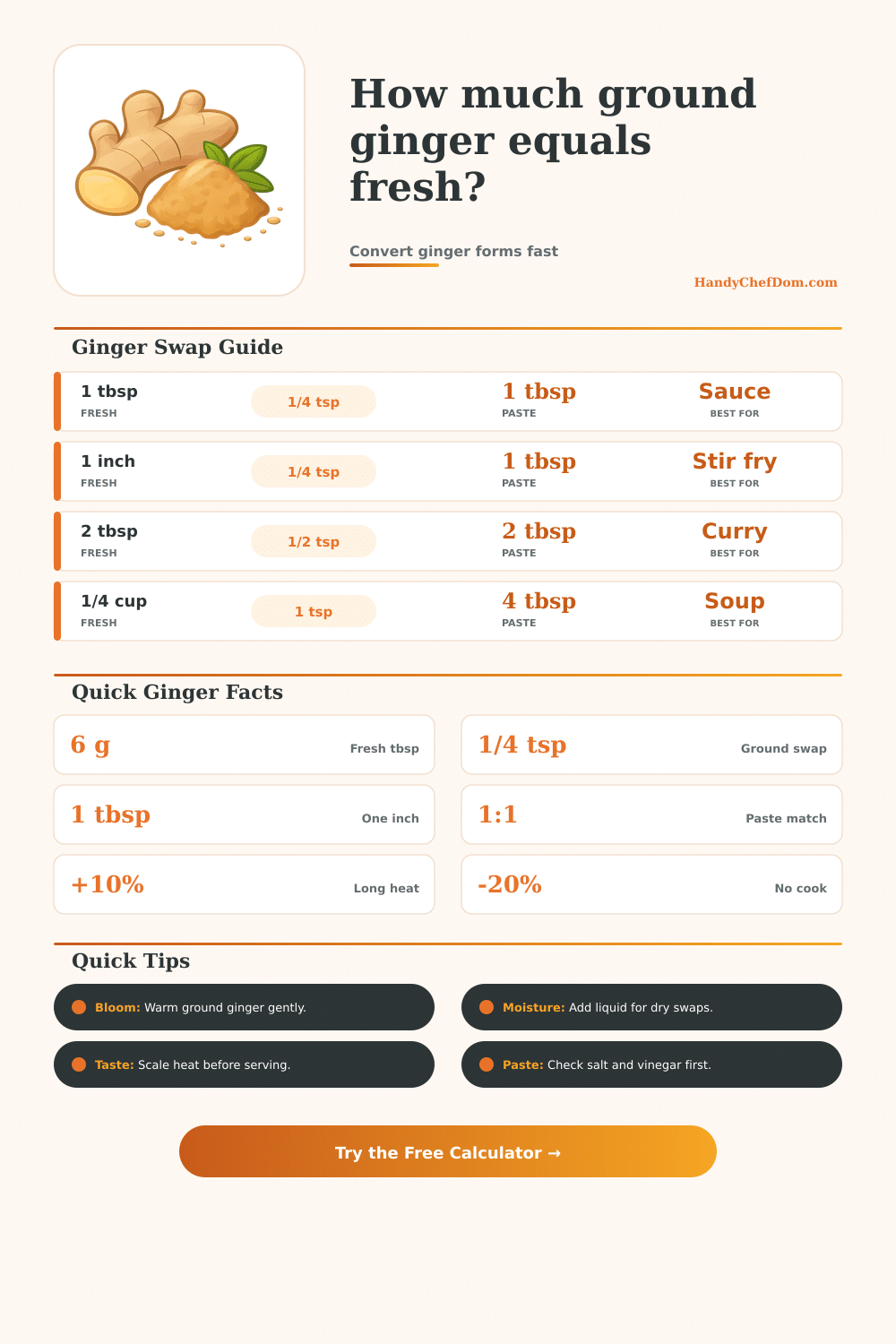
| 1 tablespoon grated fresh | 1/4 teaspoon ground | 1 tablespoon paste or minced | About 1 1/2 teaspoons liquid |
| 1 inch peeled knob | 1/4 teaspoon ground | 1 tablespoon grated or paste | About 1 1/2 teaspoons liquid |
| 2 tablespoons grated fresh | 1/2 teaspoon ground | 2 tablespoons paste or minced | About 1 tablespoon liquid |
| 1/4 cup grated fresh | 1 teaspoon ground | 4 tablespoons paste or minced | About 2 tablespoons liquid |
| 1/2 cup grated fresh | 2 teaspoons ground | 8 tablespoons paste or minced | About 1/4 cup liquid |
| Measurement Input | Fresh Equivalent Used | Ground Equivalent | Best Calculator Use |
|---|---|---|---|
| Fresh ginger grams | 6 g per tablespoon | 24 g fresh per 1 tsp ground | When a recipe lists weight |
| Fresh ginger tablespoons | 1 tbsp grated fresh | 1/4 tsp ground ginger | Most home recipes |
| Fresh ginger inches | 1 inch equals about 1 tbsp grated | 1/4 tsp ground ginger | Knob-style recipe notes |
| Ground ginger teaspoons | 1 tsp equals about 4 tbsp fresh | Direct spice measure | Reverse conversion to fresh |
| Jarred minced ginger | 1 tbsp equals about 0.9 tbsp fresh | About 1/4 tsp ground | Convenience jars |
| Ginger paste teaspoons | 3 tsp equals about 1 tbsp fresh | About 1/4 tsp ground | Tube or refrigerated paste |
| Recipe Type | Ground Ginger Tendency | Calculator Factor | Practical Reading |
|---|---|---|---|
| Stir-fry | Can taste powdery if not bloomed | 0.95x | Use slightly less and add early |
| Curry or masala | Spice base can carry more ginger | 1.12x | Works well with garlic and warm spices |
| Baking | Ground ginger is expected | 0.90x | Use measured spice levels |
| Soup or broth | Liquid softens dried spice | 1.00x | Classic conversion is usually enough |
| Marinade or glaze | Sweet and salty sauces need punch | 1.08x | Boost slightly for bold aroma |
| No-cook dressing | Ground ginger stays sharp and dry | 0.80x | Use less and hydrate first |
| Heat Level | Adjustment | Why It Changes | Calculator Note |
|---|---|---|---|
| No-cook or chilled | 0.80x | Ground ginger stays direct | Hydrate before adding |
| Quick heat | 0.95x | Short cooking blooms spice fast | Add with oil or sauce |
| Simmered | 1.00x | Liquid disperses the spice | Classic conversion works |
| Long cook | 1.10x | Flavor rounds off over time | Slight boost keeps warmth |
| Baked | 0.90x | Dried spice concentrates in crumbs | Measure carefully |
| Reheated leftovers | 0.85x | Ginger grows stronger overnight | Hold back a pinch |
Fresh ginger and ground ginger are different ingredient with different properties. Fresh ginger contain water and fiber. Ground ginger doesnt contain water or fiber.
Because fresh ginger contains water and ground ginger does not contain water, when you use fresh ginger in a recipe, the fresh ginger will provide moisture to the recipe. Ground ginger will not add moisture to a recipe. If you use ground ginger instead of fresh ginger or if you use fresh ginger instead of ground ginger, you will be change the texture of the dish.
Fresh and Ground Ginger: How to Adjust Your Recipe
The calculator will provide mathematical adjustments based on the recipe you choose and the type of cooking conditions for the recipe. You must understand the type of cooking conditions for the recipe because the behavior of ginger will differ based on the type of recipe you are cooking. For example, ginger will behave differently in a quick sauce compared to a long simmer or a baked good.
Additionally, the heat of the cooking environment will affect the behavior of ginger in the recipe. For example, recipes that require you to boil or saute the ginger for long periods will have a different result than recipes that require the ginger to be cooked for short period of time. The calculator allow you to choose between short cooking and long cooking settings to account for these differences.
Additionally, the state of the ginger will impact the recipe. For example, recipes that use young ginger will have different result than recipes that use mature ginger. The number of servings for the recipe is another factor that will impact the amount of ginger that is needed.
For example, if you double the recipe, the amount of ginger will not double. Other ingredient in the recipe will impact the strength of the ginger flavor, so the calculator will provide an adjustment to the amount of ginger that you need. If the recipe includes ingredients like sauces or marinades, you may need to add liquid to the sauce because fresh ginger will provide moisture to the sauce, and when the ginger simmers in the sauce, it will no longer provide moisture to the sauce.
The calculator will provide an estimate of the amount of liquid to add to the recipe to make up the difference of moisture that the fresh ginger provided to the sauce. People often make mistakes when using ginger. For example, if you are baking, ground ginger is the best form of ginger to use because the flavor of the ground ginger will distribute even throughout the recipe, and the flavor of the ground ginger will remain strong through the baking process.
However, ground ginger will be harsh in a salsa that does not require cooking because the ground ginger will not become softened through the cooking process. The calculator will allow you to select the type of recipe that you are making and the heat level of the recipe. This will allow the calculator to provide you with the best adjustment to the amount of ginger to use in your recipe.
In addition to the form of ginger that you use, there are other ingredients to consider. Ginger paste and jarred ginger both contain additional ingredients. For example, ginger paste may contain salt, oil, or vinegar.
These additional ingredients mean you will have to adjust other seasoning in your recipe. Additionally, jarred minced ginger isnt the same as fresh ginger. The texture of jarred minced ginger is softer, and the aroma is flatter.
The calculator will allow you to select the specific type of ginger to use in your recipe so that the calculator can adjust for the differences in texture and aroma in jarred minced ginger and ginger paste. The tables that the calculator provides will display information about scaling ginger. For example, the tables will display the comparison between one tablespoon of fresh grated ginger and ground ginger.
The tables will also display the comparison between one tablespoon of fresh grated ginger and ginger paste. Additionally, the tables will display how the amount of ginger will change based on the type of recipe that you are creating. While you do not need to memorize the information in these tables, you should remember that the ratio between forms of ginger is not a one-to-one ratio.
You should taste the food while cooking the food. The flavor of ginger quickly builds in the food being cooked. Additionally, it is easier to add more of an ingredient to food than to remove an ingredient from food.
If you add too much ginger to a recipe, you can always remove some of the food from the stove. However, if you add too much ginger to the food while it is cooking, you cant remove it from the food. To avoid adding too much ginger to your food, you should of started with the amount of ginger that the calculator indicated for your recipe.
Additionally, you should allow the ginger to cook in the fat or liquid in your recipe for a short time so that you can taste the flavor of the ginger before you add more of the ingredient. Eventually, as you use ginger in different types of recipes, you will notice patterns in the amount and type of ginger that is needed. For example, curries use more ginger than other flavorings in the same recipe because other spices balance the flavor of ginger in curries.
No-cook dressings require less ginger than sauces that require cooking because the flavor of ginger remains strong and sharp in no-cook dressings. Braised foods require more ginger because the heat of the braised food will soften the flavor of the ginger in the foods. However, you can always use the calculator to determine the amount of ginger to add to your food when braising it.
The calculator will always provide you with a reliable starting point for the amount of ginger to add to your recipe.