🌾 Protein in Flax Seeds Calculator
Estimate protein from whole flax seeds, ground flax, or flaxseed meal using grams, ounces, tablespoons, or cups, then split the result by serving.
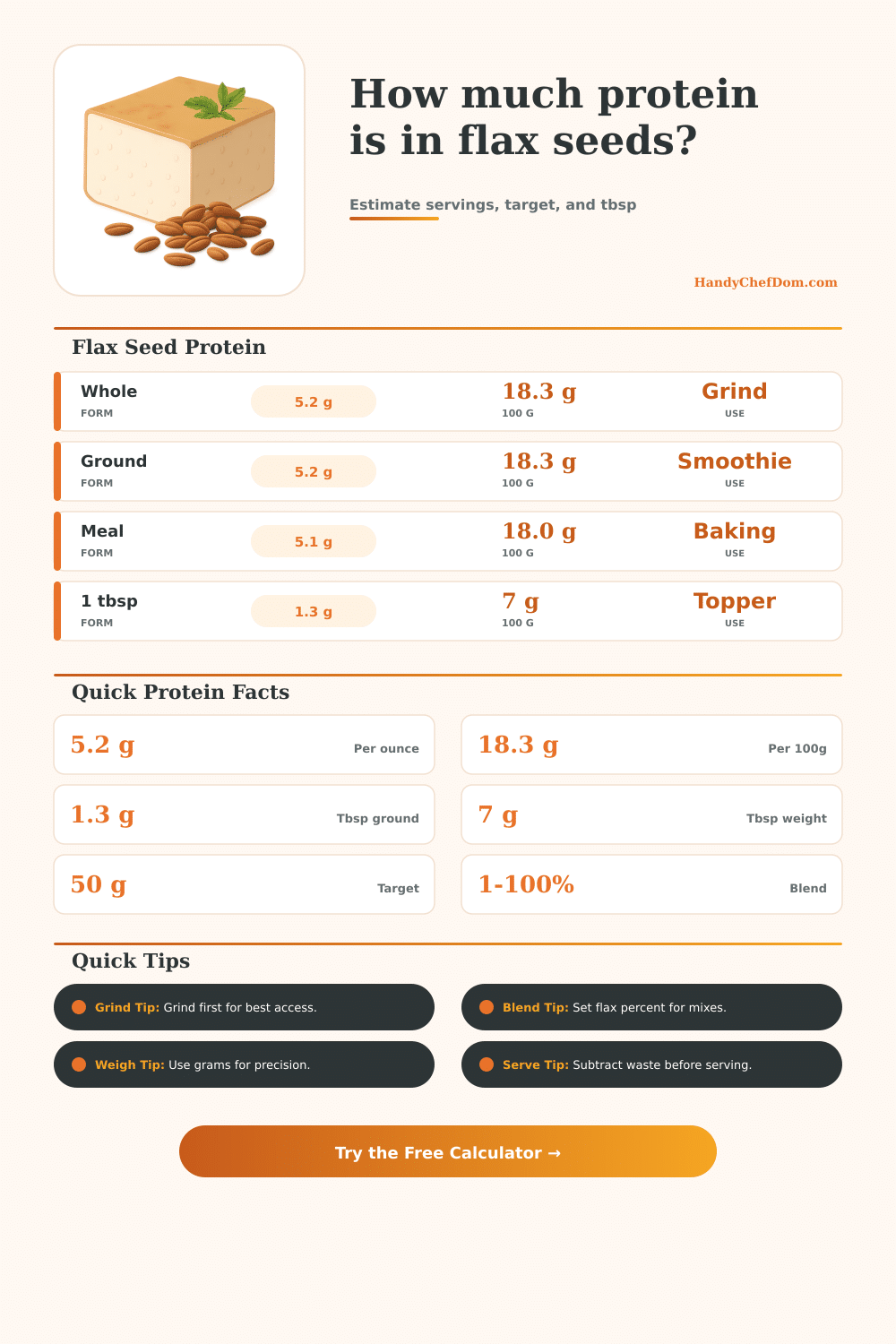
Flax seeds are estimated at about 5.2 g protein per ounce, 18.3 g per 100 g, and about 1.3 g protein per tablespoon of ground flax. The freshness/access setting estimates how much protein to count after grinding, storage, or leaving seeds mostly whole.
| Flax Form | Protein per Oz | Protein per 100 g | Tablespoon Weight | Calculator Note |
|---|---|---|---|---|
| Whole flax seeds | 5.2 g | 18.3 g | 10 g | Best counted after grinding or chewing well |
| Ground flax seeds | 5.2 g | 18.3 g | 7 g | Main tablespoon reference used here |
| Flaxseed meal | 5.1 g | 18.0 g | 7 g | Fine grind for baking and batters |
| Mixed seed blend | Calculated | Calculated | Varies | Use blend percent to count only flax |
| Seed or Nut | Protein per Oz | Protein per 100 g | Common Portion | Protein Style |
|---|---|---|---|---|
| Flax seeds | 5.2 g | 18.3 g | 1-2 tbsp ground | Moderate seed protein |
| Chia seeds | 4.4 g | 16.5 g | 1 tbsp or pudding | Similar spoon use |
| Hemp hearts | 9.5 g | 31.6 g | 2-3 tbsp topping | Higher protein seed |
| Pumpkin seeds | 8.5 g | 30.2 g | 1 oz snack | Dense snack protein |
| Sunflower seeds | 5.8 g | 20.8 g | 1 oz topping | Close seed comparison |
| Sesame seeds | 5.0 g | 17.7 g | 1 tbsp garnish | Similar garnish use |
| Serving Measure | Ground Flax Weight | Protein Estimate | Tablespoon Eq. | Use Case |
|---|---|---|---|---|
| 1 teaspoon | 2.3 g | 0.4 g | 0.33 tbsp | Small garnish |
| 1 tablespoon | 7 g | 1.3 g | 1 tbsp | Smoothie boost |
| 2 tablespoons | 14 g | 2.6 g | 2 tbsp | Oat bowl topping |
| 1 ounce | 28.35 g | 5.2 g | 4.0 tbsp | Large daily add-in |
| 1/4 cup ground | 28 g | 5.1 g | 4 tbsp | Baking batch |
| 1 cup ground | 112 g | 20.5 g | 16 tbsp | Recipe canister |
| Recipe Use | Typical Flax Amount | Protein Range | Best Unit | Calculator Setting |
|---|---|---|---|---|
| Smoothie or shake | 1-2 tbsp ground | 1.3-2.6 g | Tablespoons | Freshly ground or well mixed |
| Oats, yogurt, cereal | 1 tbsp ground | 1.3 g | Tablespoons | Pure flax at 100% |
| Baking batter or dough | 1/4 cup ground | 5.1 g batch | Cups or grams | Divide by finished servings |
| Seed blend jar | 25-75% flax | Blend based | Grams | Set flax share percent |
| Meal prep bowls | 7-14 g each | 1.3-2.6 g | Grams | Use serving count |
Flax seed contain protein and can be added to many different meal. Flax seeds can be added to a meal in either whole or ground form. Because the body cannot easily digest the whole flax seeds, the whole form of flax seeds will provide less protein to the body than ground flax seeds.
Thus, it is important to understand the difference between these two form of flax seeds in order to accurately track the protein consumption of an individual who incorporate flax seeds into there diet. The flax seed protein calculator is use to calculate the protein content of the flax seeds that an individual consumes. In order to calculate the amount of protein content of the flax seeds, the individual must enter the form of flax seeds (whole or ground) and the amount of flax seeds that are to be consumed.
How to Calculate Protein in Flax Seeds
Such a calculator are necessary to account for the fact that the measurement in the kitchen may differ from those on the nutrition label, or for slight loss of flax seeds during the cooking process. Many individuals choose to use flax seeds as an added ingredient to meals because flax seeds is easy to store and use in meals. Flax seeds can be added to meals like oatmeal and smoothies, and they do not change the flavor of the meals in which they are added.
The protein content of flax seeds, however, can differ based off the freshness of the flax seeds. If flax seeds have been sitting in a jar for a long time, the body may absorb less protein from those seed than if they were fresh and recently ground. To account for this, the calculator also include a setting to adjust for the freshness of the flax seeds.
The way that flax seeds are use in recipes can also affect the amount of protein that an individual may receive from those meals. For instance, if flax seeds are used in baking, some of the flax seeds may remain in the bowl or on the spoon. Thus, the individual will consume fewer flax seeds.
In contrast, if flax seeds are added to a breakfast item like yogurt, an individual will eat most of the flax seeds. The calculator accounts for this waste of flax seeds by asking the user for the percentage of flax seeds that may be wasted in the recipe. Flax seeds can be compared to other seed to determine the protein content of flax seeds.
For instance, hemp hearts contain more protein than flax seeds, but are more expensive and have a stronger taste to the individuals meal. Chia seeds contain a similar amount of protein as flax seeds, and behave similar when added to recipes. Pumpkin seeds contain more protein than flax seeds, but require a different method to be portion out of meals.
Thus, by comparing flax seeds to these other types of seeds, the user can understand the difference in the protein content of flax seeds. The serving count of the meals that contain flax seeds is also important when calculating the protein content of the meals. If an individual plans to use flax seeds to make a large batch of food, the total protein content of that food must be divided by the number of serving that will be made.
It is easy for individuals to make the mistake of considering the entire recipe as one serving, but each portion of food prepared with flax seeds should of been counted as one serving. The target percentage indicate the portion of the individuals daily protein goal that is contributed by the protein content of the flax seeds. Due to the consistency with which an individual can use flax seeds, an individual may incorporate one or two tablespoon of ground flax seeds into their meals each day.
Thus, ground flax seeds provide protein, fiber, and healthy fats to the body. The flax seed protein calculator allow an individual to avoid guessing at the protein content of their meals that contain flax seeds, and allow them to more easy determine if the addition of flax seeds to their meals helps to meet their daily nutritional needs.