🍗 Baking Powder for Chicken Wings Calculator
Measure baking powder, kosher salt, per-wing coating, and tray batches for crisp chicken wings without guessing.
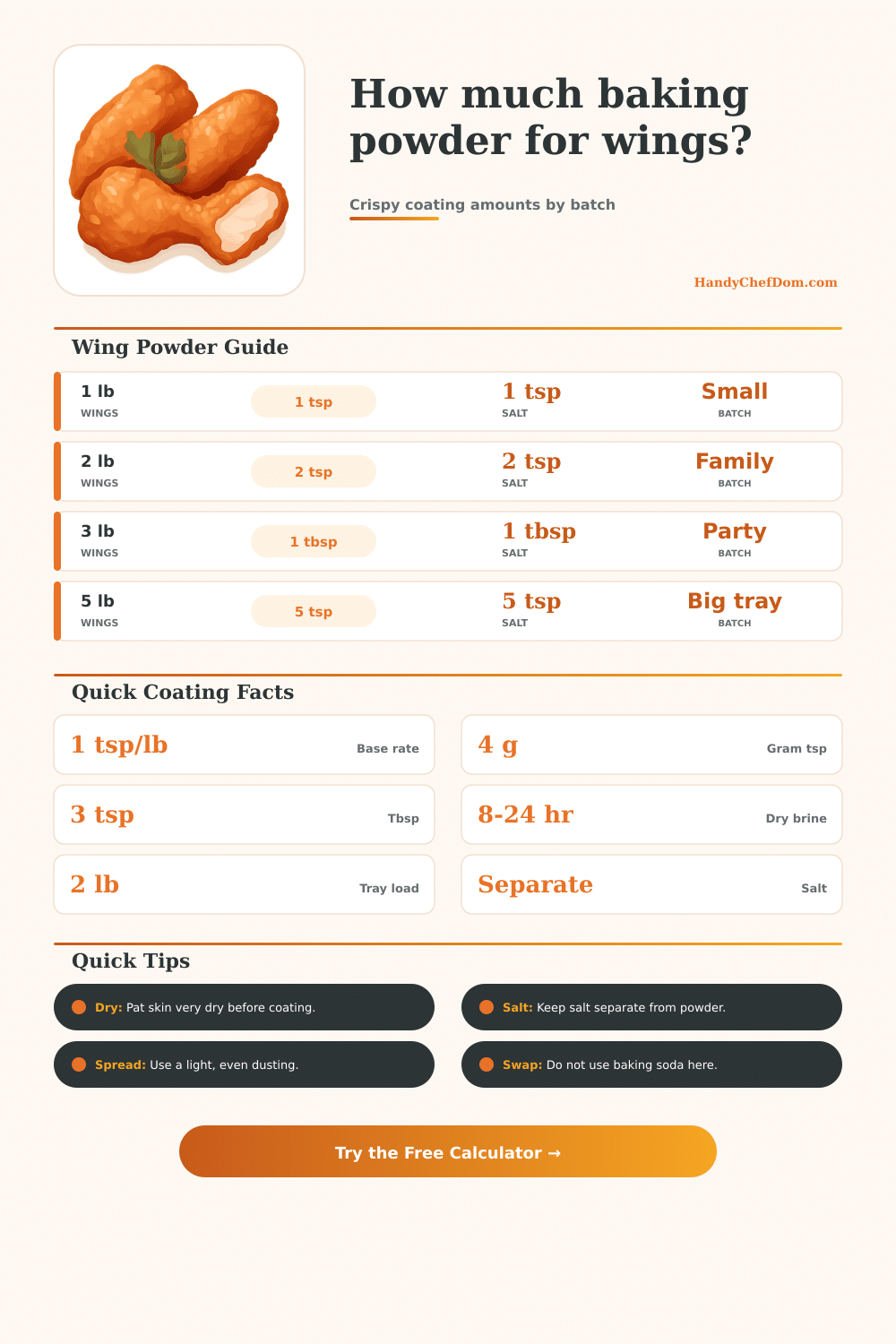
A common crispy-wing starting point is about 1 teaspoon baking powder per pound of wings, with salt calculated separately so the coating stays balanced.
| Wing Batch | Typical Pieces | Base Powder | Balanced Salt |
|---|---|---|---|
| 1 lb wings | 8-12 pieces | 1 tsp | 3/4 tsp |
| 2 lb wings | 16-24 pieces | 2 tsp | 1 1/2 tsp |
| 3 lb wings | 24-36 pieces | 1 tbsp | 2 1/4 tsp |
| 4 lb wings | 32-48 pieces | 4 tsp | 1 tbsp |
| 5 lb wings | 40-60 pieces | 5 tsp | 3 3/4 tsp |
| 6 lb wings | 48-72 pieces | 2 tbsp | 4 1/2 tsp |
| Coating Target | Powder Rate | Best Fit | Texture Note |
|---|---|---|---|
| Light dusting | 0.85 tsp/lb | Sauced wings | Thin, tidy coat |
| Standard crispy | 1.00 tsp/lb | Classic wings | Reliable crunch |
| Bold crunch | 1.15 tsp/lb | Large wings | More surface grip |
| Extra-crisp | 1.30 tsp/lb | Very dry skin | Use an even dusting |
| Air fryer close fit | 0.95 tsp/lb | Small baskets | Less residue |
| Overnight rest | 0.95 tsp/lb | Dry brine trays | Cleaner finish |
| Setup | Powder Adjust | Batch Capacity | Coating Note |
|---|---|---|---|
| Oven sheet pan | 1.00x | About 2 lb | Single layer spacing |
| Convection rack | 0.97x | About 2.5 lb | Air reaches both sides |
| Air fryer basket | 0.95x | About 1.25 lb | Avoid powdery patches |
| Split cooking | 1.02x | Two small loads | Buffer helps transfer |
| Still damp skin | 1.10x | Any setup | Pat dry if possible |
| Uncovered fridge dry | 0.95x | Any setup | Powder clings easily |
| Coating Style | Powder | Salt | When To Use |
|---|---|---|---|
| Minimal dust | 0.85 tsp/lb | 1/2 tsp/lb | Light snack wings |
| Balanced crisp | 1 tsp/lb | 3/4 tsp/lb | Most wing nights |
| Salty classic | 1 tsp/lb | 1 tsp/lb | Unsauced platters |
| Extra crunch | 1.3 tsp/lb | 3/4 tsp/lb | Very dry wings |
| Low-salt coat | 1 tsp/lb | 1/2 tsp/lb | Seasoned sauce later |
| Party buffer | 1.05 tsp/lb | 3/4 tsp/lb | Large mixing bowls |
Baking powder is a tool that you can use to change the texture of chicken wing skin. Baking powder work because baking powder raises the pH level of the skin of the chicken wing and baking powder pull moisture out of the skin of the chicken wing. As a result, a thin crust form on the skin of the chicken wing that can brown quick when exposed to high heat.
Salt is a different ingredient from baking powder and does not have the same effect upon the skin of the chicken wing. You must understand how baking powder works to use it correctly when preparing chicken wings. The weight of the chicken wings that you will prepare is an important measurement in the cooking process.
How to Use Baking Powder to Make Crispy Chicken Wings
Knowing the weight of the chicken wings that you will prepare will allow you to determine how much baking powder to use on each pound of chicken wing. Using the calculator will allow you to determine the amount of baking powder that you should use based off the weight of the chicken wings and the number of piece of chicken wings that you will prepare. The calculator will also calculate the amount of salt that you need for the recipe, although it will keep the measurement for salt separately from the amount of baking powder that you will use.
The dryness of the skin of the chicken wings can affect the amount of baking powder that will stick to the skin of the chicken wings. If the skin of the chicken wings is too damp, the baking powder will clump together in some area of the skin of the chicken wings but will not cover others. You can dry the skin of the chicken wings using kitchen towels to absorb the excess juice or by leaving the chicken wings uncovered in the refrigerator.
The calculator includes a setting for skin dryness because the dryness of the skin can change the texture of the chicken wings once you have prepared them. If the skin of the chicken wings is tacky, you may need to add more baking powder then the calculator suggests. The appliance that you use to cook the chicken wings can change the amount of baking powder that you should use on the chicken wings.
If you use an air fryer to cook the chicken wings, you can use a lighter amount of baking powder because the hot air will help to brown the skin of the chicken wings. If you use a sheet pan in a regular oven to cook the chicken wings, you will need to use more baking powder because the air will not circulate as quick on the sheet pan as in an air fryer. A convection oven sits somewhere in the middle of the two appliances.
The baking powder calculator allows you to adjust the base rate for baking powder according to the appliance you will use to cook the chicken wings so that you can avoid using the wrong amount of baking powder for your appliance. Salt and baking powder should be two separate ingredients used in preparing chicken wings. Salt enhances the flavor of the chicken wings.
Baking powder affects the texture of the skin of the chicken wings. For each pound of chicken wings, you can use approximately three-quarters of a teaspoon of kosher salt. However, the amount of salt that you use will depend on whether you will add sauce to the chicken wings after you cook them.
The salt measurement will be separate from the baking powder on the recipe calculator so that you can adjust the amount of salt without affecting the amount of baking powder that you use. The length of time that you allow the chicken wings to rest before you cook them can affect the outcome of the recipe. If you allow the chicken wings to rest for a few hours, the baking powder can begin to dry the skin of the chicken wings and the salt can penetrate the skin of the chicken wings.
If you allow the chicken wings to rest for an entire overnight period, the salt will enhance the flavor of the chicken wings and the skin of the chicken wings will become tight. If you allow the chicken wings to rest for longer than 24 hours, the salt can dry the skin of the chicken wings too much, especially in dry climates. The baking powder calculator includes a field for determining the length of time that the chicken wings should rest before cooking them.
The longer that the chicken wings rest, the more baking powder you will need to apply to the skin of the chicken wings. When preparing the chicken wings, you should avoid a few mistakes. Using eye estimation to determine how much baking powder to use is one mistake that you should avoid.
Eye estimation will result in adding incorrect amount of baking powder. Crowding the chicken wings together on the sheet pan is another mistake to avoid because baking powder will not be able to circulate around the chicken wings. Baking soda instead of baking powder is another mistake to avoid because baking soda can impart a harsh taste to the chicken wings and will not dry the skin of the chicken wings as wellly as baking powder.
Finally, using the baking powder calculator will allow you to understand your preference for the chicken wings. Using the calculator will allow you to understand the behavior of an air fryer as opposed to a sheet pan, and how strong of a crunch you prefer in your chicken wings. Once you understand each of these variable, the calculator will be a simple tool to use while the chicken wings rest and while the oven heats up to the cooking temperature.