🍚 Water to Cook Bulgur Wheat Calculator
Calculate the water ratio for bulgur wheat by dry cups or grams, grind size, soak or simmer method, texture goal, servings, salt level, altitude, and covered-pot evaporation.
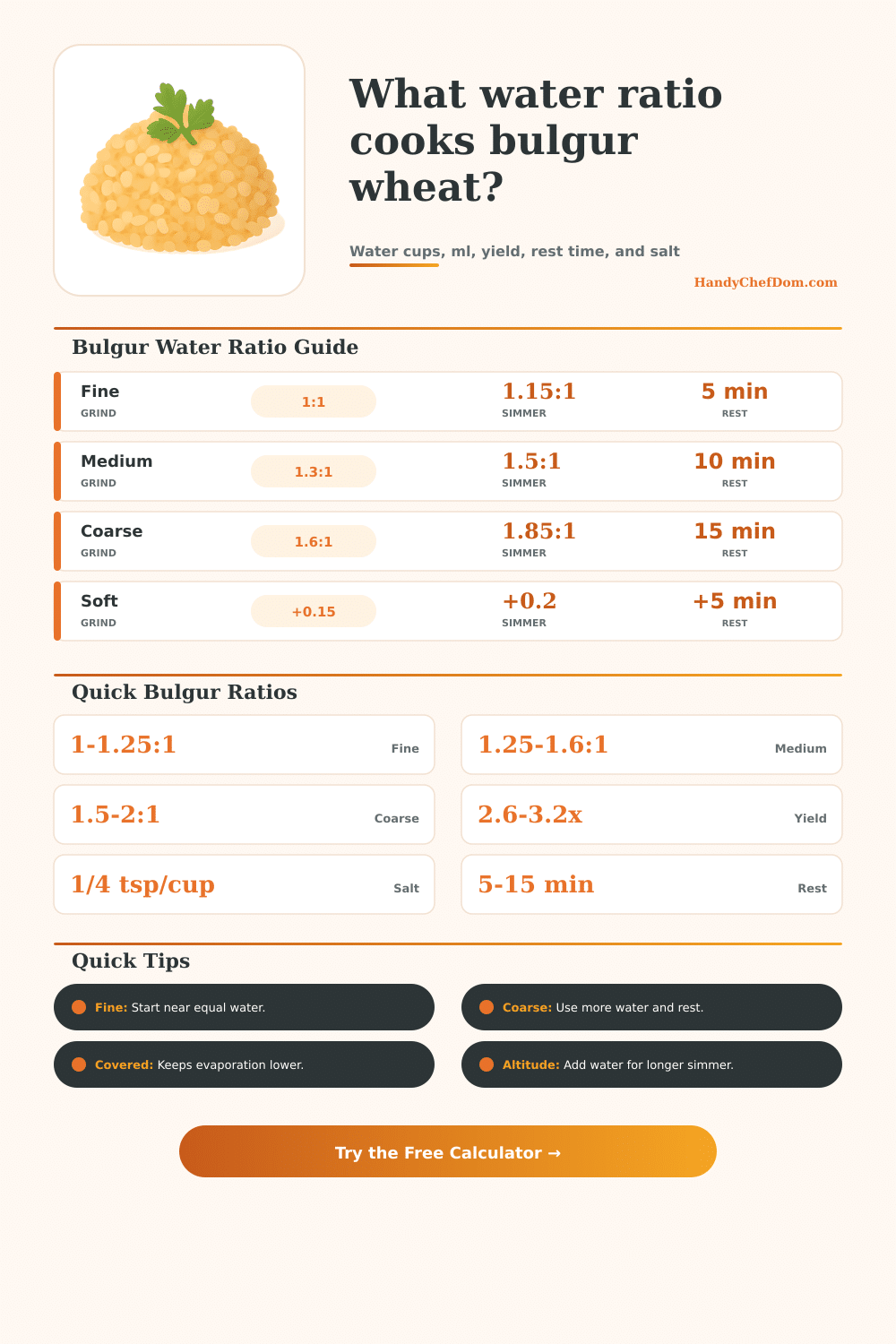
Fine bulgur often hydrates around 1:1 to 1.25:1 water to bulgur. Coarse bulgur commonly needs about 1.5:1 to 2:1, especially when simmered or cooked softer.
Small particles hydrate quickly, so start close to equal water for salads and tabbouleh-style grains.
The flexible middle range works for bowls, sides, and pilaf-style simmered batches.
Larger pieces need more water and time to soften, especially when the target texture is tender.
A tight lid keeps the ratio predictable and reduces the extra water needed for evaporation.
| Grind size | Approx grams per cup | Hydration behavior | Best calculator use |
|---|---|---|---|
| Fine bulgur | About 152 grams per dry cup | Hydrates quickly with hot water and short rest | Use 1:1 to 1.25:1 for tabbouleh-style texture |
| Medium bulgur | About 160 grams per dry cup | Balanced absorption for soaking or simmering | Use around 1.25:1 to 1.6:1 for bowls and sides |
| Coarse bulgur | About 168 grams per dry cup | Needs more water and longer covered rest | Use 1.5:1 to 2:1 for pilaf-style grains |
| Texture goal | Fine bulgur | Medium bulgur | Coarse bulgur |
|---|---|---|---|
| Firm and separate | 1:1 to 1.1:1 water to bulgur | 1.25:1 to 1.35:1 water to bulgur | 1.5:1 to 1.65:1 water to bulgur |
| Tender everyday | 1.1:1 to 1.2:1 water to bulgur | 1.4:1 to 1.55:1 water to bulgur | 1.7:1 to 1.85:1 water to bulgur |
| Soft hydrated | 1.2:1 to 1.3:1 water to bulgur | 1.55:1 to 1.7:1 water to bulgur | 1.85:1 to 2:1 water to bulgur |
| Method | Water planning | Typical timing | Use when |
|---|---|---|---|
| Pour-over soak | Use hot water, cover the bowl, and limit extra evaporation water | Fine 5 minutes, medium 10 minutes, coarse 15 to 20 minutes | You want simple hydration without active simmering |
| Covered simmer | Add a small evaporation allowance, then rest off heat | Fine 4 minutes, medium 8 minutes, coarse 12 to 15 minutes, plus rest | You want warmer, softer, pilaf-style cooked bulgur |
| Vented or uncovered simmer | Add extra water because steam loss is higher | Check early and stop when water is absorbed | You cannot cover tightly or use a wide pan |
| High-altitude simmer | Add water for longer cooking and lower boiling temperature | Expect a longer simmer and longer rest | You cook above about 2,000 feet |
| Grain | Common water ratio | Cooked yield | Calculator note |
|---|---|---|---|
| Bulgur wheat | About 1:1 to 2:1 by grind | About 2.6x to 3.2x dry volume | This calculator adjusts bulgur by grind, method, and texture |
| Couscous | About 1:1 to 1.25:1 | About 2.5x dry volume | Similar quick hydration but usually smaller particles |
| White rice | About 1.5:1 to 2:1 | About 3x dry volume | Longer cooking and more starch release than bulgur |
| Quinoa | About 2:1 | About 3x dry volume | Needs rinsing and a distinct simmer-rest pattern |
| Farro | Boil in excess water or 3:1 | About 2.5x to 3x dry volume | Chewier grain with much longer cooking time |
In order to successfully cook bulgur wheat, you must use the correct amount of water. The amount of waters will determine teh texture of your bulgur wheat. If you use too little water, the bulgur wheat will be hard in the middle of the grains.
However, if you use too much water, the bulgur wheat will become too soft and mushy like porridge. The texture of the bulgur wheat rely upon the amount of water that the bulgur wheat absorbs. One of the factors that impact the amount of water you should use is the grind of your bulgur wheat.
How Much Water to Cook Bulgur Wheat
Fine bulgur wheat will absorb water rapidly due to the small particles of bulgur wheat. Therefore, fine bulgur wheat require less water than more coarser varieties of bulgur wheat. Coarser bulgur wheat requires more water and more cooking time for the water to penetrate into the bulgur wheat.
Bulgur wheat that is of medium grind will be somewhere in the middle of these two varieties. Thus, the grind of the bulgur wheat will impact the amount of water need to cook the bulgur wheat. Another factor that will impact the amount of water that you should use is the cooking method for the bulgur wheat.
If you are using hot water and allowing the bulgur wheat to sit, you will use less water. However, if you are simming the bulgur wheat on the stove, you will need to use more water since some of the water will evaporate while the bulgur wheat simmers. Furthermore, the altitude at which you are cooking will also impact the water amount.
At higher altitudes, water boils at a lower temperature. Thus, you will need more water to cook the bulgur wheat at higher altitude. Another factor that will impact the amount of water is the texture that you would like your bulgur wheat to have when cooked.
If you are preparing a recipe in which you would like the bulgur wheat to be firm, you will use less water. For recipes that require the bulgur wheat to be soft, such as tabbouleh, you will add more water to the bulgur wheat so that it will absorb all of the waters. Another cooking choice is whether or not to add salt to the water.
Adding a small amount of salt will season the bulgur wheat. Alternatively, you can leave the salt out of the cooking water if you plan to add dressings to bulgur wheat that contain heavy amount of salt. In order to determine the correct amount of water for your bulgur wheat, you can utilize a calculator that takes into account each of these variables.
By entering the amount of bulgur wheat that you have, the grind of bulgur wheat that you will use, the cooking method, and the texture that you would like your bulgur wheat to have, the calculator will tell you how much water to use, how much the bulgur wheat will grow when cooked, and for how long you should allow the bulgur wheat to rest. This resting time allow the bulgur wheat to absorb the remaining water. The other factor to consider is how tightly you cover the pot in which you cook the bulgur wheat.
Bulgur wheat that is cooked in a covered pot will remain moist; bulgur wheat that is cooked in an open pot will become dry. Therefore, if the pot does not feature a tight lid, you will have to add more water to compensate for the bulgur wheat that evaporates from the pot. Many people makes mistakes when preparing bulgur wheat.
One such mistake is using the water ratio for fine bulgur wheat for coarse bulgur wheat. This mistake will result in the cooked bulgur wheat being undercooked. Another mistake is using the same amount of water that you would use for soaking bulgur wheat for simmering bulgur wheat on the stove.
Simmering requires more water due to evaporation. By knowing each of these variables, you can avoid these mistakes. Bulgur wheat is different than other grains like rice or quinoa because someone has already partially cooked bulgur wheat before it is prepared for purchase.
Because bulgur wheat is already partially cooked, it will rehydrate rather than being cooked from raw bulgur wheat. This is one of the reasons that less water is needed for bulgur wheat than for other grains, and why rest time is necessary after cooking the bulgur wheat. This resting period allow the water to move to the bottom of the bulgur wheat so it does not become gummy.
By understanding the variables that impact the amount of water needed to cook bulgur wheat, you will never have to guess the proper way to cook bulgur wheat again. A calculator can help you to determine the math behind cooking bulgur wheat, and through experience you will be able to recognize when you have cooked bulgur wheat for the proper length of times.