🐚 Cornmeal to Clean Clams Calculator
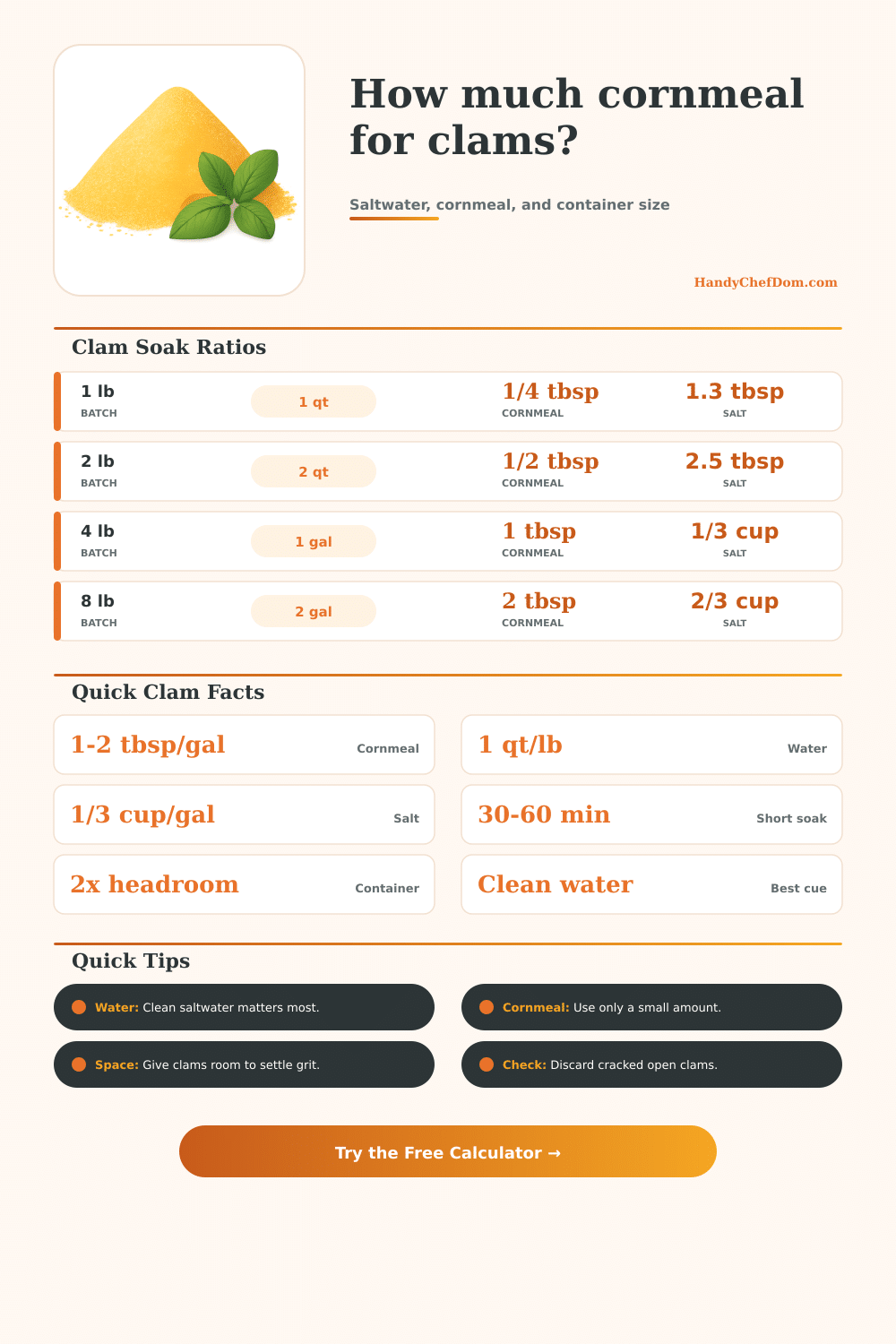
Estimate a light optional cornmeal amount, briny soaking water, salt, time, and container headroom for cleaning clams without treating cornmeal as the main purge tool.
Traditional cornmeal is optional and usually small, about 1 to 2 tablespoons per gallon. Clean salted water, enough room, and letting grit settle below the clams matter more than feeding the clams cornmeal.
Use enough briny water so expelled sand can settle below the clams instead of being stirred back in.
Traditional but optional; keep it around 1 to 2 tablespoons per gallon rather than making a thick slurry.
A wide bowl, pan, or tub gives clams a shallow layer and helps sediment stay away from the shells.
If water turns cloudy or sandy, replace it with fresh salted water at the same ratio.
| Clam type | Typical count per lb | Water planning | Cornmeal note |
|---|---|---|---|
| Littleneck hard clams | 12 to 18 | About 1 qt per lb | Use the light baseline; hard clams usually need clean brine more than cornmeal. |
| Manila clams | 18 to 24 | About 1 qt per lb | Small clams can crowd quickly, so water depth and spacing matter. |
| Cherrystone clams | 6 to 10 | About 1.25 qt per lb | Larger shells need more container room, not much more cornmeal. |
| Soft-shell steamers | 8 to 12 | About 1.5 qt per lb | Often sandier; refresh brine before increasing cornmeal heavily. |
| Razor clams | 4 to 8 | About 1.5 qt per lb | Rinse and inspect carefully; use cornmeal sparingly. |
| Cockles | 30 to 45 | About 0.85 qt per lb | Tiny shells need gentle handling and enough water to settle grit. |
| Mixed market clams | 10 to 20 | About 1.15 qt per lb | Use the grittiest type in the mix as the planning guide. |
| Soak style | Water ratio | Salt ratio | Cornmeal range |
|---|---|---|---|
| Quick market rinse | 1 qt per lb | 1 tbsp per qt | 0 to 1 tbsp per gallon, optional. |
| Standard briny soak | 1 to 1.25 qt per lb | 1 1/4 tbsp per qt | 1 tbsp per gallon is a conservative traditional amount. |
| Sandy shell batch | 1.25 to 1.5 qt per lb | 1 1/4 to 1 1/2 tbsp per qt | 1 1/2 tbsp per gallon; refresh water if cloudy. |
| Very sandy batch | 1.5 qt per lb or more | Keep brine consistent | Up to 2 tbsp per gallon; do not make thick cornmeal water. |
| Colander-in-bowl setup | Enough to cover clams | Same brine ratio | Often needs less cornmeal because grit drops below the colander. |
| Large cooler batch | Plan shallow layers | Mix salt fully first | Measure per gallon and stir before adding clams. |
| Clam batch | Water quarts | Cornmeal tbsp | Container cue |
|---|---|---|---|
| 1 lb appetizer | 1 to 1.25 qt | About 1/4 tbsp | Small wide bowl with extra room for grit. |
| 2 lb dinner | 2 to 2.5 qt | About 1/2 tbsp | Large bowl or shallow roasting pan. |
| 4 lb pasta night | 4 to 5 qt | About 1 tbsp | Food tub or wide stockpot with headroom. |
| 6 lb family boil | 6 to 8 qt | 1 1/2 to 2 tbsp | Use a pan or clean tub; avoid deep crowding. |
| 8 lb party batch | 8 to 10 qt | 2 to 2 1/2 tbsp | Split into two containers if clams stack deeply. |
| 12 lb large prep | 12 to 18 qt | 3 to 4 tbsp | Use a cooler or multiple tubs with consistent brine. |
| Seafood | Soak approach | Cornmeal fit | Cleaning focus |
|---|---|---|---|
| Hard clams | Short briny soak | Optional small amount | Use clean saltwater so sand can settle. |
| Steamers | Briny soak plus refresh | Optional, still light | Often benefits from a water change if sandy. |
| Mussels | Rinse and debeard | Usually skip | Scrub shells and remove beards instead of relying on meal. |
| Oysters | Scrub shells | Skip | Do not soak shucked oysters in cornmeal water. |
| Scallops | Rinse briefly if needed | Skip | Pat dry; avoid soaking delicate meat. |
| Razor clams | Rinse and inspect | Optional, very light | Remove sand pockets by careful cleaning. |
Clams often contains sand within them when they arrives at a kitchen. Before cooking the clams, the sand within them must be removed. Many people believe that cornmeal is the most important tool for removing sand from clams.
However, using clean salted water are the primary tool for removing sand from clams. Cornmeal is an optional tool that can assist in the process should the clams be particulerly dirty. The calculator will mathematically provide results follow you enter the weight of the clams to be cleaned, the volume of water to be used in the process, and the level of grit found within the clams.
How to Remove Sand from Clams
The clam weight and water volume will determines the volume of water per pound of clams. Using too little water will cause the clams to stir the sand back onto the clams. Using too much water will dilute the salt content of the water.
Using too much salt will also prevent the clams from properly pumping water through there systems. The cook must choose the level of salt in the water. Using a light brine is appropriate for delicate types of clams.
For other clams, an ocean-style brine can be used. The ocean-style brine will cause the clams to remain active for a longer period of time. An active clam will expel more sand than a clam that is inactive.
Using the calculator will allow you to add the exact numbers of tablespoons of salt to the water. The calculator will also give you the measurement of cornmeal to be used. However, the amount of cornmeal should of been limited to a minimum because using too much will make the water cloudy without providing any additional benefit to the clams.
One or two tablespoon of cornmeal per gallon of water is the maximum amount of cornmeal to be used. The container in which the clams are soaked must allow for the clams to have headroom. A wide bowl or a wide roasting pan is one such container in which the clams can be soaked.
Using a wide container will allow the sand to settle at the bottom of the container while the clams remains shallow within the container. Using a container that does not allow the clams to have headroom may cause the clams to push sand onto other clams as they open there shells. If the water should become cloudy during the soaking of the clams, you can utilize the refresh option on the calculator to determine the amount of new brine to be added to the water.
Due to the different types of clams that may be available, different amounts of water must be used for each type of clam and different times must be allowed for the soak. For instance, because soft-shell steamers contain more sand than littlenecks, more water will be required to soak the clams and the clams will be required to sit in the brine for a longer period of time. Razor clams are another type of clam that requires a manual rinse prior to soaking because their long shape may allow sand to becomes trapped in areas that cornmeal cannot reach.
A consultation of the reference tables included in the calculator will provide information regarding the different types of clams and the different methods required to properly cleaning them. A clam soak is not a method that can be used to fix every problem with the clams. Using this method will not revive clams that have been sitting on ice for too long.
Additionally, if the shells of the clams have cracked, the clam soak will not help fix that issue. This method can only be used on healthy clams that already contain most of the sand within their bodies. According to the calculator, using clean brine and allowing the clams to have headroom in the soaking container are the two most important factors in removing sand from clams.
If the water is clear after the soaking process is complete, the clams have successfully expelled the sand from there bodies.