🍞 Bread From Flour Calculator
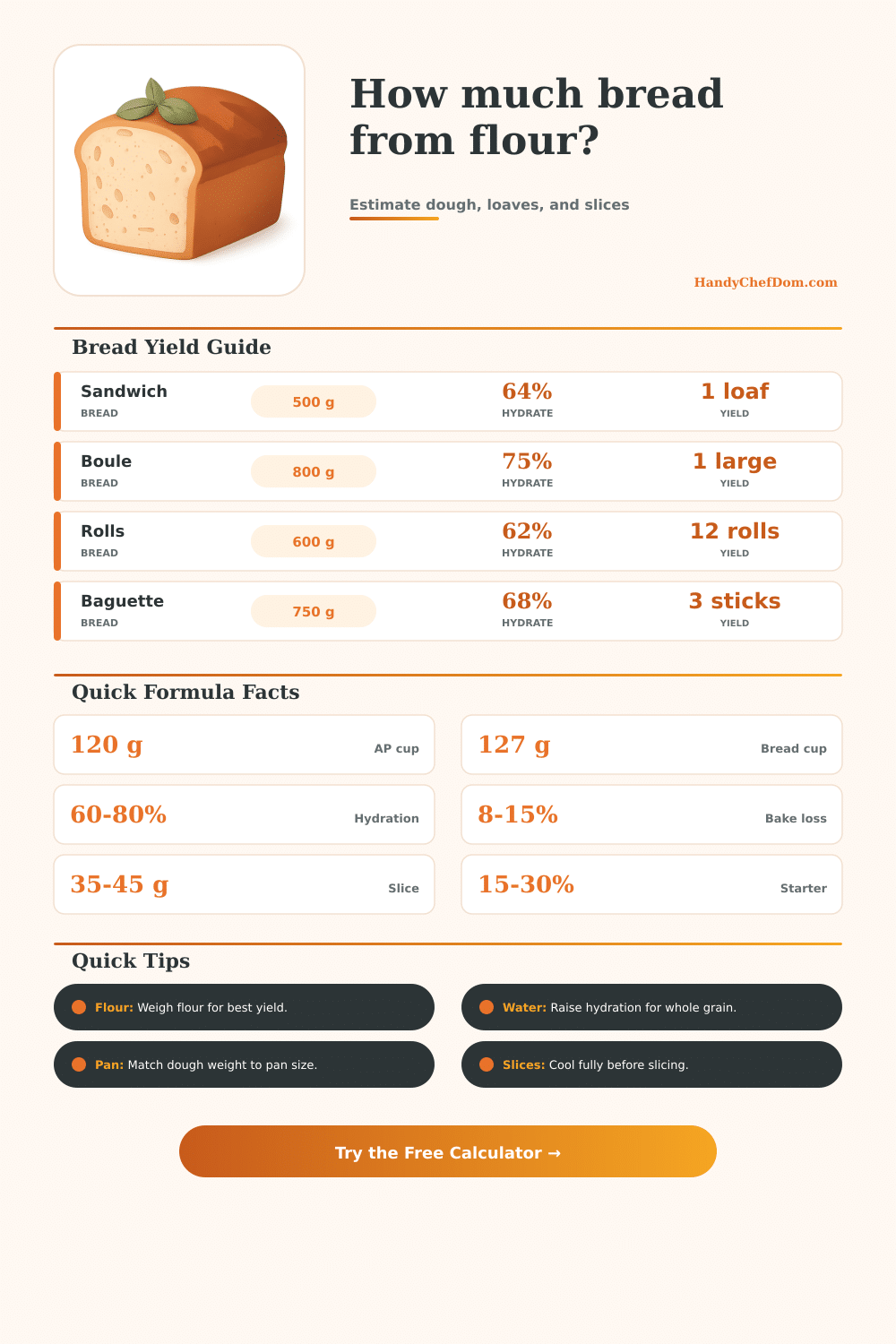
Estimate how much dough, baked bread, loaves, rolls, slices, water, yeast, starter, and pan capacity you get from a flour amount in cups or grams.
Enter the flour you have, then tune hydration, leavening, starter, pan size, bake loss, target piece size, and slice size. Flour is treated as total recipe flour, including any flour carried by sourdough starter or preferment.
| Flour Type | Approx g Per Cup | Protein Feel | Yield Note |
|---|---|---|---|
| All-purpose flour | 120 g | Medium | Good baseline for sandwich loaves, rolls, and enriched dough |
| Bread flour | 127 g | Strong | Usually holds more hydration and gives a taller loaf |
| Strong bread flour | 130 g | Very strong | Useful for high hydration, bagels, pizza, and long fermentation |
| Whole wheat flour | 113 g | Bran-heavy | Needs more water and usually bakes slightly denser |
| Wheat and rye blend | 108 g | Lower gluten | Expect less oven spring and a compact slice count |
| Semolina or durum flour | 167 g | Firm | Best entered by weight because cups vary widely |
| Bread Style | Typical Hydration | Flour For Batch | Typical Baked Yield |
|---|---|---|---|
| Sandwich pan bread | 60% to 68% | 450 g to 600 g | One medium loaf, about 16 to 22 slices |
| Country sourdough | 70% to 82% | 700 g to 900 g | One large boule or two small loaves |
| Baguette batch | 65% to 72% | 700 g to 800 g | Three slim baguettes after bake loss |
| Dinner rolls | 58% to 66% | 500 g to 700 g | 10 to 16 rolls depending on dough weight |
| Focaccia tray | 78% to 90% | 450 g to 650 g | One oily tray bread with lower slice height |
| Brioche-style loaf | 50% to 60% | 450 g to 600 g | One rich loaf with high dough weight |
| Pan Or Piece Format | Useful Dough Range | Baked Size Target | Fit Cue |
|---|---|---|---|
| 8.5 x 4.5 inch loaf pan | 650 g to 850 g | 550 g to 700 g | Classic sandwich loaf with domed top |
| 9 x 5 inch loaf pan | 800 g to 1050 g | 680 g to 880 g | Best for larger home loaves |
| 13 x 4 inch Pullman pan | 950 g to 1250 g | 850 g to 1100 g | Use lower fill for lidded square bread |
| Baguette piece | 280 g to 390 g | 240 g to 340 g | Divide by dough weight, not final length |
| Dinner roll or bun | 55 g to 90 g | 45 g to 75 g | Smaller rolls bake with higher loss |
| Pizza dough ball | 230 g to 330 g | Usually unbaked | Use dough weight as the practical yield |
| Leavening Method | Calculator Rule | Water Impact | Best Use |
|---|---|---|---|
| Instant yeast | Uses style yeast percent directly | No water carried in | Fast pan loaves, rolls, focaccia, pizza |
| Active dry yeast | About 1.25 times instant yeast | Blooming water counts toward recipe water | Traditional home yeast bread |
| Fresh yeast | About 3 times instant yeast | Adds small extra dough weight | Bakery-style enriched and pan dough |
| Sourdough starter | Starter flour share creates starter weight | Starter water is subtracted from bowl water | Long-fermented boule, rye, and country bread |
| Hybrid dough | Uses half yeast plus the entered starter | Starter water still counts | Reliable lift with sourdough flavor |
When planning a bake, you know how many grams of flour to use for a loaf of bread, or so you think, right? What about your hydration or your starter? What about your pan size or what happens in the oven? The answer change as each of these factors does. After cooling on the rack, most bakers realize there’s a world of difference between expected results and actual outcomes. But here’s the part no one knows: we don’t just make dough; we has to see how it behaves under the pressure of time, heat, and a pan. #loaf
The next underestimated variable? The next variable is flour. That cup measurement vary depending on the protein content, how much the flour has settled in the cup, and whether you are using all-purpose or stronger flour. Why? Because switching to weights eliminates this mystery. This is why the calculator above starts with the flour amount instead of treating it as an afterthought. When you have the actual number of grams, it make the remainder of the formula go more predictably. It is no longer a string of hopeful guesses.
How to Plan Your Bread Formula
So there’s your second level of decision making, hydration. The higher the water percentage, the better it stay fresh, and the more open the crumb will be. But it is harder to mix and shape well. White flour doesn’t soak up as much water as whole grain flours do. If I want 100% whole wheat, the amount of water feels different than if I use white flour. You can tell the tool about that with the whole grain share. It alters the formula so that the dough require less water (or more) without having to re-calculate from scratch.
Timing depends in part on leavening choices, too. Reliable rise on schedule. One you can plan around, comes from commercial yeast. Sourdough starter add acidity and longer fermentation, which shifts final crumb and dough strength. To keep the hydration numbers honest, the calculator accounts for share of starter flour. Lots of bakers neglect this consideration if they think of their starter as an add-on to the total flour, instead of part of it.
The batch has to fit your container: this depends on pan size and how heavy you want the finished pieces to be. If too much, it will take longer to bake through or mushroom over the sides of the pan. If too little, it will be squat with a thick crust relative to volume. The dough weight provide a useful warning about whether the dough will fit the pan before starting a long proof.
The quiet factor that surprises folks most is bake loss. Baking and cooling cause water to leave your bread. How much? It is typically eight to fifteen percent, based off the oven humidity level, crust thickness, and loaf size. The tool use that loss to show you what your actual baked weight will be. That’s the one you want if you’re looking to create a specific number of slices, or servings.
You can work backwards from how you eat the bread: Rolls dissapears faster than a single large loaf; sandwich slices run heavier than baguette portions. Enter both the number of slices per serving and the slice weight to see how many actual meals you’ll get out of that batch. This way, rather than seeing an abstract total weight, you see how many real meals the batch will produce based off your slice weight and slices per serving.
In the end, this gives you an opportunity to try out trade-offs ahead of time, before you even get to mixing anything. Adjust the flour content and see how it impacts the rest of the formula (hydration), yeast, and pan size all adjust together. Change the portion of starter and see how that changes the water calculation. In these simple tests you learn which variables affect your results, and which you can comfortabley ignore based off the kind of bread you’re making. That’s when planning shifts from wishful thinking about whether or not the dough will cooperate to knowing what you’re creating before you even start to mix.