Heavy Cream for Cheesecake Calculator
Balance heavy cream cups against cream cheese pounds, cheesecake style, pan volume, batter height, set richness, servings, and baked or no-bake structure.
1Cheesecake Cream Presets
2Cream Cheese, Cream, Pan, and Set Inputs
This calculator estimates heavy cream as a cheesecake formula ingredient, not a shopping guide. It compares your current cream amount with a style-specific target, then checks batter volume, serving yield, whipped expansion, and set support.
Cheesecake Heavy Cream Result
Enter your cream cheese, style, pan, and serving details to size heavy cream.
3Live Cheesecake Formula Grid
4Heavy Cream Breakdown Table
| Calculation item | Amount | Equivalent | Why it matters |
|---|---|---|---|
| Cream cheese basis | 2 lb | 907 g | Heavy cream is scaled from the cheese mass first |
| Target heavy cream | 0.5 cups | 119 ml | Main result after style, richness, fat, and buffer |
| Current cream entered | 0.5 cups | 119 ml | Compares your planned cream with the target |
| Batter volume estimate | 8 cups | 1893 ml | Checks whether the filling fits the chosen pan |
| Per serving cream | 0.04 cups | 10 ml | Shows richness across the planned slice count |
5Reference Tables
| Cheesecake style | Heavy cream per lb cheese | Typical set | Best calculation use |
|---|---|---|---|
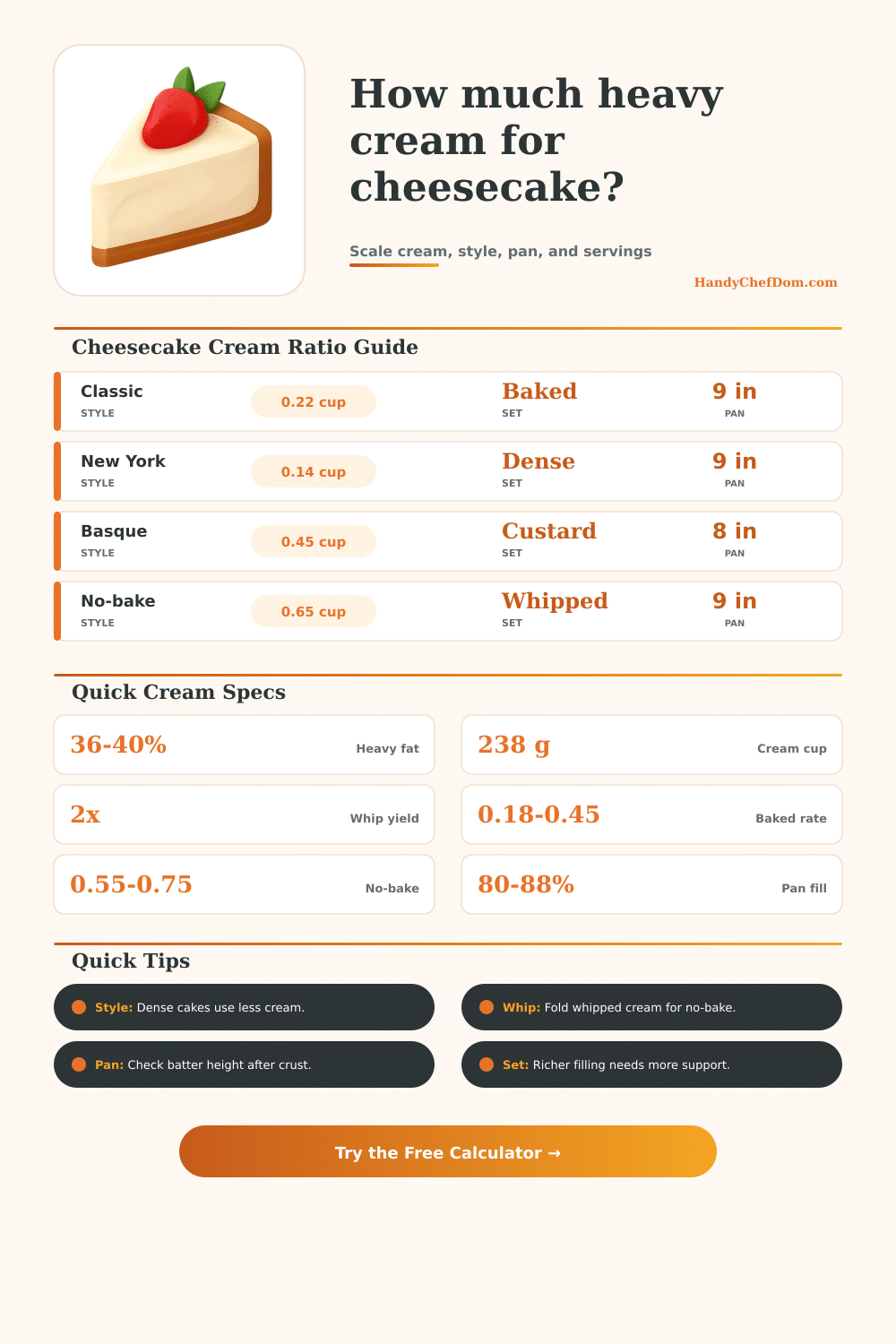
| Classic baked cheesecake | 0.18 to 0.28 cup | Egg-set and sliceable | Moderate cream for smooth texture |
| New York dense cheesecake | 0.10 to 0.18 cup | Dense baked custard | Less cream keeps the slice compact |
| Basque custard cheesecake | 0.35 to 0.55 cup | Soft baked custard | High cream for a spoonier center |
| No-bake chilled cheesecake | 0.50 to 0.72 cup | Gelatin or whipped set | Cream supplies volume and lightness |
| Whipped mousse cheesecake | 0.65 to 0.85 cup | Whipped and supported | Needs folded air and enough structure |
| Japanese cotton cheesecake | 0.08 to 0.16 cup | Egg foam structure | Low cream so the foam stays light |
| Cheesecake bars | 0.10 to 0.20 cup | Firm baked slice | Lower cream helps clean cuts |
| Ricotta blend cheesecake | 0.20 to 0.34 cup | Soft dairy blend | Cream smooths grainier cheese blends |
| Pan format | Common size | Usable filling volume | Heavy cream clue |
|---|---|---|---|
| Round springform | 8 x 2.5 in | 7 to 8.5 cups | Often 0.4 to 0.7 cup cream |
| Round springform | 9 x 2.75 in | 9 to 11 cups | Often 0.5 to 0.9 cup cream |
| Deep Basque pan | 8 x 3 in | 9 to 10.5 cups | Often 1 to 1.5 cups cream |
| Rectangle bars | 9 x 13 x 2 in | 8 to 10 cups | Use lower cream for clean squares |
| Mini cups | 12 muffin cups | 3 to 4.5 cups | Whipped cream adds light height |
| Topping layer | 9 in top | 1.5 to 2.5 cups whipped | About 0.75 to 1.25 cups cream |
| Cream role | Expansion used | Set impact | Calculator behavior |
|---|---|---|---|
| Mixed into batter | 1.00x | Smooths baked custard | Raises batter volume directly |
| Whipped and folded | 1.70x to 2.00x | Lightens no-bake filling | Checks support score more strictly |
| Whipped topping | 1.80x to 2.10x | Mostly outside the filling | Separates topping volume from batter |
| Split use | Partial whip | Rich batter plus soft topping | Splits cream between structure and garnish |
| Set richness | Cream adjustment | Texture goal | Support cue |
|---|---|---|---|
| Lean | Minus 18% | Firm, clean slice | Works well for bars and minis |
| Balanced | Baseline | Creamy but sliceable | Good for classic baked cakes |
| Rich | Plus 18% | Custardy and soft | Watch pan fill and chill time |
| Ultra creamy | Plus 35% | Very soft center | Use stronger set support |
| Airy whipped | Plus 28% | Mousse-like volume | Fold with whipped structure |
6Cheesecake Style Comparison
New York and bar styles use the least heavy cream. The calculator keeps cream lower so the slice stays compact and clean.
Basque and rich classic styles accept more cream because the batter is meant to bake into a softer custard center.
No-bake filling depends on whipped cream volume and support. Higher cream can work when gelatin or another set aid is selected.
Split mode lets the calculator count some cream in the batter and some as whipped topping, preventing an overly loose filling.
7Two Heavy Cream Cheesecake Tips
Cheesecakes vary by type. Some have heavy cream that lightens them, while others do not. Some hold their shape, while others do not. Some are fluffy, while others are not.
Heavy cream can make all the difference, although sometimes not as everyone expects. With too much cream, a cheesecake won’t set up quite right, or will even slump into itself. Too little and the cake will be so tight, so chalky, that there’s no life left to enjoy.
Why Cream Amount Matters in Cheesecake
Naturaly, it depends on the amount of cheese you begin with and what sort of structure you’re aiming for. Cream can be an absolute quantity in most recipes, but it’s meant to vary depending on style, pan size, and how you plan to set the filling.
For example: Basque cheesecakes depends on more cream, since their centers is intended to remain soft enough to spoon. New York-style is thicker and uses less cream to make a firm slice. And no-bake styles require even more, as they rely on whipped cream (and another setting agent) instead of just eggs for structure.
Once you’ve plugged in your selected cake style, pan details, and cheese weight into the calculator above, it do the math for you (and tells you if your batter fits). But the actual decisions come from inputs.
How rich do I want the texture? The richer it is, the more cream it can absorbs without affecting the set.
Decide which ingredients goes straight into the batter and which get beaten up first. This choice changes your volume and affects how much support you get from gelatin or eggs.
Will there be crust or will the batter go right into the pan? That’s what affects the space available for the batter and makes a difference in pan depth and crust thickness. What will the batter rise to once the crust is poured determines if you’re about to over-fill or end up with a look of an under-filled, cake short on its feet. Those are the variables that make a generic recipe fit the pan that you actualy own.
Most errors stem from thinking cream is interchangeable between recipes. Why did my no-bake filling not firm? Someone added a cup or two like in the classic version, but they forgot that’s not at all the same thing. Measuring the cream by size of the original package rather than scaling based off the amount of cheese means that changing the batch size will throw off the ratio.
The reason for the buffer percentage in the calculator is because in an actual kitchen there’s always some loss to the spatula and bowl, and that tiny bit of padding ensure consistent final height. Other considerations, such as whipping stage and fat percentage, are easily overlooked, too.
Fat creams will whip up larger volume (and help cover a weak set when you didn’t used enough eggs/gelatin). With no bake fillings, stiff peaks contributes more height, but also create an unforgiving batter if your pan’s nearing max capacity. These trade-offs show up on the tool’s surface: Adjust beforehand instead of after your initial slice.
We try to find that magic bullet of the perfect number and go chasing after it. But rather than just chasing numbers, we’re trying to learn about what’s happening at each one, so the final cake will do what we want it to. When those relationships fall into place, cream stops being an unknown quantity; it becomes a tool to guide things like height, texture, and how the finished product slices.
We should of found that balance earlier.