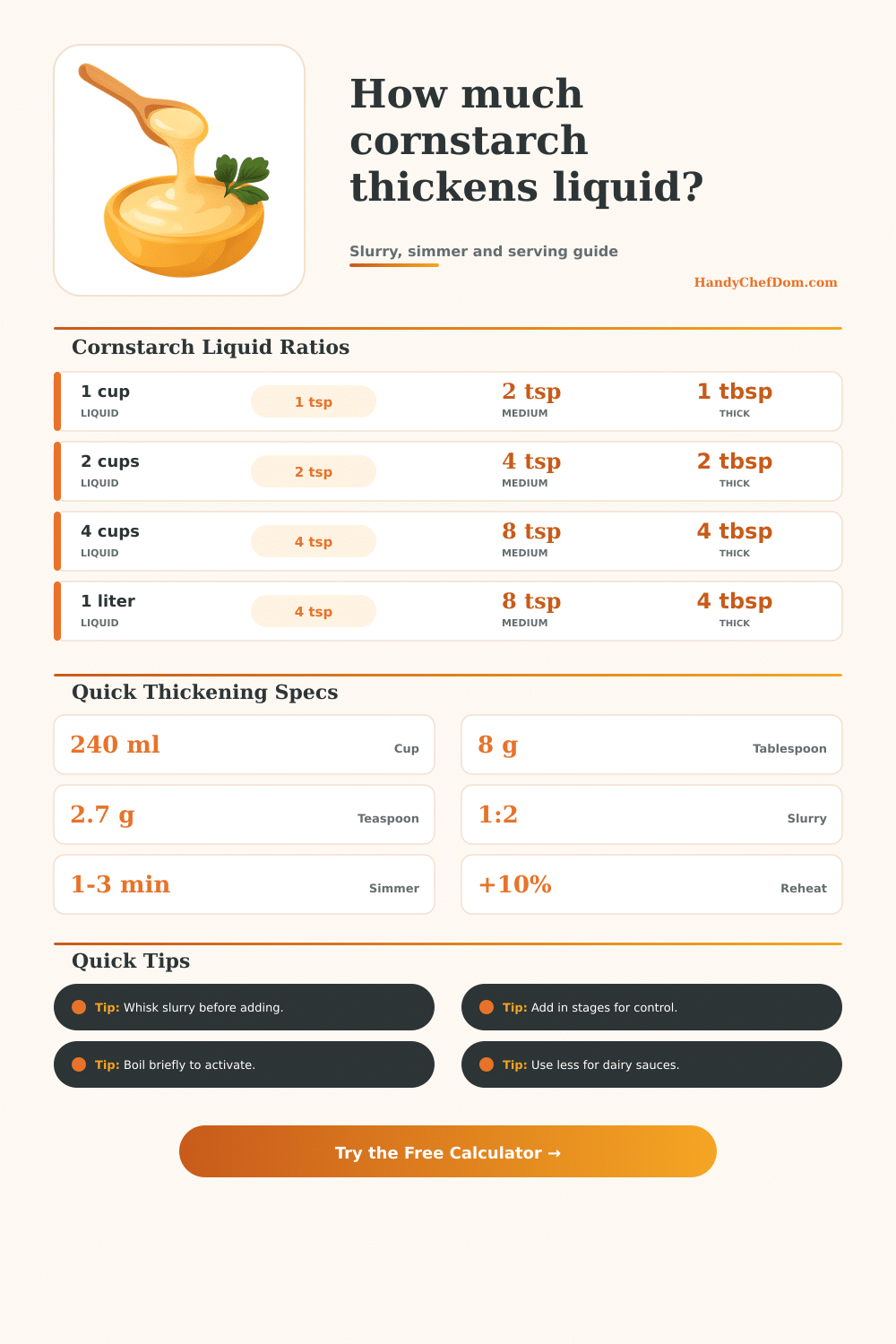
🥣 Cornstarch to Thicken Liquid Calculator
Estimate cornstarch for sauces, soups, stir-fry sauce, fruit filling, dairy-style liquids, pan reductions, and reheated leftovers using liquid volume, target body, slurry ratio, simmer time, and servings.
Cornstarch thickens after it disperses in cold liquid and reaches a brief simmer. This calculator uses a measured tsp-per-cup base, then adjusts for liquid type, starting thickness, target thickness, slurry dilution, simmer time, reheating, and serving yield.
Thickening Plan
Your cornstarch estimate will appear here after calculation.
Base Cornstarch by Liquid Volume
| Liquid volume | Light body | Medium sauce | Coating sauce | Filling style |
|---|---|---|---|---|
| 1 cup or 240 ml | 1 tsp | 1 3/4 to 2 tsp | 2 1/2 tsp | 1 tbsp plus 1/2 tsp |
| 2 cups or 480 ml | 2 tsp | 1 tbsp plus 1 tsp | 1 tbsp plus 2 tsp | 2 tbsp plus 1 tsp |
| 4 cups or 950 ml | 1 tbsp plus 1 tsp | 2 tbsp plus 2 tsp | 3 tbsp plus 1 tsp | 4 tbsp plus 2 tsp |
| 8 cups or 1.9 L | 2 tbsp plus 2 tsp | 5 tbsp plus 1 tsp | 6 tbsp plus 2 tsp | 9 tbsp plus 1 tsp |
| 12 cups or 2.8 L | 4 tbsp | 7 tbsp | 10 tbsp | 14 tbsp |
Liquid Type Adjustment Table
| Liquid type | Typical use | Adjustment | Texture cue | Calculator behavior |
|---|---|---|---|---|
| Broth or stock | Sauce, stew base, savory liquid | Baseline | Clear and glossy | Uses standard tsp per cup |
| Pan sauce | Reduced cooking juices | Small increase | Clings to meat | Adds 5 percent |
| Stir-fry sauce | Soy, stock, aromatics, glaze | Moderate increase | Coats fast over high heat | Adds 10 percent |
| Dairy or coconut | Cream sauce, milk sauce, curry | Small decrease | Softer, less bouncy | Reduces 10 percent |
| Fruit or acidic | Pie filling, lemon, tomato, wine | Increase | Needs more body | Adds 15 percent |
Slurry and Simmer Control Table
| Slurry style | Cold liquid | Best for | Simmer cue | Adjustment note |
|---|---|---|---|---|
| Tight slurry | 1.5 tsp liquid per 1 tsp starch | Small sauces | Whisk quickly | Lowest dilution |
| Standard slurry | 2 tsp liquid per 1 tsp starch | Most liquids | 1 to 3 minutes | Calculator baseline |
| Loose slurry | 3 tsp liquid per 1 tsp starch | Large pots | Pour evenly | Minor dilution |
| Very loose slurry | 4 tsp liquid per 1 tsp starch | Delicate dairy or soup | Add gradually | Adds a small allowance |
| Long hold sauce | Use standard slurry | Buffet or meal prep | Avoid hard boiling | Reheat factor applies |
Serving Yield and Texture Table
| Serving style | Liquid per serving | Target thickness | Typical starch | Use case |
|---|---|---|---|---|
| Drizzle sauce | 2 to 3 tbsp | Light | 1/8 to 1/4 tsp | Plated vegetables or meat |
| Noodle coating | 1/4 to 1/3 cup | Coating | 1/2 to 1 tsp | Stir-fry, noodles, rice bowls |
| Soup bowl | 1 to 1 1/2 cups | Light to medium | 1 to 3 tsp | Chowder-style body |
| Fruit filling | 1/2 to 3/4 cup | Filling | 1 1/2 to 3 tsp | Pie, cobbler, compote |
| Meal prep sauce | 1/3 to 1/2 cup | Medium | 1/2 to 1 1/2 tsp | Chill and reheat once |
Using starch can change consistency of your soups and sauces. Thicken with cornstarch; simmer; success! Or fail. Whether or not that happens may depend on no more than several teaspoons of cornstarch. And your skill at incorporating them in the broth. That’s where many cooks turns to the calculator rather than guesswork, because a little change makes a big impact on a recipe.
Enter your liquid volume and the kind of body you are after (and what kind of liquid you’re starting with) and the calculator will do the rest for you, above. It just needs to know how thin your liquid starts out and what kind of liquid it is. It also needs to know if it will be reheated or held at some point after.
How to Thicken Sauces with Cornstarch
Why does that last part matter? Because a broth-based sauce will loosen up more then a cream-based sauce. And if you leave the sauce sitting in a warm spot, like on a buffet table, it’s going to loosen up more than if you serve it hot off the stove. All these factors is combined into an estimate for you, which means when you’re making the dish, you don’t have to keep them all in mind.
First, make a slurry by mixing cornstarch into cold water or other liquid; this helps keeps the starch free of lumps when added to hot liquid, where it then swells up and thickens. How loose or tight your slurry is determine how much additional liquid goes into the soup (more on that below). For big pots of soup; less important with small batches. You want to spread something easily over a large surface, so make a looser slurry. A tighter slurry keeps dilution low, while a looser one makes it easier to pour evenly across wide pot. Once back at a gentle boil, give it another minute or two to fully thicken.
People who think all liquids are interchangeable will be hard-pressed in the kitchen. Tomato sauces and acidic fruit fillings needs a little extra starch compared to an equal volume of plain stock. If you use the full amount intended for broth in dairy sauces, you risk making them gummy and gluey. The calculator allows you to identify the liquid type, accounting for this adjustment in advance.
If you want to know the correct amount of liquid already lightly thickened, it does that too. You shouldn’t of add too much and end up with a paste rather than a sauce. And there’s one more modification: When you reheat, you’ll notice something different. That perfectly sauced dish might loosen when it cools and heats once more. To account for this variation in the tool, there is a little wiggle room, so your final dish come out exactly as expected. Same thing if you’re prepping multiple meal to serve or put on a buffet: Plan for the repeat heat, then you won’t lose any texture along the way.
There are also reference tables for volume-based ratios that let you test your gut instinct. These shows the equivalent in teaspoons per cup for various target thicknesses. You can use these to scale a recipe up or down. And then there’s the tasting and adjusting part: At the stove, where it matters, we must do our best. The numbers gives us a solid place to start, no longer a total guess.
And then the rest is up to us. Turns out when you know what every input demands, though, it’s like having a silent helper rather than a black box. You still have to use your own eyes and spoon to get the final texture right, but at least you don’t have to do any math while the burner is on. From workable to just-right; that’s the transformation of informed adjustment over guessing.