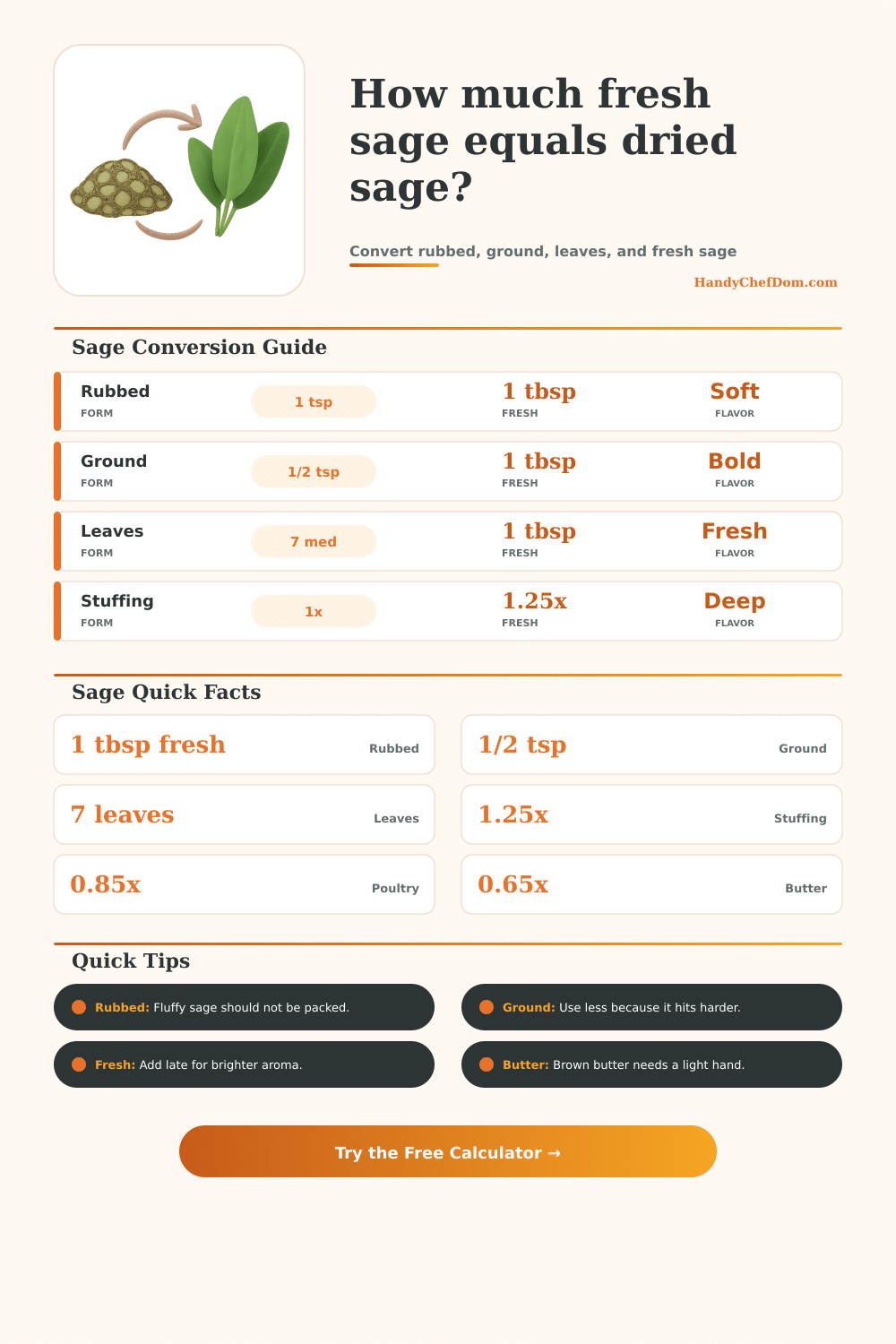
🌿 Dried to Fresh Sage Converter
Convert rubbed, ground, crushed, and whole dried sage into fresh chopped tablespoons, leaves, and balanced recipe amounts.
Use the direction, form, dish style, and flavor controls to convert sage without making poultry, stuffing, or browned butter taste dusty or medicinal.
| Sage form | Base amount | Fresh chopped equivalent | Best use |
|---|---|---|---|
| Dried rubbed sage | 1 tsp | 1 tbsp fresh chopped | Poultry, gravy, stuffing |
| Dried ground sage | 1/2 tsp | 1 tbsp fresh chopped | Sausage, rubs, smooth sauces |
| Dried crushed leaf sage | 1 1/4 tsp | 1 tbsp fresh chopped | Stuffing and beans |
| Whole dried leaves | 3 leaves | 1 tbsp fresh chopped | Infused butter or pan sauce |
| Fresh sage leaves | 7 medium leaves | 1 tbsp fresh chopped | Brown butter and finishing |
| Fresh sage sprigs | 1 1/2 sprigs | 1 tbsp fresh chopped | Roasts and pan aromatics |
| Recipe style | Factor | Flavor target | Why it changes |
|---|---|---|---|
| Poultry rub or roast pan | 0.85x | Clean herbal edge | Rendered fat carries sage strongly |
| Bread stuffing or dressing | 1.25x | Holiday depth | Bread absorbs aroma and softens bite |
| Browned butter sauce | 0.65x | Nutty and fragrant | Butter blooms sage quickly |
| Sausage or meat blend | 1.15x | Classic breakfast profile | Ground meat dilutes leafy notes |
| Turkey gravy or pan sauce | 0.75x | Round background | Reduction concentrates dried sage |
| Beans, squash, or vegetables | 1.00x | Balanced garden note | Vegetables tolerate a fuller dose |
| Fresh measure | Rubbed dried | Ground dried | Leaf estimate |
|---|---|---|---|
| 1 tsp fresh chopped | 1/3 tsp | 1/6 tsp | 2 to 3 leaves |
| 1 tbsp fresh chopped | 1 tsp | 1/2 tsp | 7 medium leaves |
| 2 tbsp fresh chopped | 2 tsp | 1 tsp | 14 medium leaves |
| 1/4 cup fresh chopped | 4 tsp | 2 tsp | 28 medium leaves |
| 1/2 cup fresh chopped | 8 tsp | 4 tsp | 56 medium leaves |
| 1 cup fresh chopped | 16 tsp | 8 tsp | 112 medium leaves |
| Texture or timing | Factor | Use with | Calculator meaning |
|---|---|---|---|
| Airy rubbed flakes | 1.00x | Fresh jars | Standard spooned measure |
| Settled jar flakes | 0.92x | Older dried sage | More sage fits in the spoon |
| Packed spoonful | 0.80x | Dense rubbed sage | Reduce to avoid bitterness |
| Powdery ground jar | 0.70x | Very fine powder | Ground sage blooms fast |
| Late fresh finish | 1.12x | Chopped fresh leaves | Aroma stays bright but softer |
| Fried sage garnish | 0.78x | Brown butter | Frying concentrates the leaf |
It’s the time of year for sage: a critical ingredient in fall cuisine, yet also one of the most underappreciated. Perhaps you’ve got a recipe that specifies fresh sage but all you have is some dried? Or maybe it are the other way around? Swapping one teaspoon for the other hardly ever turns out right.
Why? When they are dried, there precious oils are concentrated. Also, certain textures will releases those oils more easily during cooking. This makes a big difference between a fragrant roast chicken and something that tastes medicinal.
How to Use Fresh and Dried Sage
When you plug in the ingredients you use, the calculator at top does all the math for you (instead of having to guess at conversions and coefficients). And it factors variables beyond just volume, differences like weight of a finely ground spice vs. Leaf bits, for instance. Since the cell walls is already broken, ground sage will pack a bigger punch by releasing its flavor immediately when it touch moisture or fat. A rubbed sage is lighter, softer; there’s less actual mass of herb in each spoon compared to what you’d have with a packed-in scoop of ground stuff. This change significantly affect the conversion ratio; sometimes by half or more, depending on how it is packed in the jar.
Because fresh herbs contain both strong scents and some water weight. Meaning they’ll rapidly dissipate during intense cooking, they behave very differently from dry ingredients. For example: When you’re preparing browned butter for pasta, toss in those fresh sage leaves too soon and they’ll burn long before nuttiness emerges. Toss them in near the finish instead, and you get all that bright, green aroma without dulling the depth of final product.
This is the part where the tool considers timing, such as whether to begin lightly or add more toward the end. This is also where it accounts for leaf size, or how much the size decrease when chopping up whole ones. At one end of the spectrum are poultry and at the other stuffings. Dried sage clings to salt and fat; it’s good on a roast turkey because its clean herbal edge balances skin while not stealing the show. On the other hand, stuffings is sponges. They soak up liquid and soften the bite of the herbs. Because of this, they needs more sage per bite to give a seasoned taste with each spoonful.
That’s why the conversion factors vary by type of dish. In a sauce, you may use one part dried sage to three parts fresh, but in a bread mixture with many ingredient, almost equal amounts make sense. Another reason is the age of your dried herbs. Ground sage from an old jar isn’t potent anymore; it’s flat, not pungent. It is dusty. No amount of calculation will made up for years-old dried sage. Use twice as much (or more) as the recommended ratio would of call for, or even better, swap it out with fresh.
Fresh sage (well), you’ll see what I mean. It adds flavor, texture, and looks good too. This is nicely explained in the reference table on the page (and can be compared side by side), though knowing the why of all these numbers gives you the confidence to cook without having to stop every few minutes with measuring spoons in hand.
Consider sage not a base chord, but an accent note. If there’s too little, you’ll feel something is missing; if there’s too much, well, that’s just soap. Start off conservatively and taste along the way: Fresh herbs are fleeting. Dried ones take longer to “bloom” in hot liquid. Knowing this helps you make sure to add at the right moment so they builds over time instead of spike or fade.
Finally, it’s all about balance with sage. Meat enhances it; acid mutes its earthy quality. Oil doesn’t carry sage quite as well than butter. The right amount depends not just on the ratio of sage to everything else, but also how those elements interact. Get close with the tool, then rely on your palate to do the rest. Respect the form and potency of this fragrant herb, a little sage goes a long way.