🥑 Avocado Calorie Calculator
Estimate avocado calories, edible flesh yield, fat, fiber, potassium, toast portions, and guacamole servings from size, variety, cups, halves, or grams.
Pick the entry style you measured: whole avocados, halves, edible flesh weight, cups, toast portions, or guacamole portions. The calculator converts everything to edible avocado flesh first.
| Avocado Type | Whole Weight | Edible Flesh | Calories | Best Use |
|---|---|---|---|---|
| Small Hass | 136 g | 92 g | 154 kcal | Half snack |
| Medium Hass | 201 g | 137 g | 219 kcal | Toast |
| Large Hass | 250 g | 175 g | 280 kcal | Guacamole |
| Florida | 304 g | 219 g | 263 kcal | Salads |
| Reed | 240 g | 170 g | 301 kcal | Bowls |
| Mini | 105 g | 72 g | 115 kcal | Lunch box |
| Measure | Edible Avocado | Calories | Fat | Fiber |
|---|---|---|---|---|
| 1 tablespoon mashed | 9 g | 14 kcal | 1.3 g | 0.6 g |
| 1/4 cup mashed | 38 g | 61 kcal | 5.6 g | 2.5 g |
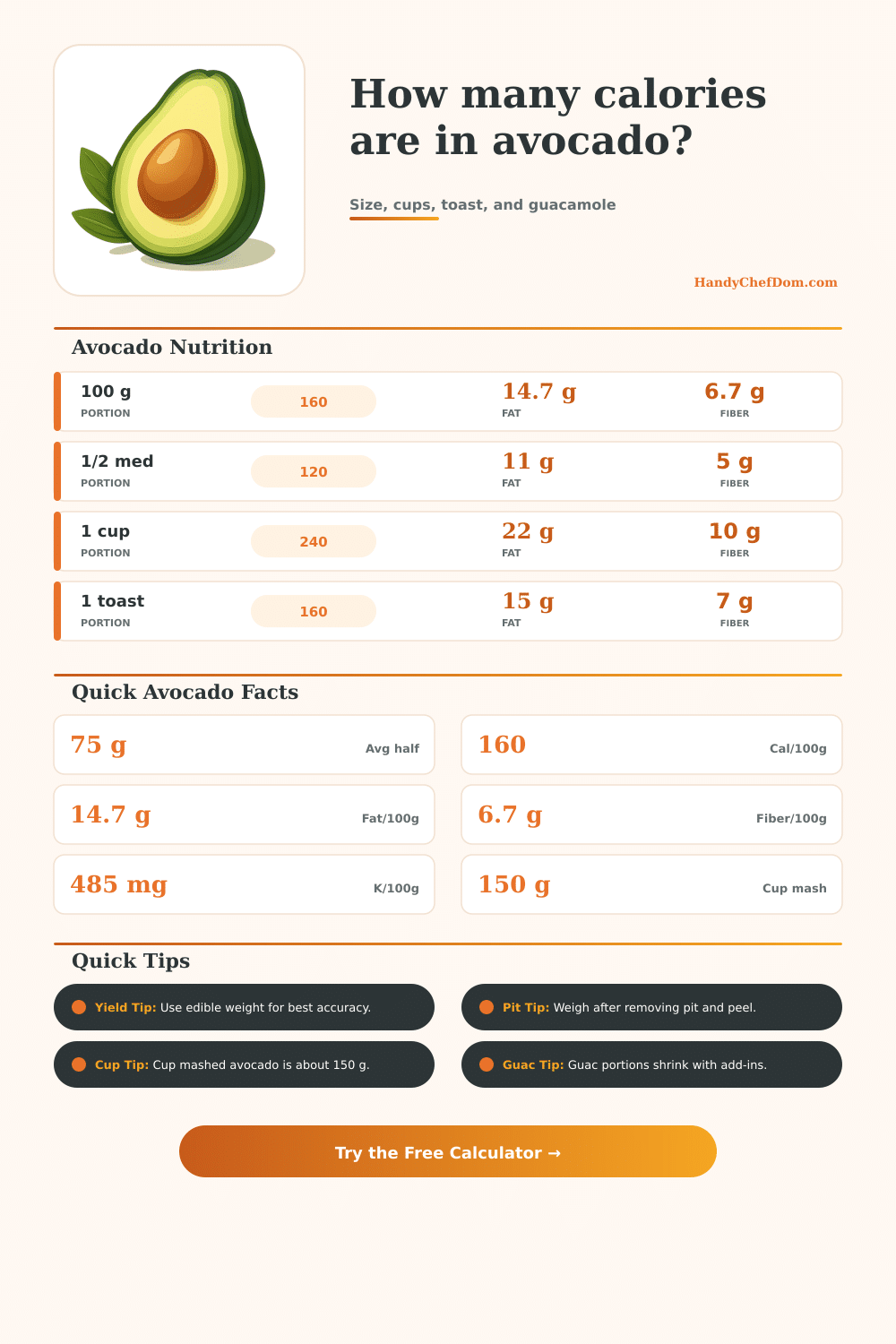
| 1/2 cup mashed | 75 g | 120 kcal | 11.0 g | 5.0 g |
| 1 cup mashed | 150 g | 240 kcal | 22.1 g | 10.1 g |
| Standard toast | 50 g | 80 kcal | 7.4 g | 3.4 g |
| Guac side scoop | 55 g | 88 kcal | 8.1 g | 3.7 g |
| Variety | Cal/100 g | Fat/100 g | Fiber/100 g | Potassium/100 g |
|---|---|---|---|---|
| Hass | 160 | 14.7 g | 6.7 g | 485 mg |
| Florida | 120 | 10.1 g | 5.6 g | 351 mg |
| Reed | 177 | 16.9 g | 7.0 g | 507 mg |
| Fuerte | 160 | 14.7 g | 6.7 g | 485 mg |
| GEM | 167 | 15.4 g | 6.8 g | 490 mg |
| Mini Hass | 160 | 14.7 g | 6.7 g | 485 mg |
| Serving Style | Avocado Flesh | Calories | Whole Hass Needed | Portion Note |
|---|---|---|---|---|
| Light toast | 35 g | 56 kcal | 0.26 | Thin spread |
| Standard toast | 50 g | 80 kcal | 0.36 | Breakfast slice |
| Thick toast | 75 g | 120 kcal | 0.55 | Brunch portion |
| Side guacamole | 55 g | 88 kcal | 0.40 | Dip scoop |
| Bowl topping | 70 g | 112 kcal | 0.51 | Meal add-on |
| Half medium Hass | 69 g | 110 kcal | 0.50 | Snack half |
The other day I bought a bag of five Hass avocados. Good idea! And by Wednesday, three is in various stages of being either mushy or rock hard. That’s the avocado paradox: On the exterior, they look fine; on the inside, they’re either rotting away or still green and not-ripe at all.
It isn’t just that we can’t select ripe ones, it’s that we don’t know how much actual flesh we’ll be committing ourselves to if we do. If you’ve already cut up and removed the pits from the fruit (most nutrition label figures give data for every 100 grams of edible portion), then using a scale is fine. However, if you’re looking down at an intact piece of fruit in your palm, there’s no easy way to guess how much that will weigh after being trimmed off its heavy pit and thick skin. That’s where the calculator above comes in: just enter the number/volume and let it do the math for you.
How to Use This Avocado Calculator
No need to guess at the percentage yield. Just select the measurement format, be it cups of mash, toast servings, halves, or whole fruit. Edible Yield is the key variable: the portion of the whole thing that’s good for eating (measured in percentage). A very ripe avocado may have some bruises you want to trim off. The skin will also be looser and the pit will be smaller compared to its total weight. On the other hand, a firmer, not-fully-ripe avocado will have tighter skin and a harder pit. You will end up with less food per gram of total weight because you has to trim away the bruises and other waste.
You can fiddle with this variable to account for how ripe your fruit was. If it’s all mushy and easily scooped out without any trimming, then you’re getting more calories per gram (more nutrition) than if it’s really hard or damaged. In the latter case, you’re paying for more waste then nutrition. That’s why that variable matters a lot, so much that it can change the bottom-line number by a huge amount, since the pit itself can make up forty percent of total weight!
Variety counts for something: Hass avocados is also fat-rich and bumpy-textured compared to Florida ones (which are green and smooth and much lower in oil). Their density is very different (compare their density on the page’s reference table). This is why switching from one type to another, say replacing a Hass with a Florida avocado, without adjusting your expectations means you’ll get less creamy texture and calories then expected. A big Florida fruit may weigh as much or more than a small Hass, for instance, yet deliver far less energy because it contains mostly fiber and water.
Portion size also depends on how you prepare it: sliced avocado take up more space than the mashed form found in a cup, for example. The calculator takes that into account: One cup of packed mashed avocado equals slightly less actual flesh than one cup of chopped avocado (the difference in air pockets between chunks of avocado flesh). That’s important if you like to use measuring cups and want to make sure you’re not overestimating based on the amount of mashed versus loose avocado flesh.
The healthful fats in avocado are great for fullness… They keep you full longer than just carbs on their own, which is why avocado toast has turned into such a diet mainstay. But not all avocados is equal. The amount of avocado on any given piece of toast ranges from a slight layer (thirty-five grams of flesh) to a hefty brunch slice (nearly ninety grams). This means anywhere from seven additional grams of fat and almost eight extra cals. When counting calories throughout the day, it’s tempting to think all toast is created equal; saying which kind you want ensures you know just how much you’re eating versus some vague average.
To complicate matters further, avocados are used to create guacamole. The added ingredients like lime juice, salt, cilantro, and onion increase the volume with less mass and fewer calories or fats than the fruit itself provides. Additionally, these other ingredients make the dish even less dense. If you make guacamole for six people, there may not actually be as much avocado in that big ol’ bowl of guac; and your body isn’t getting all the nutrients it was expecting. By subtracting out the contribution from the rest of the mixture, the tool gives you an accurate representation of how many calories are coming from the actual avocado.
In terms of nutrition, fiber and potassium are strong points for the fruit regardless of type. Fat contents varies between types, but they are still present in each. It’s not simply calorie restriction, but optimization of the calories you do consume with knowledge of what you’re getting from them. In the end, the care we take with our avocados matters. It forces us to notice their differences, value their varieties, and avoid waste.
If we can start thinking of avos as a main ingredient instead of a vague addition, so much the better. The next time you’re at the store picking out a bag of five items, you’ll do so with full knowledge of what you have on hand; without having picked one up yet.