🍪 Chocolate Chip Cookie Calorie Calculator
Estimate cookie calories, sugar, fat, and carbs from cookie size, count, dough weight, portion style, and chocolate chip or nut add-ins.
Choose a cookie profile, portion size, and add-in style. The calculator estimates total batch nutrition and per-cookie nutrition from dough weight.
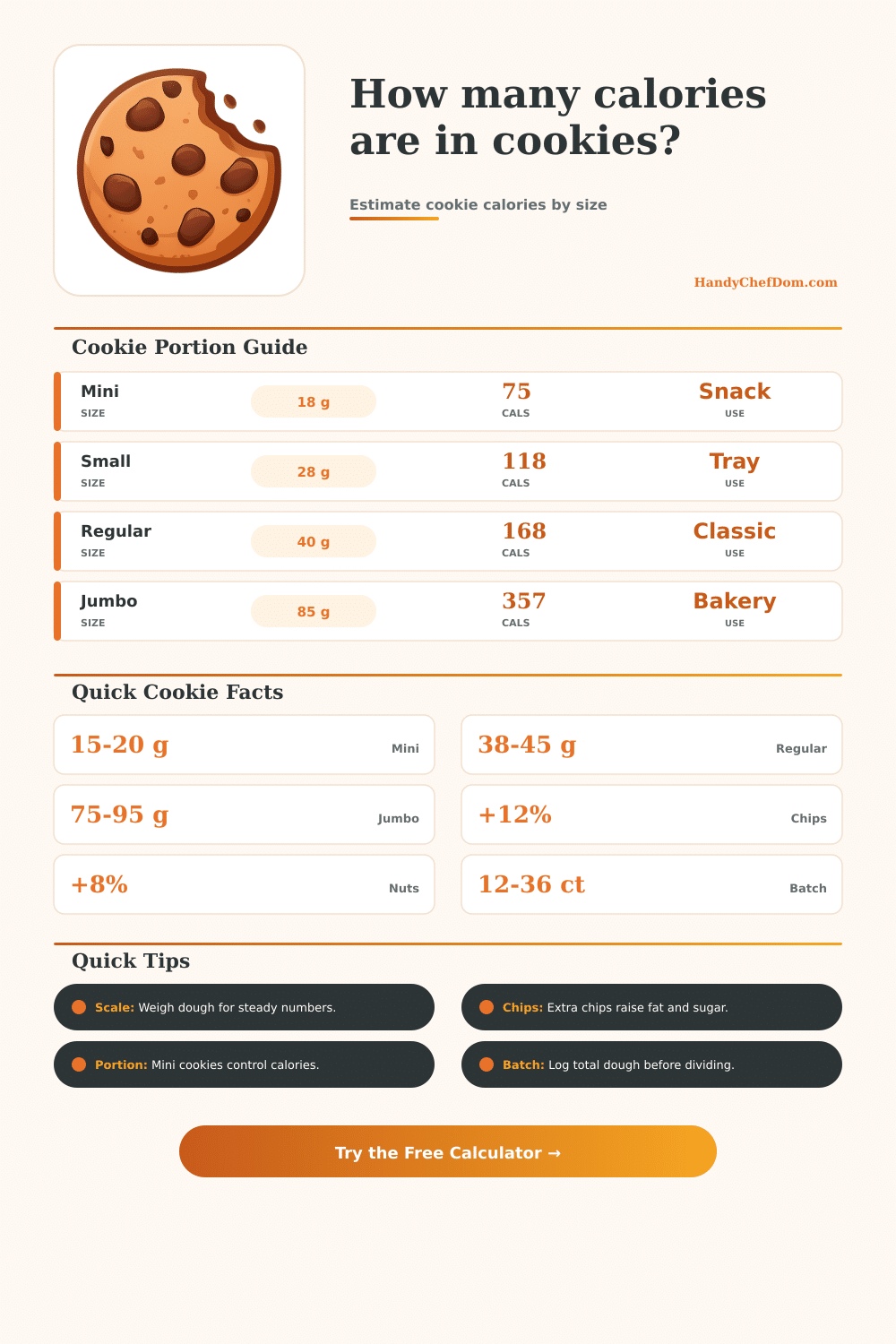
Regular cookies often use 1.3 to 1.6 oz dough.
| Cookie label | Dough weight | Calories each | Portion note |
|---|---|---|---|
| Mini bite | 0.6-0.8 oz | 65-95 | Snack plate |
| Small lunchbox | 0.9-1.1 oz | 105-135 | Kids portion |
| Regular classic | 1.3-1.6 oz | 150-195 | Standard scoop |
| Large bakery | 2.0-2.6 oz | 240-320 | Big cookie |
| Jumbo shareable | 3.0-4.0 oz | 360-500 | Split portion |
| Thin crisp | 1.0-1.3 oz | 125-165 | Wide spread |
| Thick soft | 1.8-2.3 oz | 220-290 | Tall center |
| Cookie bar square | 1.6-2.2 oz | 195-275 | Pan cut |
| Dough profile | Cal/oz | Sugar/oz | Fat/oz |
|---|---|---|---|
| Classic chocolate chip | 120 | 7.6 g | 5.3 g |
| Buttery bakery dough | 132 | 7.9 g | 6.2 g |
| Thin crisp dough | 116 | 7.2 g | 5.0 g |
| Soft chewy dough | 123 | 8.1 g | 5.4 g |
| Oat chocolate chip | 118 | 6.9 g | 5.1 g |
| Double chocolate chip | 128 | 8.4 g | 5.9 g |
| Brown butter dough | 136 | 7.8 g | 6.6 g |
| Lighter homemade dough | 106 | 6.5 g | 4.4 g |
| Add-in style | Calorie factor | Sugar factor | Fat factor |
|---|---|---|---|
| Standard chocolate chips | 1.00x | 1.00x | 1.00x |
| Light chips | 0.92x | 0.90x | 0.94x |
| Extra chocolate chips | 1.12x | 1.18x | 1.10x |
| Mini chocolate chips | 1.04x | 1.07x | 1.03x |
| Chips plus walnuts | 1.08x | 0.96x | 1.18x |
| Chips plus pecans | 1.10x | 0.95x | 1.22x |
| Dark chocolate chips | 1.05x | 0.92x | 1.11x |
| No nuts, chip base | 1.00x | 1.00x | 1.00x |
| Batch count | Mini dough | Regular dough | Jumbo dough |
|---|---|---|---|
| 6 cookies | 4 oz | 9 oz | 21 oz |
| 12 cookies | 8 oz | 18 oz | 42 oz |
| 18 cookies | 12 oz | 27 oz | 63 oz |
| 24 cookies | 16 oz | 36 oz | 84 oz |
| 36 cookies | 24 oz | 54 oz | 126 oz |
| 48 cookies | 32 oz | 72 oz | 168 oz |
Here’s one possible situation: You’re pulling a tray of fresh-from-the-oven cookies out of the oven. The smell in the kitchen is heaven; it’s all buttery and sugary goodness… But now you wonder how many of these cookie should go into your body today. “I just want the cookie to taste good,” you think, “but I also want to know what’s the nutritional cost of eating it and not feel bad about reading the label.”
That’s where a decent estimation tool makes itself valuable: converting nebulous hunches into tangible figures you can put to use. Before the oven timer can ding, the math has already begun. The math began when you put some dough into your hands. If you’re like most home bakers, your estimates are blind. Your measurements by eye or based off muscle memory vary dramaticly from batch to batch. An ounce scoop may well be twice that: two ounces of calories for no change in the taste.
Why You Should Calculate Your Cookie Calories
When you enter the dough size and number of cookies per batch into the calculator above, it does the rest of the math for you. This removes the need for you to do the conversion and coefficient calculations yourself. A regular classic cookie is in its own nutritional group just like a mini bite or a bakery-style jumbo. Not only this matter in terms of satisfaction: it matters in terms of energy density.
Look at the texture of your dough. When you bake a thin cookie it will spread out and crisp up. More surface area mean more chance for moisture to release and therefore a lighter overall weight when finished baking. If you have a soft, thick cookie, all that moisture stays trapped and makes the whole thing dense and heavy. That’s where the tool comes into play, with an ability to pick a dough profile. So if you like a lighter, homemade type base or something closer to a rich buttery bakery style, that shifts the underlying calorie per ounce quite a lot. It’s not just about how big the cookie looks on the plate but also what is inside it to hold it together.
And then there’s the other stuff: the add-ins that usually send the nutrition flying off the rails. The baseline here are standard chocolate chips. Mix in pecans and walnuts, go with extra chunks, and you’re going to change the fat/sugar ratio in some predictable way. Extra nuts will increases the number of calories (healthy fats, but still) while keeping the sugar down. Dark chocolate may reduce sugar somewhat, but maintains high-fat profile. Choose your poison, so to speak.
Mini portions gives you volume without busting your limit, just by making sure you physically serve up less. It’s half behavioral hack, half nutritional tweak. To make it clear what I’m talking about, here’s the page with the reference table. The chart shows what happens as your batch size goes up or down. If you keep the weight of your dough the same, the per-unit estimate will also stay the same. That means you know what to expect no matter what batch you’re making. If you need six cookies for a late night snack or you need forty-eight for a party, the per-unit estimate remains consistent. It makes planning possible.
Know what? Baking becomes a measured activity rather than an art form. Sounds clinical. But it’s not. It frees you up. In short, understanding the number isn’t the same as self-restraint. It’s about making an informed decision: Sure, maybe now I’ll only get one giant shareable cookie instead of two and order black coffee instead of milk. Knowing the calorie content doesn’t dictate your actions (it simply makes them transparent).
Now, go forth and scoop up some dough. Weigh it if you can. Bake away without any worries or fear of the unknown. Ultimately, all of this leads back to our favorite step in the entire process, the cookie-eating part.