Apple Fiber Calculator
Estimate total fiber, soluble fiber, pectin, edible yield, and daily goal percent from apple size, peel, variety, preparation, and servings.
🍏Quick Apple Fiber Presets
🧮Apple Fiber Inputs
Apple Fiber Result
🍎Fiber Snapshot Grid
📊Apple Peel, Variety, and Fiber Comparison
| Variety | Peel-on fiber tendency | Peeled fiber tendency | Pectin note |
|---|---|---|---|
| Granny Smith | High, tart profile | Moderate | Often higher pectin feel |
| Honeycrisp | Average to high | Moderate | Balanced soluble fiber |
| Gala | Average | Moderate-low | Softer pectin profile |
| Fuji | Average | Moderate-low | Dense flesh, mild pectin |
| Pink Lady | Average to high | Moderate | Tart-sweet, useful for blends |
| McIntosh | Average | Moderate-low | Breaks down easily, pectin-rich texture |
| Golden Delicious | Average | Moderate-low | Gentle soluble fiber profile |
| Red Delicious | Average to high | Moderate | Skin contributes a large share |
🥣Sliced, Cooked, and Applesauce Conversion Table
| Apple form | Typical measure | Approx grams | Fiber estimate |
|---|---|---|---|
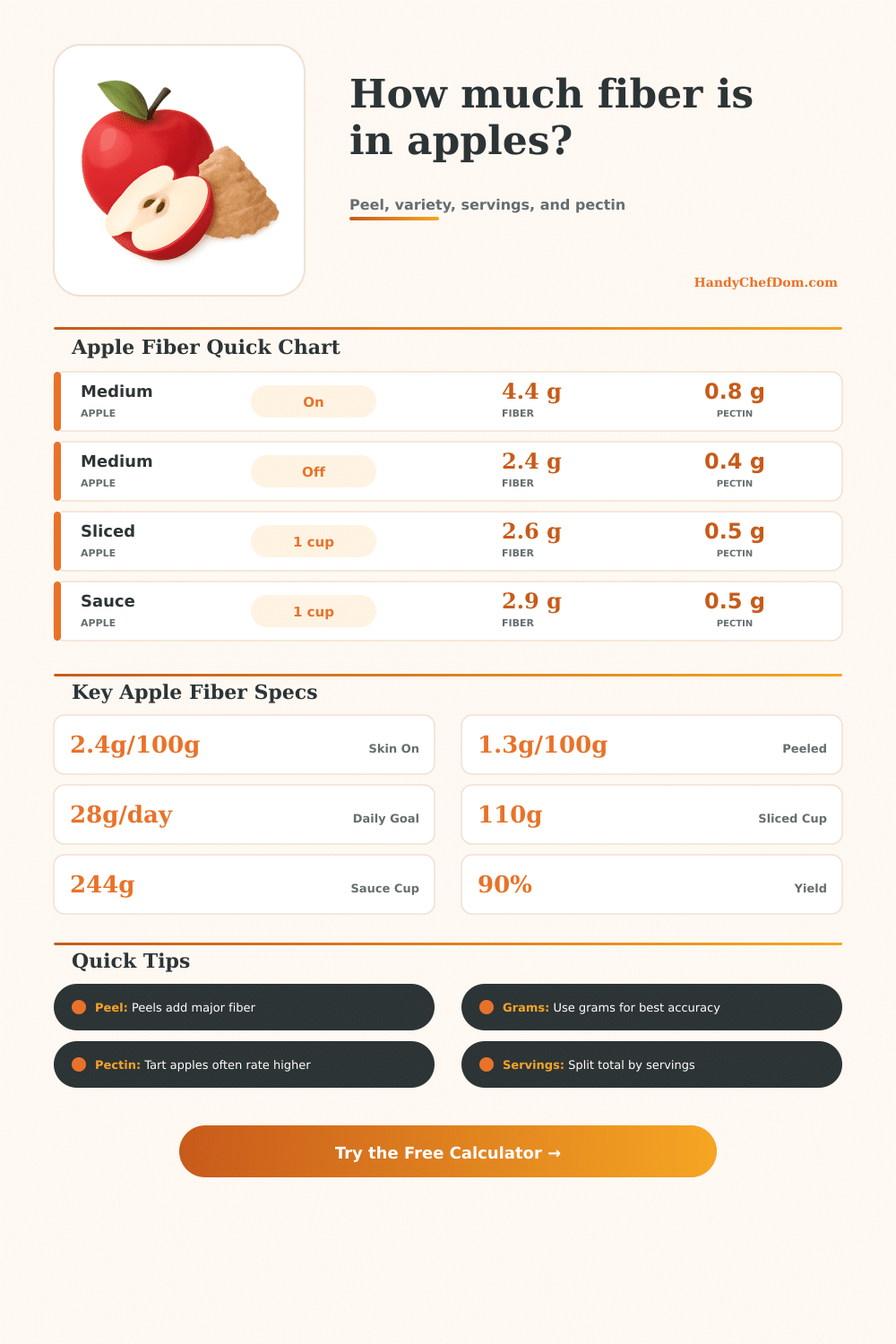
| Small apple with peel | 1 apple | 134 g edible | About 3.2 g |
| Medium apple with peel | 1 apple | 164 g edible | About 3.9 g |
| Large apple with peel | 1 apple | 201 g edible | About 4.8 g |
| Fresh sliced apple | 1 cup | 110 g | About 2.6 g |
| Cooked apple pieces | 1 cup | 170 g | About 3.9 g |
| Unsweetened applesauce | 1 cup | 244 g | About 2.9 g |
🎯Daily Fiber Goal Table
| Daily goal | Fiber target | Medium apples with peel | Best use in calculator |
|---|---|---|---|
| FDA Daily Value | 28 g | About 7 apples | General label comparison |
| Adult women target | 25 g | About 6 apples | Daily menu planning |
| Adult men target | 38 g | About 10 apples | Higher-fiber daily planning |
| Young child target | 19 g | About 5 apples | Small serving checks |
🧺Edible Yield and Preparation Reference
| Scenario | Yield setting | Fiber impact | When to use |
|---|---|---|---|
| Efficient coring | 93% | More edible grams | Thin core removal or slicer |
| Average coring | 90% | Standard estimate | Everyday whole apples |
| Thick core removal | 86% | Less edible apple | Wide wedge cuts |
| Heavy trimming | 82% | Lowest edible yield | Bruised spots or deep peel |
💡Apple Fiber Tips
If you’ve heard that apples are good for you then you know what I mean by “apple.” Or do you? There’s more to eating apples than meets eye (or the mouth). Meal planning and keeping track of fiber for gut health mean understanding more variables than most people think. Sure, apples is healthy. But which apple, sliced or cooked down? How many bite will you leave in the core?
That’s where the calculator comes in. Feed in your details and it does the math for you. No need to guess at conversions and coefficients, this will tell you exactly what fraction of your diet is pectin, soluble fiber, and total fiber.
Why Apples Are Good For Your Health
So now we come to the interesting part: the peel. Most of the insoluble fiber exist just beneath surface of the apple, so when you peel your apples, you’re basically chucking out almost 50 percent of the fruit’s potential fiber boost. That is a hefty price to pay for the smoother feel. To take this into account, the tool allow you to toggle between peeled, peel-on and something in-between.
You can use peeled slices if presentation matters (think salad), or leave skins on for a much more dense nutritional punch if you’re eating an apple as a snack while at the office. It makes a big difference, so much so that it affects how many daily values you’re hitting each time you eat.
There’s also the softer-but-still-important role of variety: For example, tart apples such as Granny Smith generally have a slightly higher pectin content then their sweet cousins such as Fuji or Gala. That’s because pectin, a form of soluble fiber, becomes gelatinous in your digestive system; it slows down sugar absorption, making you feel fuller longer. But it’s not all about bulk. It’s about what kind of bulk you’re consuming.
A table on the page breaks it down. You can see from the reference table that certain types of cultivar tends toward one behavior or another, so you can select the best fruit for eating raw versus baking. Generally speaking, the tarter the fruit, the firmer it will be, meaning its cell walls stays more intact after cooking and retain more fiber.
Everything else is prepared different. If you blend your apple puree into unsweetened applesauce, it has less fiber per gram than if you had sliced the apples into cups. For example: A cup of applesauce contains roughly one cup of fruit. Sliced apples pack looser because they break down, so you can fit more fruit in a cup. This means you recieve more fiber in each spoonful of sauce, even though there is less concentrated fiber per 100g. To account for this difference, the calculator switches from counting whole fruits for raw apples and sauce to measuring out volume for both.
And it accounts for the edible yield, how much fruit remains after taking out core and discarding any bruised bits. If you’re good at coring, you end up keeping more of your fruit intact, leaving more to be eaten, whereas if you go wild on the trimming, you waste more of your fruit and consequently lower your overall fiber content from that batch.
Every day is different. The FDA has established a standard daily value. However, everyone’s needs is different depending on their age. They also depend on type of health they’re trying to achieve. Once you plug in your personalized goal, the app show you exactly what percentage of your daily requirement you get from each serving.
For example, a medium apple with skin may meet most of a child’s requirements but barely reach an adult male’s goal. This helps show what it means to “eat more fiber” beyond just an arbitrary number. Understanding these inputs turns fruit selection from a habit into a strategy. Instead of wondering if a bowl of sliced apples will help you reach your goals, you know exactly how it fits.
If you’re wondering what’s in your snack or prepping for the week, understanding how variety, peels, and preparation work helps you control your nutrition. The peel is the easy bit. You should of known the importance lies in how the numbers show why it matters.