Dates Potassium Calculator
Estimate potassium in Medjool, Deglet Noor, chopped dates, and date paste by count, grams, cups, pitted yield, servings, daily value percent, potassium-to-sugar ratio, and snack or baking scale.
1Dates Potassium Presets
2Date Count, Weight, Cup, Yield, Serving, and DV Inputs
Choose count mode for whole dates, gram mode for weighed chopped dates, or cup mode for recipe prep. The calculator converts whole-with-pit dates to edible pitted grams before estimating potassium.
Dates potassium estimate
Choose a preset or enter your own date details.
3Live Dates Potassium Snapshot
4Date Type, Form, and Potassium Grid
| Date type or form | Potassium per 100 g | Typical count or cup weight | Pitted yield | Best calculator entry |
|---|---|---|---|---|
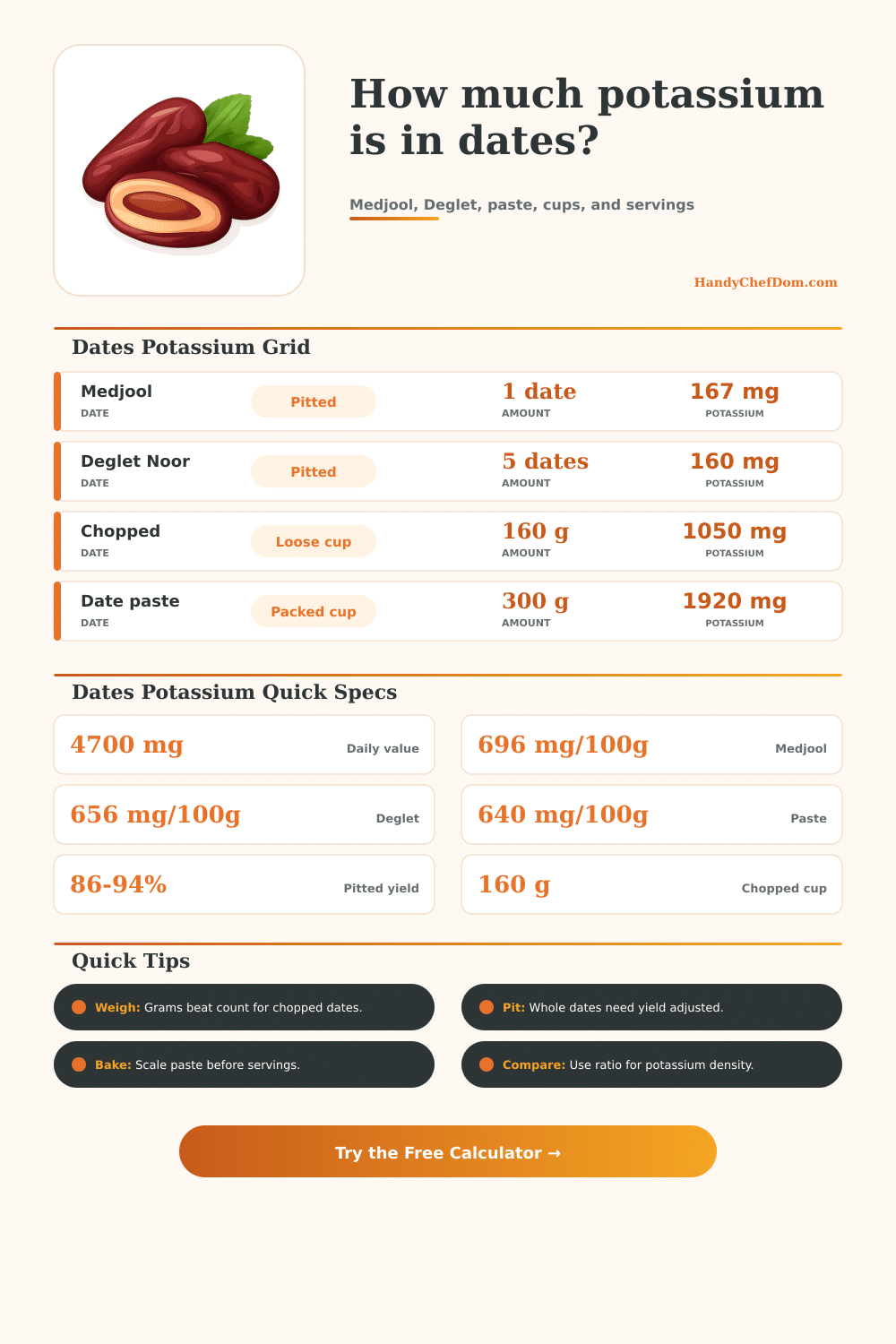
| Medjool dates | About 696 mg | 18 to 24 g each | 88% to 92% | Count for snacks, grams for chopped recipes. |
| Deglet Noor dates | About 656 mg | About 7.1 g each | 90% to 94% | Count for small-date snack packs. |
| Barhi dates | About 610 mg | About 12 g each | 88% to 92% | Count or grams when very soft. |
| Mixed chopped dates | About 670 mg | 160 g loose cup | 100% if already pitted | Cups or grams for baking. |
| Date paste | About 640 mg | 300 g packed cup | 100% | Cups for bars, sauces, and fillings. |
| Date syrup estimate | About 520 mg | 340 g cup | 100% | Cups with dilution adjustment. |
5Count, Gram, and Cup Conversion Table
| Amount | Edible grams used | Medjool potassium | Deglet potassium | Recipe note |
|---|---|---|---|---|
| 1 large Medjool | 24 g pitted | About 167 mg | About 157 mg if same grams | Quick snack estimate. |
| 3 large Medjool | 72 g pitted | About 501 mg | About 472 mg if same grams | Common pre-workout snack. |
| 5 Deglet Noor | 35.5 g pitted | About 247 mg if same grams | About 233 mg | Small-date snack pack. |
| 1/2 cup chopped, loose | 80 g | About 557 mg | About 525 mg | Oats, muffins, or granola. |
| 1 cup chopped, packed | 240 g | About 1670 mg | About 1574 mg | Dense baking measure. |
| 1 cup date paste | 300 g | About 2088 mg if Medjool | About 1920 mg paste default | Bars, sauces, and sticky fillings. |
6Serving, Daily Value, and Ratio Table
| Scenario | Date amount | Servings | Potassium per serving | Approx DV |
|---|---|---|---|---|
| Single Medjool snack | 1 date, 24 g | 1 | About 167 mg | About 4% |
| Three Medjool snack | 3 dates, 72 g | 1 | About 501 mg | About 11% |
| Five Deglet Noor | 35.5 g | 1 | About 233 mg | About 5% |
| Half cup chopped in oats | 80 g | 4 | About 139 mg | About 3% |
| Date paste energy bites | 300 g | 12 | About 160 mg | About 3% |
| Double baking pan | 480 g chopped | 24 | About 134 mg | About 3% |
7Snack and Baking Scaling Modes
| Mode | Best for | What the calculator converts | Precision tip |
|---|---|---|---|
| Date count | Whole Medjool, Deglet, or Ajwa snacks | Count x average date weight x pitted yield | Set whole-with-pit form if the pits are still included. |
| Grams | Weighed chopped dates or sticky paste | Entered grams x pitted yield when needed | If already pitted, use whole pitted or chopped form. |
| Cups | Loose chopped dates, packed chopped dates, paste, syrup | Cups x form-specific grams per cup | Do not swap loose chopped and packed paste cups. |
| Scale multiplier | Half batches, double pans, or meal prep | Date potassium, extras, and serving count together | Use servings before scaling to preserve per-piece math. |
8Four Date Potassium Planning Cards
One large pitted Medjool gives a quick potassium estimate without needing a scale.
Five Deglet Noor dates are smaller, so count matters more than date type alone.
A loose chopped cup is lighter than a packed cup, changing potassium per slice.
Paste is dense and best entered by cups or grams before dividing into servings.
9Two Practical Dates Potassium Tips
Did you know that a date can help keep your blood pressure stable and your muscles firing? Next time you snack on some to fuel up pre-workout, try tracking the potassium; most of us wouldn’t think of that. We’d think of dates as something sweet and full of sugar. However, potassium will help you balance out those electrolytes post-exercise and meet your day’s worth of nutrients; no supplement needed.
For instance, you might use half a cup of chopped Medjools. Or perhaps it’s 1/4 cup whole dates. How many Medjools in that? The calculator up top figure out the answer for you. All you do: Enter your date form (halves or quarters) and your date type (such as Medjool). It spares you the guesswork, like whether one-quarter cup equals half a cup, when chopped; or how many Medjool halves makes a half-cup.
Why You Should Use the Date Calculator
So first, know what to measure. Which variety are you eating? There’s a big range: One large Medjool weighs 24 grams, while a medium-size Deglet Noor weigh seven grams. Even at the same number of dates per serving, the amount you eat affects your nutrition. This matter if you are counting dates as part of a snack. That’s why the tool also asks for the average weight per date, which changes depending on the kind, and what type to expect.
Then it turns all these variables into grams that can be eaten. And subtracts the weight of the pit you’ll discard. A real kitchen problem is pitted yield. With a pitted date purchase, that pesky stone doesn’t get eaten. So why would you count its weight? Unless you only consume the edible portion of a fruit and calculate accordingly, you’ll end up overestimating your intake.
With the calculator, you can account for this waste. Depending on variety, it’s typically between six to fourteen percent. Sounds negligible, right? It is not negligible when your ingredient list gets divided by a dozen energy bite. You don’t want to know how much sat on the scale; you want to know what goes in your body.
Other values change with form. A cup of packed date paste weighs significantly more than a cup of loose chopped dates. Without accounting for this change in density, you’ll miscalculate your potassium value by hundreds of milligrams if you substitute one for the other in a recipe. You can see the impact that packing style has on the numbers in the reference table on the page. It matters in recipes like sauces or baking where the measurements is based off volume and not texture.
A cup is what people commonly think of as a universal constant. But dense dried fruits are a poor match to this assumption. Use measuring cups? Know the difference between packed and loose; it spares you from underestimating your nutrient intake. The moral: When you measure things with measuring cups, don’t assume that a “cup” is a fixed amount.
Beyond the bottom line: There’s more to balance than just the numbers. The potassium-to-sugar ratio puts things into context. Dates are very sugary, which is fine, but the ratio helps show how they compare in terms of nutrients. It’s not that you shouldn’t have dates, it’s that you should know how to use them properly. Eat a handful here and there when you need an energy boost. Yes. Should you snack on a whole box because they’re “healthy”? No.
Whether you’re making a big batch for meal prepping or deciding if your trail mix has enough vitamins and minerals, these estimates eliminate the guesswork. This helps prevent you from under-fueling or accidentally getting a sugar spike. These are not hard-and-fast rules for any diet plan. Food in nature isn’t always like that, and varying water content can change the mineral makeup a bit. But it will give you a good baseline so you know how to make better decisions when combining ingredients and adjusting portions.
You should of used this tool earlier. Maybe there’s a couple of nuts you can add to increase potassium but lower overall sugar-per-serving. Those are the type of tradeoffs worth learning about. When you look at the numbers clearly, those sugary goods become less of a sweet treat and more of a planned part of your fueling throughout the day.