Kale Iron Calculator
Estimate iron, daily target coverage, and nutrition totals from kale weight, cups, servings, or bunches
| Kale Form | Iron/100g | Calories/100g | Fiber/100g | Best Measure |
|---|---|---|---|---|
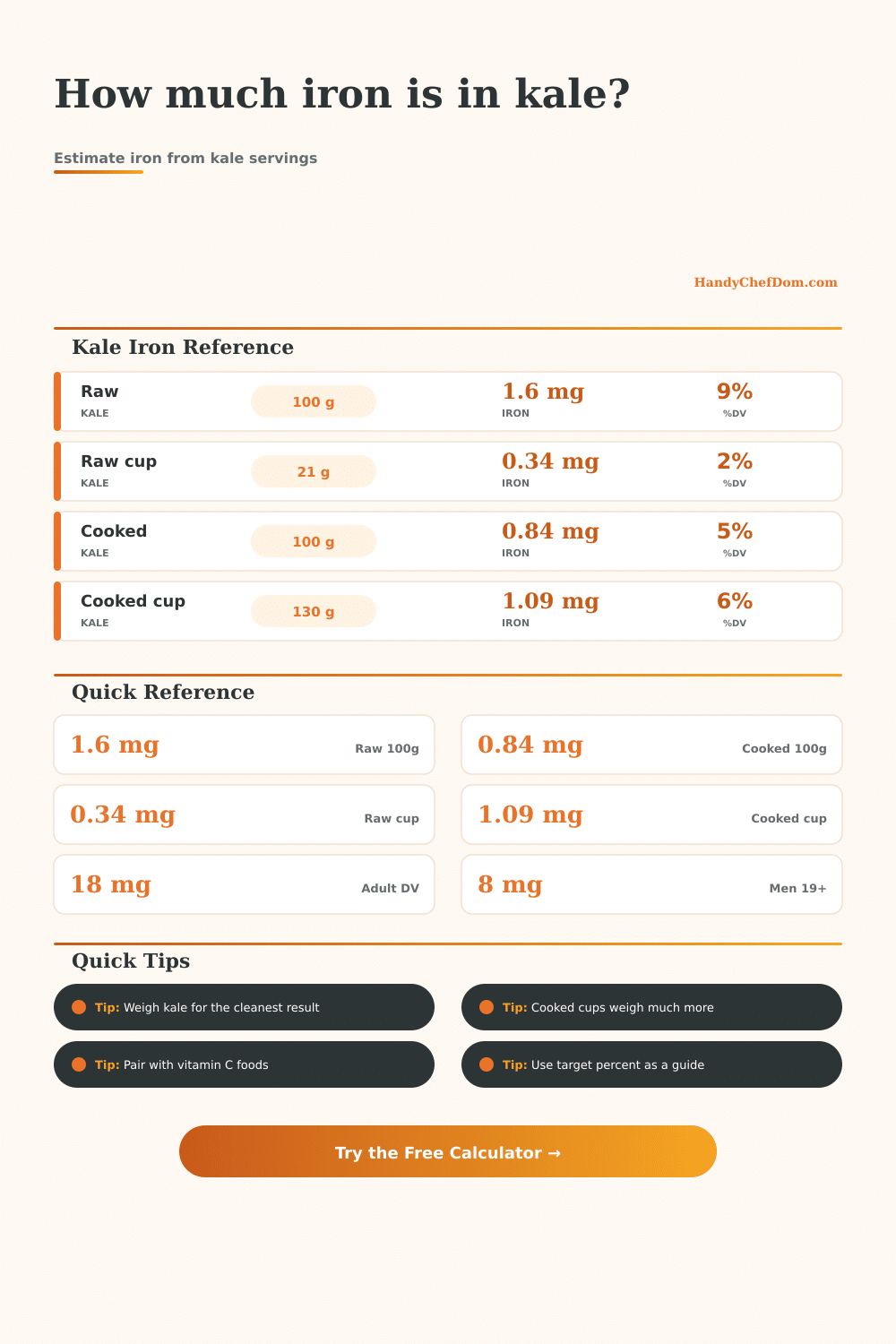
| Raw chopped kale | 1.60 mg | 35 | 4.1 g | 21 g cup |
| Raw packed kale | 1.60 mg | 35 | 4.1 g | 67 g cup |
| Baby kale raw | 1.55 mg | 35 | 4.0 g | 25 g cup |
| Cooked boiled drained | 0.84 mg | 36 | 4.0 g | 130 g cup |
| Cooked with salt | 0.84 mg | 44 | 2.3 g | 130 g cup |
| Frozen cooked drained | 0.85 mg | 36 | 2.3 g | 130 g cup |
| Frozen kale thawed | 1.10 mg | 28 | 2.0 g | 85 g cup |
| Measure | Typical Grams | Raw Iron | Cooked Iron | Use Case |
|---|---|---|---|---|
| 1 cup raw chopped | 21 g | 0.34 mg | -- | Salad topping |
| 1 cup raw packed | 67 g | 1.07 mg | -- | Smoothie base |
| 1 cup cooked | 130 g | -- | 1.09 mg | Dinner side |
| 1 oz raw | 28.35 g | 0.45 mg | -- | Snack bowl |
| 100 g raw | 100 g | 1.60 mg | -- | Scale measure |
| 100 g cooked | 100 g | -- | 0.84 mg | Scale measure |
| Target Group | Iron Target | Raw Kale 100g | Cooked Cup | Notes |
|---|---|---|---|---|
| Adult Daily Value | 18 mg | 9% | 6% | Food label comparison |
| Adult men 19+ | 8 mg | 20% | 14% | NIH RDA reference |
| Adults 51+ | 8 mg | 20% | 14% | NIH RDA reference |
| Women 19-50 | 18 mg | 9% | 6% | NIH RDA reference |
| Teen girls | 15 mg | 11% | 7% | NIH RDA reference |
| Pregnancy | 27 mg | 6% | 4% | Higher target |
| Scenario | Kale Amount | Edible Grams | Iron Estimate | Target Share |
|---|---|---|---|---|
| Small raw salad | 2 cups chopped | 42 g | 0.67 mg | 4% DV |
| Large raw salad | 4 cups chopped | 84 g | 1.34 mg | 7% DV |
| Smoothie greens | 1 packed cup | 67 g | 1.07 mg | 6% DV |
| Dinner side | 1 cup cooked | 130 g | 1.09 mg | 6% DV |
| Family side | 4 cooked cups | 520 g | 4.37 mg | 24% DV |
| Meal prep tray | 2 lb raw | 907 g | 14.51 mg | 81% DV |
Likely, raw kale was hard to chew. It is hard to chew. It tastes better cooked and cooking also changes its nutrition. Heat affects fiber and iron, and what happens if you cook your greens?
Minerals don’t hold up as well to being measured in volume, since the leaves of the kale lose volume when they collapses during cooking. Measuring by weight, like how many grams of iron; is preferable more than measuring by cups. Raw, chopped, a cup of kale is around twenty grams. Cooked, with those leaves tightly packed into a cup, that’s one-hundred-plus grams.
How to Track Iron in Kale
Don’t guess at how much the cooked kale will weigh; the tool knows and does the math for you. You may think you’re eating less iron because the leaves deflated (but no! You’re eating more).
It’s worth knowing about non-heme iron: Iron in plants doesn’t absorb as well as heme iron from meat. This mineral has to be unlocked, and that’s where vitamin C comes in. Pairing your kale with some vitamin C-rich foods makes a big difference in how much of that mineral you’ll actualy retain.
Most folks completely overlook absorption rates. If you select various meal pairings, you can adjust to match. This make it a more realistic estimate of what your body is likely to use; a static number becomes a livig number.
Another factor is trimming. When you purchase a bunch of kale, you don’t eat the woody part of the stem; it gets tossed into the compost heap. Those kale scrap count if you’re tracking exact nutrients. Your iron calculation will rise with the weight of the inedible portion if you plug in the entire weighed bunch without taking trim into account. The trim adjustment pulls it down to Earth so the number you’re left with represents what’s entering your body, not what went out into the compost bin.
That said: Kale isn’t all equal, either. Gram for gram, more-mature curly types contains more iron than baby kale, though the second is milder. (Raw, defrosted frozen kale acts more like its fresh counterpart.)
Cooked and drained frozen kale serves as a steady starting point; boil or saute your own kale, and you’ll see differences by form of cooking, as well. The reference tables shows that water weight is lost when kale is cooked, along with certain other nutrients, some leak into the cooking water, though other nutrients are concentrated. Sautéing or steaming them keeps their goodness sealed inside the leaf; boiling waters them down.
Lastly, set targets that match what you need each day. If you’re an adult male, you need eight milligrams of iron per day. A female of child bearing age need eighteen. That’s a big difference. What appears as unimportant on the page may be a huge part of the solution for one individual and nearly meaningless rounding error for someone else. Having the right target gives you perspective on exactly how much of your daily need this one ingredient provides.
You wouldn’t of trick yourself into thinking you’ve solved an issue by consuming insufficient amounts of a certain food (because it won’t budge the needle). Plants are a source of stubborn iron. But they’re certainly not impenetrable. The key lies in understanding the factors that affect absorption, respecting them, and measuring (in terms of weight) when possible.
Pair with acid to help absorption. Don’t forget the stems you discard so you have accurate measurements. Don’t worry about every single milligram of iron, but get rid of the guessing part of your ritual. Know what’s going into your body and why, exactly, you’re getting it there.
When you realize a side of kale contains X amount of iron compared to your own personal target, kale won’t be so fuzzy and warm, and cold and distant, it’ll simply become another tool for your diet. And it will feel more like a choice than a chore.