Potatoes Per Person For Mashed Calculator
Estimate raw potatoes, finished mashed cups, butter, milk, and serving yield from your guest count and mash style
| Potato Type | Best Use | Avg Each | Raw Per Cup Mash |
|---|---|---|---|
| Russet / Idaho | Fluffy mash | 5.3 oz / 148 g | 6.7 oz / 189 g |
| Yukon Gold | Creamy mash | 5.0 oz / 142 g | 6.5 oz / 184 g |
| Red Potato | Skin-on mash | 4.5 oz / 128 g | 6.9 oz / 196 g |
| White Potato | All-purpose mash | 5.0 oz / 142 g | 6.6 oz / 187 g |
| Fingerling Mix | Rustic mash | 1.5 oz / 43 g | 7.2 oz / 204 g |
| Sweet Potato | Sweeter mash | 4.6 oz / 130 g | 7.0 oz / 198 g |
| Scenario | Cups / Person | Finished Weight | Raw Potato Guide |
|---|---|---|---|
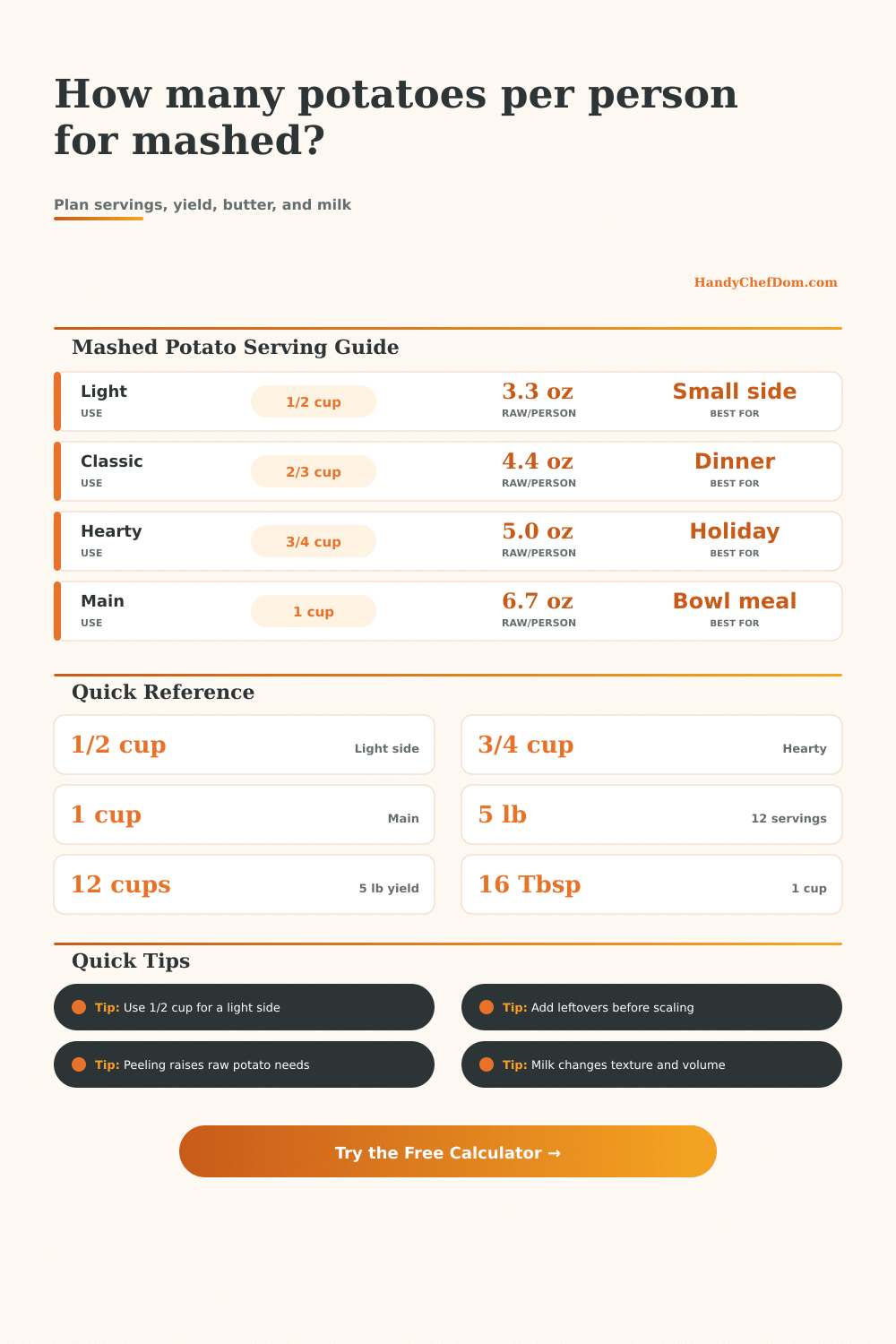
| Small side | 1/2 cup | 105 g | 3.3 oz / 95 g |
| Classic side | 2/3 cup | 140 g | 4.4 oz / 126 g |
| Hearty side | 3/4 cup | 158 g | 5.0 oz / 142 g |
| Main serving | 1 cup | 210 g | 6.7 oz / 189 g |
| Mash Style | Butter / Cup | Milk / Cup | 12 Cup Batch |
|---|---|---|---|
| Light | 1 tsp | 2 Tbsp | 4 Tbsp butter, 1.5 cups milk |
| Classic | 1/2 Tbsp | 3 Tbsp | 6 Tbsp butter, 2.25 cups milk |
| Rich | 2 tsp | 4 Tbsp | 8 Tbsp butter, 3 cups milk |
| Holiday | 1 Tbsp | 5 Tbsp | 12 Tbsp butter, 3.75 cups milk |
| Measure | Tablespoons | Fluid Ounces | Metric |
|---|---|---|---|
| 1/4 cup | 4 Tbsp | 2 fl oz | 59 mL |
| 1/2 cup | 8 Tbsp | 4 fl oz | 118 mL |
| 1 cup | 16 Tbsp | 8 fl oz | 237 mL |
| 1 lb potatoes | - | 16 oz | 454 g |
There’s also the matter of guesswork: How many people will show up? You grab a bag of potatoes that seems like it should of do the trick. Then you peel, boil, mash, and hope what comes out resembles dinner. More often than not, it doesn’t work. And so you end up with three bowl of leftover starch, even though you thought you had a dinner party for four. Or else you’re scraping the bottom of pot, wondering aloud whether your guests might prefer bread instead. The potatoes is adequate, or they are worth a second helping. There’s no guarantee you’ll make the second kind just by trying harder. It’s actualy mathematics disguised as comfort food.
But first: let’s talk about the most important ingredient in a good mash: the potato itself. What it loses (and gains) as you prepare it. A raw potato has a lot of skin and water in there that isn’t present once the first spoonful lands on your plate. Leave the skins on, yes, and you’ll keep some of that weight. But at the cost of a very different texture. Peel it, and now you’ve got waste.
How to Calculate the Right Amount of Potatoes
Enter the magic number above to compensate for the portion of each potato lost in peels. Eight percent if you’re trimming lightly, perhaps, or maybe up to eighteen if you were really hacking away with that knife. Why? Because when you buy five pounds of potatoes, you aren’t buying five pounds of mashable flesh, you’re buying all skins and the water that will end up down the sink. Knowing how much you lose closes that gap. It keeps you from panicking midway through cooking and realizing you need to get back to store.
How many do you need depends greatly on other foods on the plate. When they’re just a side dish at a family dinner, how many potatoes would you eat for one? Probably very few! This is especially true if there’s turkey, ham, stuffing, and gravy. But when they’re the center of the plate in their own bowl, paired with sausage, pulled pork, etc., then each person will eats more, especially since mashed potatoes are filling! The calculator lets you adjust based off whether these are hearty main dishes, classic portion sizes, or light sides. That’s important. A side portion may sound reasonable at two-thirds of a cup per person. However, once you double that for 12 people or multiply it by everyone coming for Thanksgiving, it starts to seem like a lot of potatoes, even for such a small amount. If the rest of the meal is pretty heavy on protein or includes some other starchy food (biscuits, rolls) go more toward the light end. If this IS the main event, then you has to adjust accordingly.
That’s where the liquids enter the picture and alter yield as well as texture. Milk and butter aren’t just for flavor; they also adds weight and volume. For a simple, firm side, less dairy is needed than for a rich holiday-style batch. To help plan your shopping list accordingly, the tool comes with reference tables that break down all the ratios. How much butter do you need (half a tablespoon per cup), or a full tablespoon? That decision will affect how rich your final dish is. And it affects how many cups of finished product you’ll end up with from a certain amount of raw potato. Softer mash, made with more liquid, takes up more space than drier, firmer mash.
We also often overlook another aspect: the type of potato matters. For example, Russets break down well (creating fluffiness). Yukon Golds has more fat so they’re creamier and also tend to keep their shape. Red potatoes stays fairly waxy. Leave the skin on them for a nice rustic effect. Because each type contains different amounts of water and has different densities, the calculator accounts for this variation. The same raw weight won’t work for a batch of fingerlings as it will for russets. If you want the same result, you need to know what kind of potato you’re working with to get what you expect.
Lastly, let’s talk leftovers. With proper care, mashed potatoes re-heat incredibly well. Sometimes they’re even better the next day! Factor in a little wiggle room here; you may not end up needing all that much food, but it’s better to have an extra cup than an empty pot. Better to be on the safe side and have too many taters then no taters at all.
When you plan using these factors, it stops being guesswork and becomes strategy. You enter the kitchen knowing exactly how much you’ll need, and for what reason. Not only do you get to fill the table, you feel confident as you stir away.