🥩 Ribeye Sous Vide Time Calculator
Plan ribeye bath time from thickness, target doneness, bone-in style, starting state, sear plan, hold window, and altitude.
Enter the thickest part of the ribeye and your serving plan. The calculator estimates minimum bath time, a practical hold window, sear time, and ready-to-slice timing.
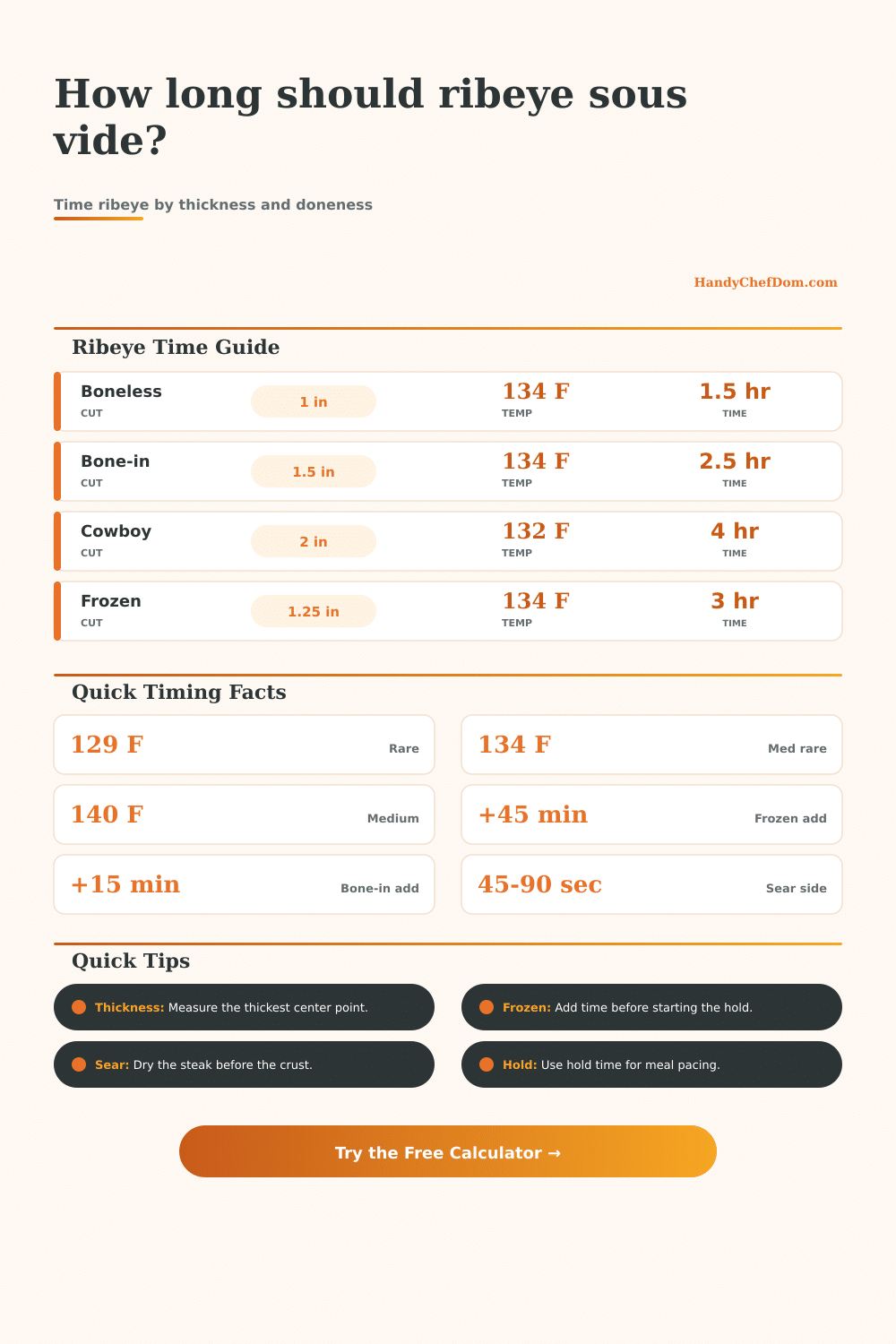
| Ribeye Thickness | Boneless Time | Bone-In Time | Best Use |
|---|---|---|---|
| 1 inch | 1 hr 15 min | 1 hr 30 min | Weeknight steak |
| 1.25 inches | 1 hr 45 min | 2 hr | Standard ribeye |
| 1.5 inches | 2 hr 15 min | 2 hr 35 min | Steakhouse cut |
| 1.75 inches | 3 hr | 3 hr 20 min | Thick butcher cut |
| 2 inches | 3 hr 45 min | 4 hr 10 min | Cowboy ribeye |
| 2.5 inches | 5 hr 15 min | 5 hr 45 min | Double-cut ribeye |
| Doneness Target | Bath Temp | Texture | Timing Note |
|---|---|---|---|
| Rare | 129 F / 54 C | Soft red center | Use shorter hold |
| Medium rare | 134 F / 57 C | Rosy and juicy | Most forgiving |
| Medium | 140 F / 60 C | Pink center | Good family target |
| Medium well | 150 F / 66 C | Slight pink | Keep hold modest |
| Bath offset | +2 F above target | Faster heating | Reduces bath time |
| Bath offset | -2 F below target | Gentler result | Adds bath time |
| Starting State | Add Time | Works Best For | Calculator Logic |
|---|---|---|---|
| Tempered 20 min | -10 min | Thin boneless steaks | Warmer center |
| Refrigerated | +0 min | Most ribeyes | Baseline timing |
| Ice-bath chilled | +15 min | Very cold prep | Cold center |
| Frozen solid | +45-90 min | Freezer dinner | Thickness based |
| Crowded bath | +12 min | Multiple steaks | Flow penalty |
| Stacked bags | +25 min | Meal prep starts | Slow contact |
| Sear Plan | Per Side | Total Finish | Crust Style |
|---|---|---|---|
| Torch finish | 45 sec | 2 min | Precise browning |
| Cast iron | 60 sec | 3 min | Deep crust |
| Hot grill | 75 sec | 4 min | Charred edges |
| Broiler finish | 90 sec | 5 min | Even top heat |
| Reverse sear | 2 min | 6 min | Heavy crust |
| No sear | 0 sec | 0 min | Bag-to-slice |
Times are planning estimates for ribeye steaks. Use your own equipment, steak shape, and preferred doneness judgment when serving.
A perfect steak or a tough steak is a matter of minutes. Expensive equipment, finest cut, all for nothing if you time it poorly. Muscle fiber are not forgiving when it comes to heat transfer. When it comes to thick steaks, there’s no guesswork here.
After inputting your desired doneness, and the steak’s thickness, the calculator do the rest, converting heat transfer into a tick-tock, tick-tock schedule. Everything else is based off thickness. Generally speaking we are relying on either what’s printed on the package or measuring the thickness of the meat at its thickest point (which is the edge of the steak). This tend to be incorrect.
How to Cook the Perfect Steak
When you cook a piece of meat it heats from the outside towards the inside. The farther it has to go, the longer it takes. So if you have a ribeye that is 2 inches in the middle and then gradually gets smaller all around as it nears the outer edges, you cook it like a 2 inch steak. The parts closer to edge will just be a little bit more cooked through. It’s a risk you take when trying to make sure something is consistent.
The tool consider that. It looks at thickness of the middle and determines how long until the center reaches your desired temp.
Steaks with bones in are yet another complication. Because bones slow heat transfer to surrounding flesh, they also acts as insulation. For example, a bone-in ribeye will always be longer in the bath than its boneless version of equal thickness. You can see this in the table on the page. Even a relatively small amount of bone can mean fifteen minutes or more longer in the bath. And it’s not just about increasing cooking time, but about getting the meat around the bone up to the same internal temp as the remaining part of the steak. Cook it less and there’ll be a cold, raw spot at the very place you want the most flavor.
The starting state is a bit surprising; it matters little in the long run, but still enough to mention. On one hand, it’s nice that you don’t have to defrost first, but on the other… you’re cooking from frozen. You’ve got those ice crystals to melt before your water can heat up the meat! The ice itself is a huge thermal mass, so the calculator accounts for quite some time if your steaks is frozen. You can’t rush it. Pulling your steaks out too soon when they’re still partially frozen results in a bloody, unsafe, and thawed-but-not-heated middle. It requires patience, the sole ingredient.
Most people mess up when they do their sous vide experiment with the sear. They forget: it’s all about what happens inside in the bath. The sear only hits the outside. No matter how much you torch it, if you were off by a few minutes in the bag, you’re not fixing anything.
Before hitting the grill or pan, you want to have a dry surface. Moisture stops the Maillard reaction. Pat down your steak, let it rest, then cook at an extremely high heat for just a moment. Your sear time is calculated from your methodology (the calculator estimates it) but really it’s more about self-restraint. This isn’t about cooking the steak; this is about building a crust.
The flexibility of a hold window also fits busy lifestyles: Leave a steak in water for an hour or two (or more) beyond what’s required, and you don’t mess up. Tenderness actualy increases from longer times (especially with tougher steaks). And the pull window is how the calculator helps you match your meal service time to the finished product. It is not just a cook, but a plan. When do I wish to dine? Then reverse-engineer from there. Steak doesn’t get overcooked; it just hangs out waiting on you in the ideal condition. Blast it.
The last two variables are altitude and bag crowding. Boiling point is altered with altitude, though in a sous vide environment, it’s below boiling. So there isn’t much impact if you live at high altitudes. But crowded bags hold pockets of cooler water. That means that if your bags of steaks is tightly packed or on top of each other, then circulation will suffer. You want flow. And you want the water to be consistently the same around every square inch of meat. The time added by the calculator reflect this scenario.
Sous Vide Ribeye is not a science so much as it’s a discipline. It’s a matter of measuring precisely. It’s a matter of planning backwards. It’s a matter of respecting how heat moves. Do all this correctly and the proof comes when you slice into it. It is tender throughout. It is uniformly pink on the interior. The crusts are like they were meant to be. It is a dish that makes you believe in precision.
Put in the effort up front, and dinner serves itself.