🥩 Brisket Average Weight Calculator
Estimate the average raw brisket weight to buy per packer, flat, or point using cut type, grade, trim loss, cooked yield, thickness, servings, and leftovers.
Use plan mode to estimate the total raw brisket and average raw weight per brisket piece. Use check mode when you already know the total raw weight.
| Brisket Cut | Typical Raw Size | Trim Loss | Cooked Yield |
|---|---|---|---|
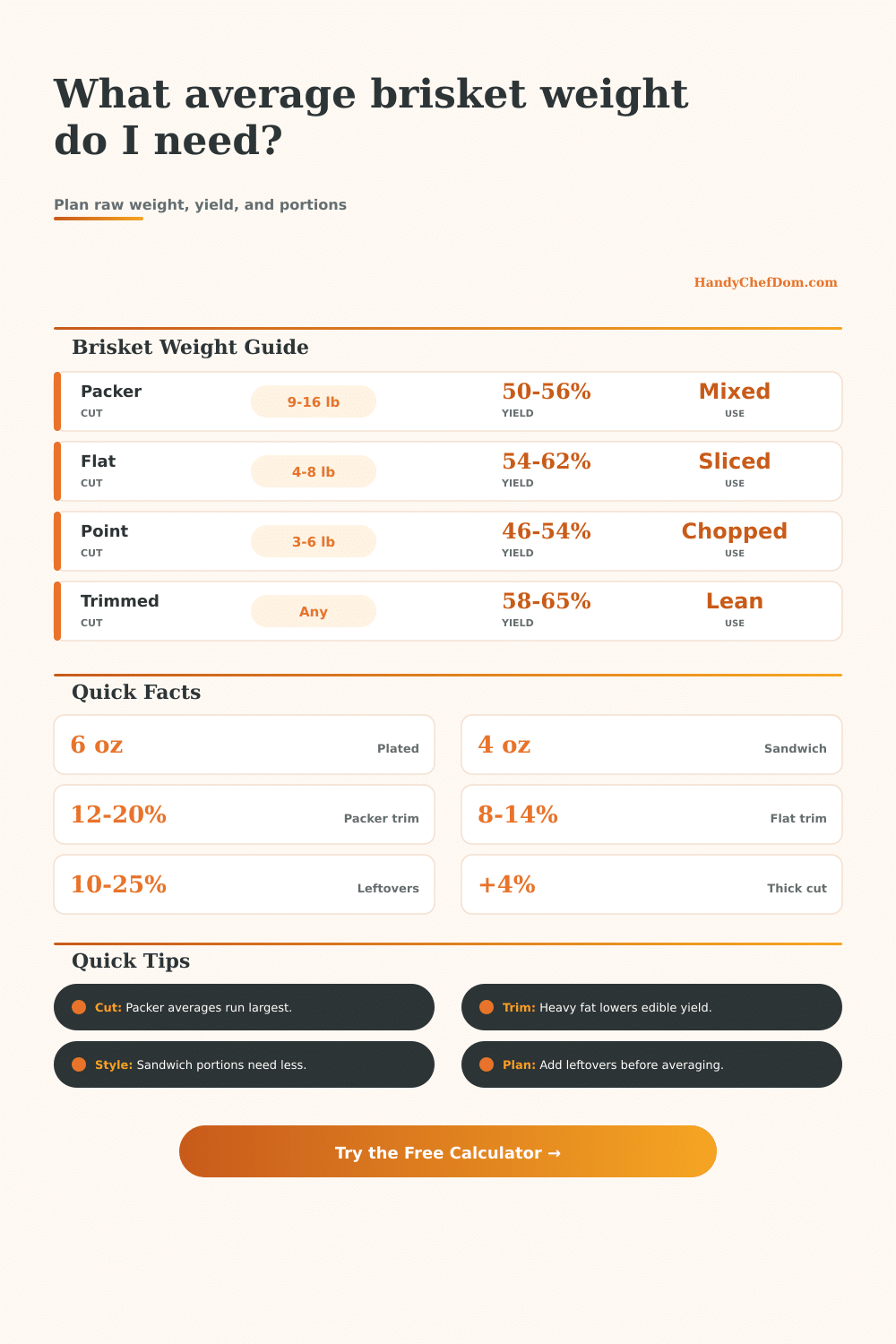
| Whole packer brisket | 9 to 16 lb | 12% to 20% | 50% to 56% |
| Large whole packer | 14 to 20 lb | 14% to 22% | 49% to 55% |
| Flat only | 4 to 8 lb | 8% to 14% | 54% to 62% |
| Point only | 3 to 6 lb | 10% to 18% | 46% to 54% |
| Market trimmed brisket | Any weight | 3% to 8% | 58% to 65% |
| Lean trimmed flat | 3 to 7 lb | 5% to 10% | 58% to 64% |
| Grade and Trim | Typical Effect | Trim Setting | Yield Setting |
|---|---|---|---|
| Select, leaner trim | Less marbling and smaller fat cap | 10% to 14% | 55% to 61% |
| Choice, normal trim | Balanced fat and slice yield | 12% to 18% | 52% to 58% |
| Prime, normal trim | More marbling with moderate render | 12% to 18% | 51% to 57% |
| Very marbled, rich trim | Rich point-heavy feel | 14% to 22% | 48% to 55% |
| Market trimmed | Less trimming needed at home | 3% to 8% | 58% to 65% |
| Competition style trim | More shaping and fat removal | 18% to 28% | 50% to 56% |
| Serving Style | Cooked Portion | Average Raw Rule | Best Fit |
|---|---|---|---|
| Sandwich tray | 4 oz per guest | 0.55 to 0.75 lb raw | Buns, slaw, and several sides |
| BBQ buffet line | 5 oz per guest | 0.7 to 0.9 lb raw | Mixed meats or potluck sides |
| Plated brisket dinner | 6 oz per guest | 0.85 to 1.1 lb raw | Dinner plates with sliced brisket |
| Tacos or sliders | 3 oz per guest | 0.45 to 0.6 lb raw | Small-format portions |
| Burnt ends portion | 5 oz per guest | 0.85 to 1.15 lb raw | Point meat with heavier render |
| Meal prep containers | 5.5 oz each | 0.8 to 1.0 lb raw | Planned leftovers and boxes |
| Guests | Sandwich Average | Plated Average | Suggested Split |
|---|---|---|---|
| 6 guests | 4 to 5 lb | 5 to 7 lb | One flat or small point |
| 12 guests | 7 to 9 lb | 10 to 12 lb | One small packer |
| 20 guests | 12 to 15 lb | 17 to 20 lb | One large packer or two flats |
| 35 guests | 22 to 26 lb | 30 to 36 lb | Two packers or mixed cuts |
| 50 guests | 31 to 38 lb | 43 to 52 lb | Three to four packers |
| 75 guests | 47 to 57 lb | 64 to 78 lb | Five or more pieces |
| Thickness | Weight Signal | Yield Adjustment | Use In Calculator |
|---|---|---|---|
| Thin flat or small point | Usually lighter pieces | Subtract about 2% | Good for quick portion checks and small meals. |
| Medium thickness | Typical butcher case brisket | No adjustment | Use as the baseline for most estimates. |
| Thick packer or point | Often heavier average weight | Add about 4% raw need | Helpful when the brisket is tall or very point-heavy. |
| Uneven mixed thickness | Varied slices and chopped bits | Add about 3% buffer | Use for trays made from several brisket pieces. |
The downside to throwing a barbeque party is that there’s typically either too much or too little meat. And fear of buying too little or too much beef is usually due to an error in quantity. To prevent such a mistake, I use this Brisket Weight Calculator.
It calculates how many pounds you should buys depending on your eating habits, how much you trim off before cooking, and how much will cook out (moisture). Why? Because what you buy isn’t necessarily what you eat. Know what you’re buying, and that’s yield.
How to Use the Brisket Weight Calculator
If you buy a twelve-pound brisket you’re not going to get twelve pounds of food. That’s because it shrivels when cooked. To serve people, you have to start with twice as much meat (and then hope for leftovers). Generally speaking, the rule of thumb is a fifty-five percent shrink.
So choose the right cut, the point cut loses about half its weight while the flat cut retain as much as sixty percent. The calculator takes care of this loss.
But not all cuts are created equal. The amount of trim make a big difference at the end. In-store, that fat cap may seem huge but it isn’t edible plate weight. That doesn’t get cooked into your dinner. To make sure you’re planning correctly, enter how much of your meat you’ll be trimming off and the calculator will ask you what percent that is.
Thick-trimming or thin-trimming (competition style) just means that one method leave you with more trim than the other. Pick your poison: food or beauty? Enter your selection into tool and the rest of the meat will adjust accordingly so you don’t run out of anything.
Portion size depend on serving style. If your meal is being served in sandwich form, you will serve less then if it’s plated with sides. With the calculator, you can toggle back and forth between different styles to adjust for ounces per person. This becomes important when catering large events.
Six ounces per person isn’t as much as four but at thirty people that translate into multiple pounds of raw beef. Account for leftover factor. Having some left over helps ensure you don’t run out while also having plenty of food.
The geometry differs with thickness of cut. Brisket is thick. Thicker means more moisture, better yield. The tool accounts for that too. You aren’t purchasing by weight alone, you’re purchasing flavor, and texture. There are tables of reference where meat grade will impact the result. Select grade is lean, while prime meat has more fat that melts away.
Manage your expectations actualy. With your guest count in mind, it give you a target weight for how much raw product you should of buy. Then it calculates how many servings that represents and how much leftover you might have. That’s the safety net.
When you’re at the store you can double-check whether you’ve got enough or not. How do you avoid spending money on food you don’t need while making sure there’s enough to feed everyone? It is stress-free and waste-free.
You get perfect meat every time. Get the numbers down first and then let the cookin finish the job.