🧁 Baking Powder to Baking Soda Converter
Instantly convert between baking powder and baking soda with proper acid adjustments
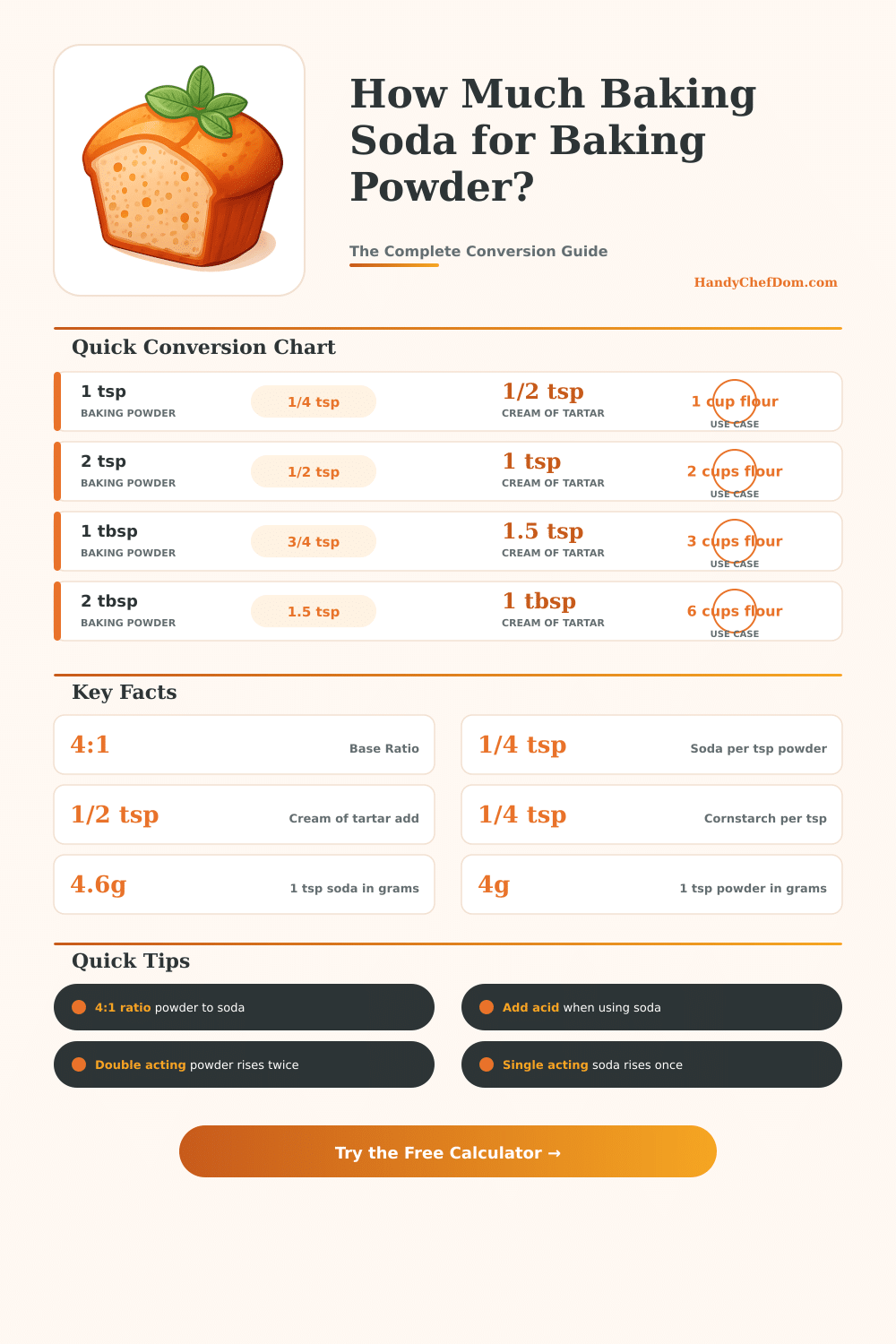
| Baking Powder | Baking Soda | Cream of Tartar | Metric (Soda) |
|---|---|---|---|
| ½ tsp | ⅛ tsp | ¼ tsp | 0.58g |
| 1 tsp | ¼ tsp | ½ tsp | 1.15g |
| 1 ½ tsp | ⅜ tsp | ¾ tsp | 1.73g |
| 2 tsp | ½ tsp | 1 tsp | 2.3g |
| 1 tbsp (3 tsp) | ¾ tsp | 1 ½ tsp | 3.45g |
| 2 tbsp (6 tsp) | 1 ½ tsp | 1 tbsp | 6.9g |
| 3 tbsp (9 tsp) | 2 ¼ tsp | 1 ½ tbsp | 10.35g |
| Acid Source | Amount per ¼ tsp Soda | Amount per ½ tsp Soda | Notes |
|---|---|---|---|
| Cream of Tartar | ½ tsp | 1 tsp | Best 1:1 substitute base |
| Lemon Juice | ½ tsp | 1 tsp | Adds slight citrus flavor |
| White Vinegar | ½ tsp | 1 tsp | Neutral flavor after baking |
| Apple Cider Vinegar | ½ tsp | 1 tsp | Mild fruity undertone |
| Buttermilk | ½ cup (120ml) | 1 cup (240ml) | Replace equal amount of liquid |
| Plain Yogurt | ½ cup (120ml) | 1 cup (240ml) | Replace equal amount of liquid |
| Molasses | ¼ cup (60ml) | ½ cup (120ml) | Adds sweetness & color |
| Flour Amount | Baking Powder | Baking Soda Equiv. | Metric (Flour) |
|---|---|---|---|
| 1 cup | 1 – 1 ½ tsp | ¼ – ⅜ tsp | 125g |
| 2 cups | 2 – 3 tsp | ½ – ¾ tsp | 250g |
| 3 cups | 3 – 4 ½ tsp | ¾ – 1 ⅛ tsp | 375g |
| 4 cups | 4 – 6 tsp | 1 – 1 ½ tsp | 500g |
| 5 cups | 5 – 7 ½ tsp | 1 ¼ – 1 ⅞ tsp | 625g |
| Component | Percentage | Role | Per 1 tsp (4g) |
|---|---|---|---|
| Baking Soda (NaHCO₃) | ~28% | Base / leavener | ~1.12g |
| Cream of Tartar (acid) | ~30% | Acid activator | ~1.20g |
| Cornstarch (buffer) | ~25% | Moisture buffer | ~1.00g |
| Sodium Aluminum Sulfate | ~17% | Second acid (heat) | ~0.68g |
The standard ratio, that I used for years, now is 4:1, one teaspoon of baking powder becomes a quarter teaspoon of baking soda. That results in around 1.15 grams of soda instead of 4 grams of powder. Amount does not change a lot even though baking soda takes up bigger space in the recipe as a rising agent.
Main point: you must mix it with acid, for instance cream of tartar, lemon juice or vinegar.
How to use and replace baking powder and baking soda
For a quarter teaspoon of baking soda I usually take half a teaspoon of cream of tartar. Lemon juice and white vinegar work just as well in amounts of around 2.5 ml each. Buttermilk needs more, namely half a cup for a quarter teaspoon of soda, which must add around 120 ml to otehr liquids in the recipe.
Regarding volume, one tablespoon of powder equals three quarters of a teaspoon of soda, weighing about 3.45 grams, quite a lot for 3 cups of flour, according to my experience.
baking powder is made up of a chemical for rising, done from carbonate or bicarbonate together with powdered acid, plus starch that absorbs moisture and stops too early reaction of the parts. It mainly serves to form brief bubbles and lighten the structure of baked products.
baking powder is basically baking soda mixed with acid. Without that, baking soda needs a sour element in the recipe, as vinegar or buttermilk, to work. Baking powder works on its own, without extra acids; hear is the key difference.
They can seem alike, but absolutely no one should swap them.
When baking powder touches liquid, it right away reacts and creates that CO₂ bubbles. Acid and baking soda dissolve and start the whole rising process. Without such a rising agent, your mix would end dense, heavy and flat.
The advantage of double-acting baking powder is, that it reacts twice. About 70 % of the process starts when liquid is added, and the other 30 % during the heat in the oven. This gives extra rise during baking, which helps baked goods.
Also, some brands offer versions without aluminium, which changes everything, especially for crisp chicken wings.
baking powder serves as a handy replacement for yeast risers. Yeast works by means of fermentation and adds its own taste. Even so for pastries, biscuits, cookies, cakes, flat breads and quick breads, baking powder is the best choice, if one wants to avoid yeasty taste.
There are many types of special baking powders (without cornstarch), without gluten, low-sodium for those, that watch their salt intake. It is not hard to prepare baking powder from some basic kitchen items. Use commonly a quarter teaspoon of baking soda with two teaspoons of lemon juice or vinegar for one teaspoon of baking powder.
General rule of thumb is one teaspoon of baking powder for one cup of flour in quick breads and chemical batters. Too much causes cakes to rise too high, making them spongy and somehow bland. One can also create self-raising flour mixing one and half teaspoons of baking powder with half teaspoon ofsalt for one cup of all-purpose flour.