🍰 Baking Time Conversion Calculator
Convert baking times between oven types, pan materials, recipe sizes & altitudes
| °F | °C (Conventional) | °C (Fan/Convection) | Gas Mark | Description |
|---|---|---|---|---|
| 250 | 120 | 100 | ½ | Very Low |
| 275 | 135 | 115 | 1 | Very Low |
| 300 | 150 | 130 | 2 | Low |
| 325 | 160 | 140 | 3 | Moderately Low |
| 350 | 180 | 160 | 4 | Moderate |
| 375 | 190 | 170 | 5 | Moderate |
| 400 | 200 | 180 | 6 | Moderately Hot |
| 425 | 220 | 200 | 7 | Hot |
| 450 | 230 | 210 | 8 | Very Hot |
| 475 | 245 | 225 | 9 | Very Hot |
| Adjustment Factor | Temperature Change | Time Change | Notes |
|---|---|---|---|
| Glass Pan | Reduce 25°F / 15°C | Same or slightly less | Glass retains more heat |
| Dark / Nonstick Pan | Reduce 25°F / 15°C | Reduce by 10–15% | Absorbs more heat |
| Light / Shiny Pan | No change | May add 5–10% | Reflects heat, slower browning |
| Insulated Pan | No change | Add 5–10 min | Slower heat transfer |
| Mini / Smaller Pan | Same temp | Reduce 25–30% | Less volume, faster bake |
| Larger Pan (shallower) | Same temp | Reduce 10–15% | Thinner batter bakes faster |
| Altitude | Temp Increase | Sugar Reduction | Liquid Increase |
|---|---|---|---|
| 3,000–5,000 ft (900–1,500 m) | +15–25°F | 1 tbsp per cup | 2–4 tbsp per cup |
| 5,000–7,000 ft (1,500–2,100 m) | +25°F | 2 tbsp per cup | 3–4 tbsp per cup |
| 7,000–9,000 ft (2,100–2,700 m) | +25°F | 2–3 tbsp per cup | 3–4 tbsp per cup |
| 9,000+ ft (2,700+ m) | +25°F | 3 tbsp per cup | 4 tbsp per cup |
| Size Multiplier | Time Adjustment | Example (30 min base) | Tip |
|---|---|---|---|
| 0.5x (Half) | Reduce 25–30% | 21–23 min | Check 5 min early |
| 1x (Same) | No change | 30 min | Follow recipe |
| 1.5x | Add 15–20% | 35–36 min | Use larger pan |
| 2x (Double) | Add 25–30% | 38–39 min | Monitor closely |
| 3x (Triple) | Add 35–45% | 41–44 min | Multiple pans help |
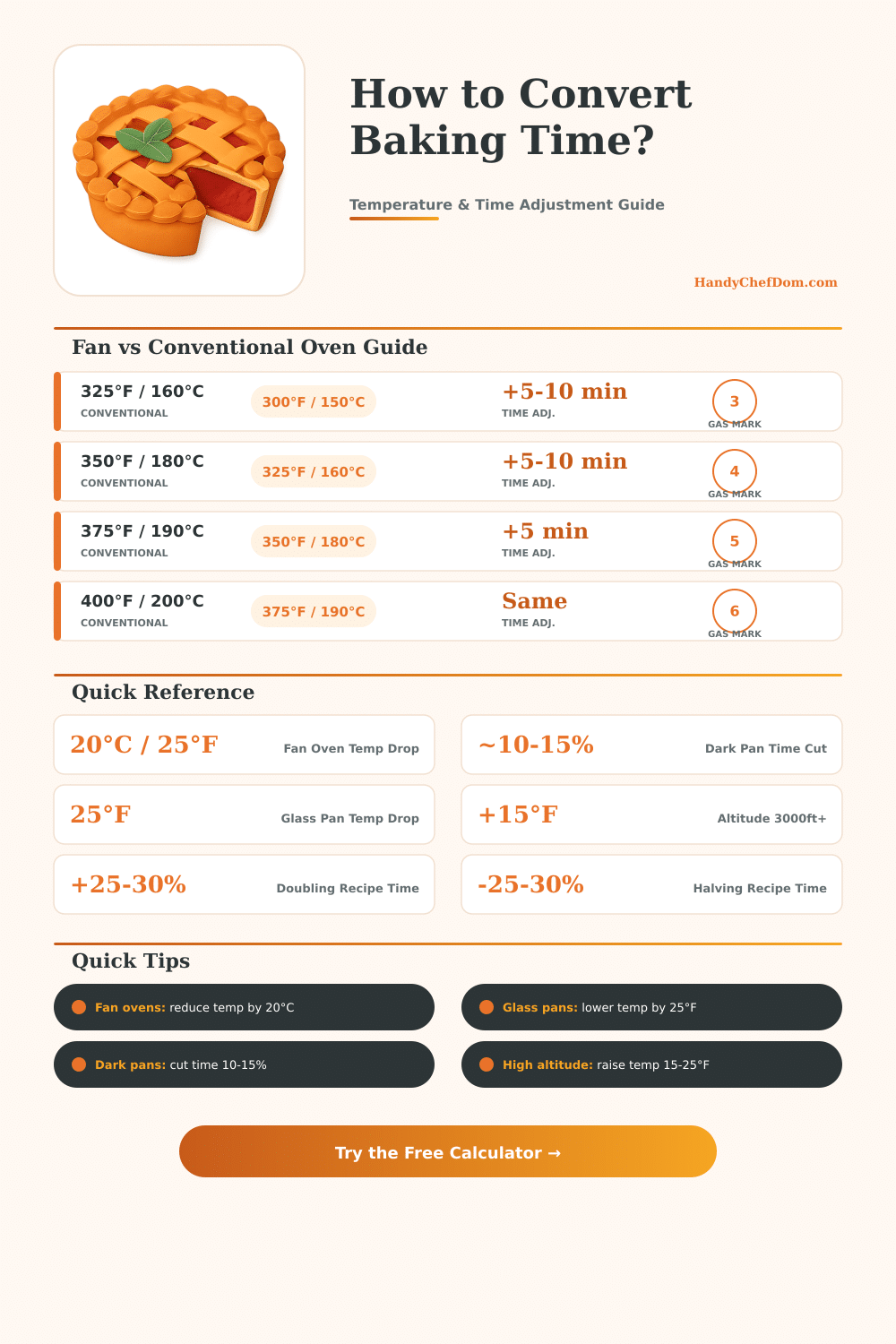
Changing the boiler from normal mode to convection? That is not a problem simply lower the temperature by around 25 degrees Fahrenheit (this is the secret number). What about the duration of cook?
Lower it by 10-15 percent also. It does not seem a big change, but it really creates quite a clear result.
Easy Oven Temperature and Time Rules
Cooking in glass tins against metal plates is another interesting point. For glass, lower the heat by 25F again. What about the black nonstick plates?
Same lowering of temperature, except that you cut the Time by 12 percent now. Say, a recipe requires 40 minutes at 375 on a light plate, that becomes 35 minutes at 350 on a black nonstick.
Doubling a recipe does not exactly double the Time for baking. It is more like a 27-percent increase. For an original baking of 30 minutes?
It gets to 38 minutes for the double batch. Halving it works the other way, removing around 27 percent, down to about 22 minutes. And for bakers at high heights?
Raise the temperature buy 25 extra degrees Fahrenheit because of the low air pressure. Small, but it helps well.
The info below comes directly from expert bakers, not from any calculator or converter. Here are the tips and results that I gathered from forums, recipe blogs and our local group of bakers.
Recipes usually show a range for baking times, not only one exact moment. For example 12-15 minutes at 350. The reason is that boilers, plates and height all affect the result.
So I always check the process at the shortest Time listed. It is much better to pull something out some minutes early than to let it go too long.
A useful rule of thumb is to set the timer at 5 minutes under the shortest duration. That way you can watch it and pull it out as soon as it looks ready. It only takes a bit of practice to get the feeling about heat.
The first Time I try a new recipe, it can take a whole hour. The third Time, maybe 40 minutes. The fourth, around 25.
The more you bake, the better gets your internal clock.
The plate itself makes a big difference also. Lower and wider plates cook more quickly than tall and narrow. Round forms bake more evenly than rectangular.
When I halve a recipe and use a smaller plate, if the depth of the mix stays the same, the temperature and Time stay the same. But if the mix is thinner, I will lower the duration.
Doubling a recipe is a whole other story. If I split the double batch into two normal plates, the Time does not change. But if I fill the whole boiler up, it can take more because of bad heat flow.
Things spread out cook more quickly than fully filled.
Glass plates can be tricky. They hold the heat very well, but that sometimes causes longer times for baking compared to metal. And in higher regions, baked goods need more Time because of the low air pressure.
Adding to the temperature or to the duration is the fix here. But test only one change at a Time.
Preheating is key. Recipes assume that the boiler already reached the heat. Usually it takes around 15 minutes to reach 350°F. Skipping that really can ruin everything.
And for a convection boiler, you can keep the temperature the same but shorten the Time by 10-15 percent. Just watchattentively.
The ideal settings for cake are around 180°C, which matches 350°F, for 30-40 minutes. But you also can lower it to 160-170°C and stretch the duration a bit. Cookies usually need 5-10 minutes, but sometimes they need 20 or more to really finish well.