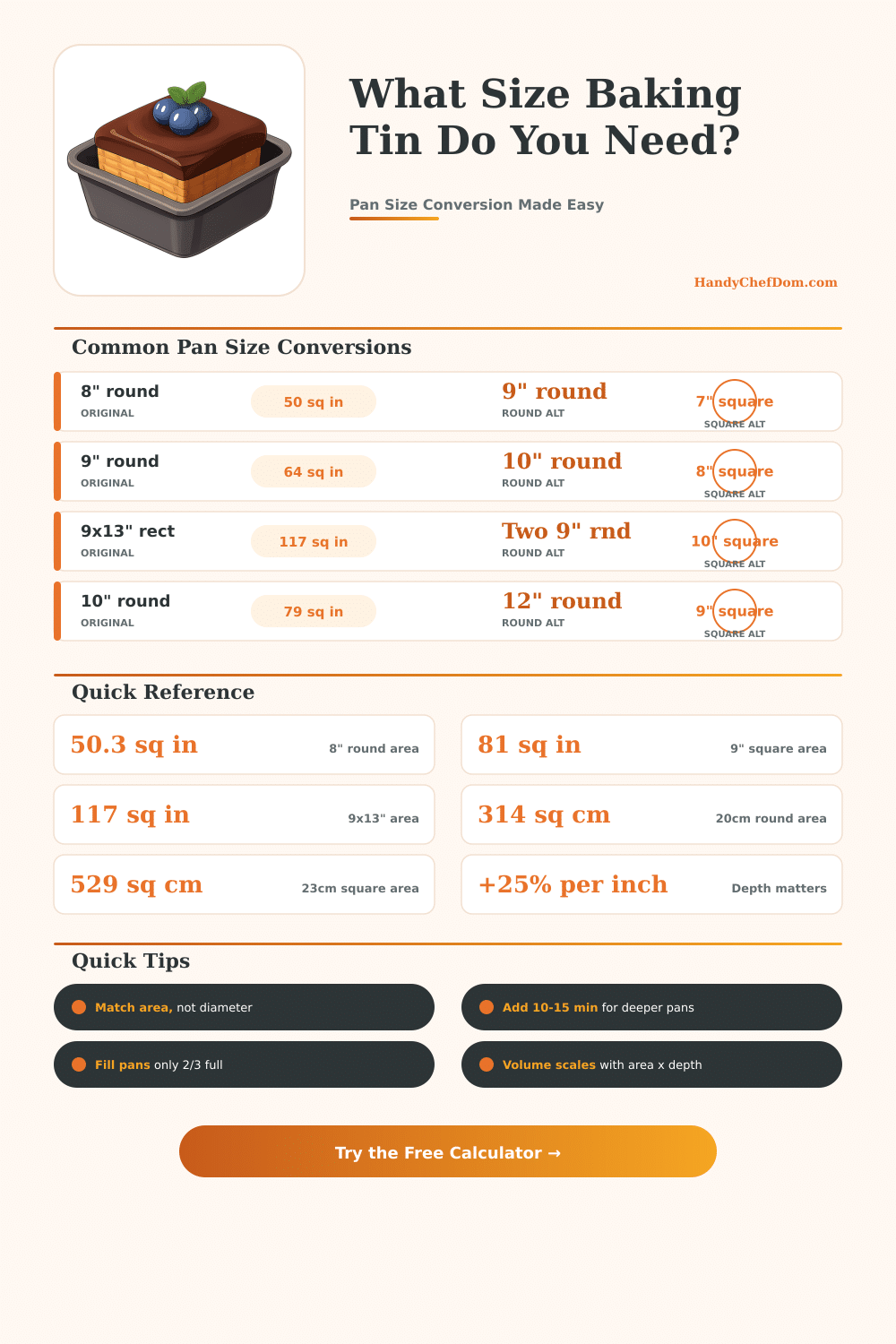
🎂 Baking Tin Size Converter
Convert between round, square & rectangular pans in inches or centimeters
| Diameter | Metric | Area (sq in) | Area (sq cm) | Volume at 2″ |
|---|---|---|---|---|
| 6″ | 15 cm | 28.3 | 177 | 56.5 cu in |
| 7″ | 18 cm | 38.5 | 254 | 77.0 cu in |
| 8″ | 20 cm | 50.3 | 314 | 100.5 cu in |
| 9″ | 23 cm | 63.6 | 415 | 127.2 cu in |
| 10″ | 25 cm | 78.5 | 491 | 157.1 cu in |
| 11″ | 28 cm | 95.0 | 616 | 190.1 cu in |
| 12″ | 30 cm | 113.1 | 707 | 226.2 cu in |
| Pan Size | Metric | Area (sq in) | Area (sq cm) | Volume at 2″ |
|---|---|---|---|---|
| 7″ square | 18 cm | 49.0 | 324 | 98.0 cu in |
| 8″ square | 20 cm | 64.0 | 400 | 128.0 cu in |
| 9″ square | 23 cm | 81.0 | 529 | 162.0 cu in |
| 10″ square | 25 cm | 100.0 | 625 | 200.0 cu in |
| 8×11″ | 20×28 cm | 88.0 | 560 | 176.0 cu in |
| 9×13″ | 23×33 cm | 117.0 | 759 | 234.0 cu in |
| 11×15″ | 28×38 cm | 165.0 | 1064 | 330.0 cu in |
| Original Pan | Equivalent Round | Equivalent Square | Area Ratio |
|---|---|---|---|
| 6″ round | — | 5.3″ square | 1.00 |
| 8″ round | — | 7.1″ square | 1.00 |
| 9″ round | — | 8.0″ square | 1.00 |
| 8″ square | 9.0″ round | — | 1.00 |
| 9″ square | 10.1″ round | — | 1.00 |
| 9×13″ rect | 12.2″ round | 10.8″ square | 1.00 |
| Two 8″ rounds | 11.3″ round | 10.0″ square | 1.00 |
| Inches | Centimeters | Inches | Centimeters |
|---|---|---|---|
| 5″ | 12.7 cm | 9″ | 22.9 cm |
| 6″ | 15.2 cm | 10″ | 25.4 cm |
| 7″ | 17.8 cm | 11″ | 27.9 cm |
| 8″ | 20.3 cm | 12″ | 30.5 cm |
8-inch round pan has around 50.3 square inches of surface, but if one swaps it with 8-inch square pan, one reaches 64 square inches. That means almost 27% more batter for the recipe. I did not expect that the difference will be this big, until I counted the numbers.
Passing from 9-inch round with 63.6 square inches to 9×13 rectangular pan, 117 square inches, requires expanding the ingredients 1.84 times. Fierce, right? A 20 cm round pan equals around 7.9 inches wide, depending on the depth.
Choosing the Right Cake Pan: Size, Shape and Material
Also the height plays a role: every extra inch expands the whole volume by about 25%.
This info does not come from any calculator or converter. It is based on real experiences of users, talks in forums and shared cooking experiences across teh net.
Ovens are used for various materials, including aluminium, steel and cast iron. Aluminium works well when one wants to simply bake. It is very lasting and should not rust.
Worth searching for heavy aluminum pans, because they perform more well over time. Non-stick surfaces and heavy heat transfer are main features that one must consider when buying.
Round pans work for layered and plain cakes. Square or rectangular pans ensure smooth edges and ease the cutting. Bundt and fancy pans go well with simple glazes or designs that fully hide frosting.
Pick the shape according to the event and the serving style of the cake simplifies the decorating and improves the look of the finished baking.
9×13-inch rectangular pan holds around 3 quarts. It is useful for brownies, lasagna, vanilla sheet-cake and casseroles. 8×8-square pan works for brownies, cakes and small casseroles.
Muffin trays work with cupcakes, muffins and tiny baking batches. Sheet pans serve well for cookies and frosted treats.
Size has big importance. Many recipes point instructions as “prepare 3 eight-inch pans or 4 six-inch pans.” Mostly, pans in two inches of depth work for most recipes. Baking in a deeper pan can cause undercooking, so separate pans commonly are better.
When a recipe requires 8-inch pan, 7-inch pan is nearer than 10-inch. The volume of cakes relates to the square of their radius, so that half the diameter does not simply halve the capacity.
One can swap a round pan by means of a square of alike volume. For instance, 20 cm round pan equals 18×18 cm square pan. A chart based on volume helps to ensure that the batter fits exactly to the chosen size.
Round cakes come in several styles: average, springform, with removable bottom and bottomless. Every type has separate uses. Springform pans sometimes are fragile.
Flipping the bottom upside-down removes the edge and helps to release cakes. Using non-stick parchment is also useful.
Sheet-baking cut in square bits works for big dinners. Round cakes limit to slices in triangles, which creates weak spots that easily break. Round cakes are cut only at the serving spot.
Greasing the pan with butter works, but spray for non-stick cooking is simpler. Non-stick paper on a baking sheet stops cookies from moving. Using baking paper in the pan removes the need to grease or flour it.
Without fat or cover, the cake will stick to the pan. Also the pan colour affects the final baking, similarly to how dark materials absorb more heat.