🥩 Beef Roast Cooking Time Calculator
Calculate precise cooking times by weight, cut, and desired doneness
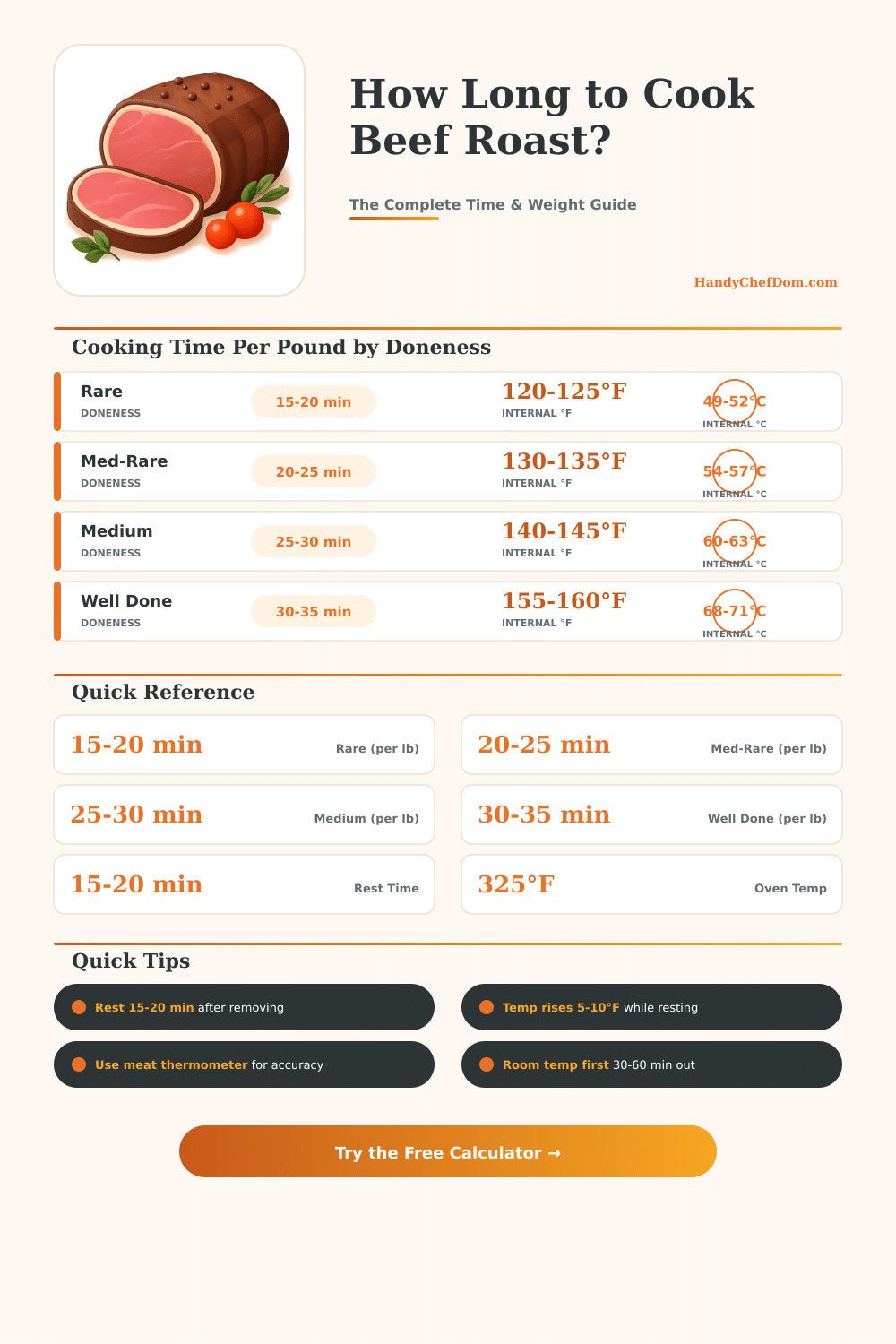
| Doneness | Min/lb (Boneless) | Min/lb (Bone-in) | Internal Temp |
|---|---|---|---|
| Rare | 15–20 min | 13–17 min | 120–125°F / 49–52°C |
| Medium Rare | 20–25 min | 17–22 min | 130–135°F / 54–57°C |
| Medium | 25–30 min | 22–27 min | 140–145°F / 60–63°C |
| Medium Well | 28–33 min | 25–30 min | 150–155°F / 66–68°C |
| Well Done | 30–35 min | 28–33 min | 155–160°F / 68–71°C |
| Cut | Raw-to-Cooked Yield | Servings Per lb | Bone/Trim Loss |
|---|---|---|---|
| Rib Roast (bone-in) | 65–70% | 2 servings | 20–25% |
| Rib Roast (boneless) | 70–75% | 2.5–3 servings | 10–15% |
| Tenderloin | 75–80% | 3–4 servings | 5–10% |
| Sirloin Tip | 70–75% | 3 servings | 10–15% |
| Top Round | 68–73% | 3 servings | 10–12% |
| Eye of Round | 70–75% | 3 servings | 8–12% |
| Chuck Roast | 60–65% | 2–2.5 servings | 15–20% |
| Rump Roast | 65–70% | 2.5–3 servings | 12–18% |
| Guests | Boneless (lb / kg) | Bone-in (lb / kg) | Servings Assumed |
|---|---|---|---|
| 4 | 2.5 lb / 1.1 kg | 3.5 lb / 1.6 kg | 6–8 oz each |
| 6 | 3.5 lb / 1.6 kg | 5 lb / 2.3 kg | 6–8 oz each |
| 8 | 5 lb / 2.3 kg | 7 lb / 3.2 kg | 6–8 oz each |
| 10 | 6 lb / 2.7 kg | 8.5 lb / 3.9 kg | 6–8 oz each |
| 15 | 9 lb / 4.1 kg | 13 lb / 5.9 kg | 6–8 oz each |
| 20 | 12 lb / 5.4 kg | 17 lb / 7.7 kg | 6–8 oz each |
| Oven Temp | Time Adjustment | Best For | Notes |
|---|---|---|---|
| 300°F / 150°C | +15–20% longer | Chuck, Rump | More even, tender result |
| 325°F / 163°C | Baseline (1x) | All cuts | Most common oven temp |
| 350°F / 177°C | -10–15% shorter | Tenderloin, Sirloin | Slightly faster, good crust |
| 375°F / 190°C | -15–20% shorter | Tenderloin | Watch carefully |
For Roast Beef I figured, that the best amount usually reaches around 6 until 8 ounces each guest if one wants them plain. That matches to almost 170 until 225 grams. Roast with bones is entirely other story even so; one must count 12 until 14 ounces for every person, to make up for the weight of the bones, that commonly forms 20 until 25 percent of the whole.
About the duration of cooking I surprisingly learnt, that medium-rare Beef Roast finishes in around 20 until 25 minutes each pound at 325°F.
How Much Roast Beef to Serve and How Long to Cook It
The amount of cooked products commonly range between 70 and 75 percent for the most many cuts, but chuck Roast drops that to around 60 percent. Hence for group of 10 folks I would start with 6-pound Beef Roast. Filet are a bit more lean, giving 75 until 80 percent after cooking, and it prepares even more quickly, around 15 until 20 minutes each pound for medium-rare.
A three-ounce cooked portion will provide to you 26 grams of protein together with around 213 calories and 11 grams of fat. Cooks normally intend that 6-ounce cooked portion for a fancy Beef meal.
The details below do not come from some web calculator or converter. They base on real experiences from life and viewpoints from talks in cooking forums and groups across the net.
Beef Roast form a classic main dish, that one commonly serves on Sunday in English-speaking lands. Usually it goes with Yorkshire pudding. Cut Beef Roast sells also as deli meat for sandwiches.
Roasting applies dry heat, almost always in the oven.
Choosing the right cut, the top round ranks between the favorites. It comes from the softest part of the Beef round, from the back leg. Upper loin Roast form other good option, it bears a lot of meaty taste and one can easily remove the surface fat after the cook.
Chuck Roast, round Roast and sirloin Roast work well also, although sirloin tips can turn a bit too dry, hence one cuts them against the fibers.
For reaching the best results, slowly roasting the tough cuts in low heat is the best way. Method, that I saw to succeed well, is made up of heating of the oven to 500°F during 5 minutes each pound, later total closing of it and keeping of the door closed for 2 hours. That results in perfectly cooked medium-rare Roast.
Usually one pulls it at around 125°F internal temperature for the ideal spot.
Extras can stay very basic (salt), freshly cracked pepper, a pinch of paprika and onion powder. Olive oil with fresh herbs and garlic in smooth paste can well cover the Roast. The fat content matters a lot, because it builds the taste and helps to create nice crust.
Marinades are possible, but the meat genuinely requires some days, so that the flavors get past the surface.
Overcooking of thin cuts causes dryness and toughness in the meat. Cuts with more marble, as chuck Roast, hold up more well, because the fat protects and keeps everything nice and juicy.
Now about the pot Roast, it is entirely other case. French-style version maybe carries good Beef with lard pieces, mushrooms, potatoes and carrots in rich red wine sauce. The options are endless even so, one can add beer, tomatoes or other vegetables as turnips or squash.
For chuck Roast, brown it on both sides in Dutch oven at 325°F and later cook half covered by means of liquid makes a good method. Little baby potatoes answer great, because they keep their shape without falling apart, and thick carrots with celery will avoid overcooking.