🍞 Bread Proofing Time Calculator
Calculate bulk & final proof times based on yeast type, temperature & dough weight
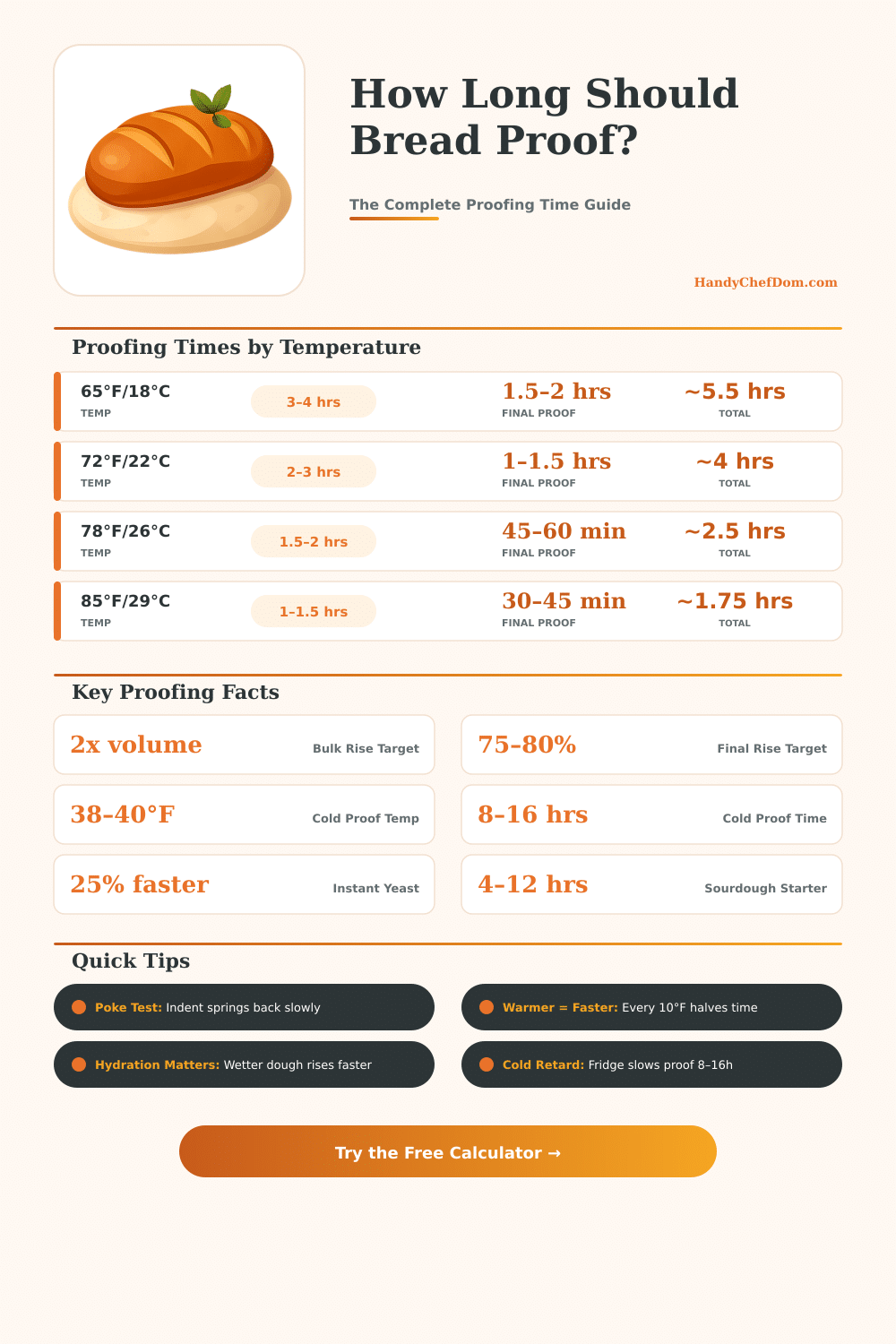
| Yeast Type | 65°F / 18°C | 72°F / 22°C | 80°F / 27°C | 85°F / 29°C |
|---|---|---|---|---|
| Active Dry (1%) | 3–4 hrs | 2–2.5 hrs | 1.5–2 hrs | 1–1.5 hrs |
| Instant Yeast (1%) | 2.5–3 hrs | 1.5–2 hrs | 1–1.5 hrs | 45–75 min |
| Fresh Yeast (2%) | 2.5–3.5 hrs | 1.5–2 hrs | 1–1.5 hrs | 45–60 min |
| Sourdough Starter | 8–12 hrs | 5–8 hrs | 3–5 hrs | 2–3 hrs |
| Wild / Slow Ferment | 12–18 hrs | 8–12 hrs | 5–8 hrs | 3–5 hrs |
| Bread Type | Fridge Temp | Min Time | Max Time | Best For |
|---|---|---|---|---|
| Lean Bread / Baguette | 38–40°F / 3–4°C | 8 hrs | 16 hrs | Flavor & crust |
| Sourdough | 38–40°F / 3–4°C | 12 hrs | 36 hrs | Sour depth |
| Brioche / Enriched | 36–38°F / 2–3°C | 6 hrs | 12 hrs | Shaping ease |
| Pizza Dough | 38–40°F / 3–4°C | 24 hrs | 72 hrs | Flavor & chew |
| Whole Grain | 38–40°F / 3–4°C | 8 hrs | 12 hrs | Structure |
| Dough Weight | Imperial | Metric | Time Adjustment |
|---|---|---|---|
| Small Roll / Bun | 1.5–2.5 oz | 40–70 g | –30% of base time |
| Standard Loaf | 28–36 oz | 800–1000 g | Base time (0%) |
| Large Loaf / Boule | 40–56 oz | 1100–1600 g | +15–25% of base |
| Batch / Double Loaf | 60–80 oz | 1700–2300 g | +20–35% of base |
| Hydration | Dough Feel | Proof Speed | Typical Breads |
|---|---|---|---|
| 55–65% | Stiff, firm | Slower (–10%) | Bagels, pretzels |
| 65–72% | Smooth, tacky | Standard | Sandwich loaf |
| 72–80% | Soft, sticky | Faster (+10%) | Sourdough, baguette |
| 80–90%+ | Very wet, slack | Fastest (+15%) | Ciabatta, focaccia |
Bread is made up of baked product from food, prepared from water, flour and commonly yeast. It forms basic food in the whole world, especially in Europe and the Middle East. Through written history it plays an inherent part in the diet of many populations.
Between the most ancient creations of folk this ranks one from the mainstream. From wheat or rye one can make Bread to address grains and push them more easily digested. Like this one receives basic food that easily transports around, that requires only little preparation after the first occasion.
How to Make Simple Homemade Bread
Basic elements for Bread include flour, water, salt and yeast. An oven clearly is needed for the baking. For simple recipe of white Bread do not require special tools.
A standard blender helps to simplify the work, but a mixing bowl with wooden spoon is enough for a bit of money. Dough one can knead by means of the hands. There are also recipes without kneading that entirely skip that stage.
Perfect recipe for start is crusty artisan Bread. It requires only four ingredients, without special molds or blender. It does not require kneading or carefully forming, and the biggest part of the task happens on its own.
One gets thick crispy crust with chewy inside and big holes, similar to that of sourdough Bread. Homemade Bread can be soft and fluffy with golden surface, ideal for sandwiches or toast. Even one can freeze it for the busy days.
Sourdough culture is alive starter from flour and water. It naturally raises the dough for Bread without store yeast. One can prepare such culture home, buy it or receive from other baker.
Use whole grain flour from wheat for sourdough Bread to increase the proteins in every slice and give rich flavor too the Bread. Sourdough Bread is surprisingly attractive when it is especially crisp and chewy, although preparing the culture costs a bit of time. The ended bit one should eat in some days, otherwise it will mold or will become hard as rock.
Proofing forms an inherent stage, that is made up of leaving the dough to rise before baking. That requires a warm spot for usually at least one hour. One can change the texture of Bread by means of various additions like toasted wheat bark and seeds, nuts, vegetables, dried meat, cheeses, fruits, purees or bits.
Many kinds of Bread exist for sale. Yeast breads, sourdough breads, baguettes, focaccia, ciabatta, bagels, hot cross rolls and dough for pizza is only some from them. Baking Bread at home can be very thrilling, and commonly the results taste better than those from store.
Normal serving of Bread is one slice, what matches around 40 grams. Some nutrition labels consider two slices asone serving, because that is the usual amount during a meal.